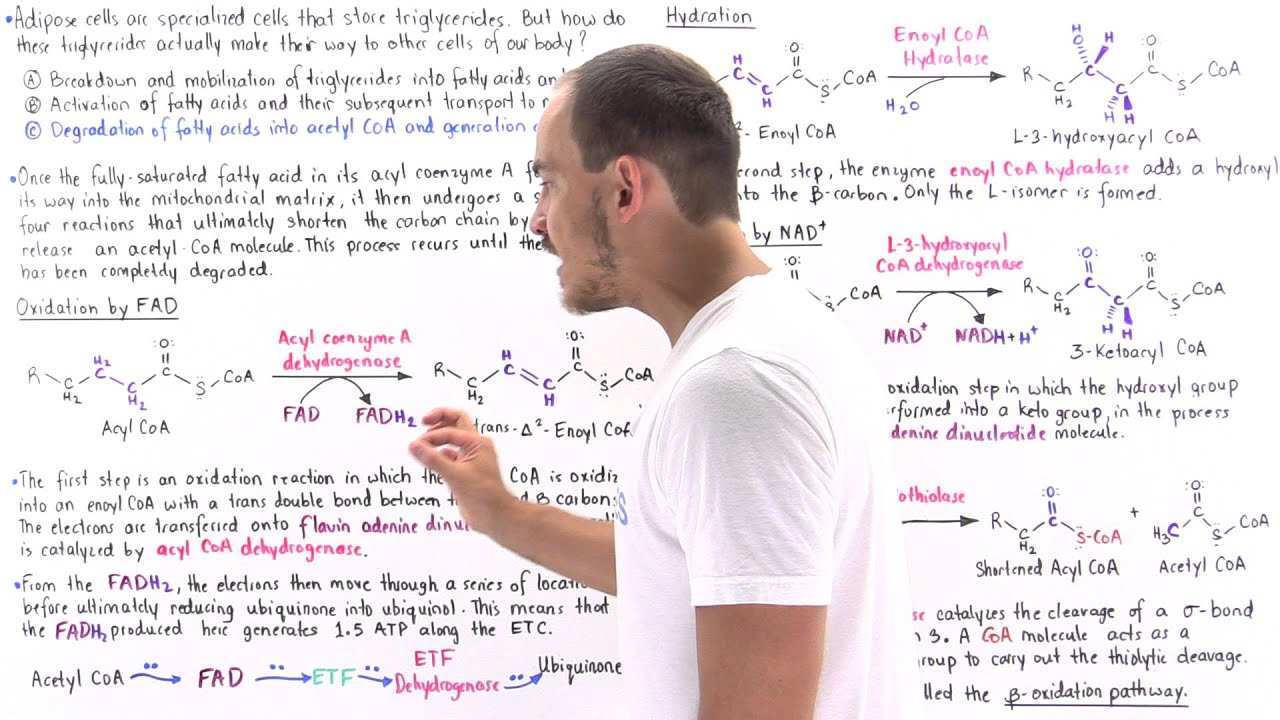
Oxidation of Fatty Acids
Keywords
Summary
163 words
Critical Evaluation
Value of the Information & Strength of the Argument
The video provides a solid, accurate explanation of beta-oxidation, breaking down the pathway into four clear steps. It effectively uses visual aids to illustrate molecular structures and reactions. The argumentation is logical and sequential, building from the overall process to detailed enzymatic mechanisms. The presenter correctly identifies key cofactors (FAD, NAD+) and products (FADH2, NADH, acetyl-CoA) and explains the role of the electron transport chain. However, the video does not discuss the regulation of beta-oxidation, the fate of odd-chain fatty acids, or the energetic yield per fatty acid, which are important for a comprehensive understanding. The explanation of ATP yield is limited to 1.5 ATP per FADH2, without mentioning the later contribution of NADH or the citric acid cycle.
Scientific Rigor, Source Quality, Title Accuracy
The video is scientifically accurate and aligns with standard biochemistry textbooks. However, it does not cite specific sources or references, relying on the presenter’s expertise. The title accurately reflects the content. The description provides links to the presenter’s website and donation page, but no direct references to scientific literature. The video’s clarity and step-by-step approach enhance its educational value, but the lack of citations reduces its scholarly rigor. The comments are overwhelmingly positive, with many viewers crediting the video for their success in biochemistry courses, indicating high pedagogical effectiveness.
223 words
Title / Content Match
The title accurately reflects the content, which focuses on the oxidation (beta-oxidation) of fatty acids.
Quality & Reliability
8/10
The video provides a clear, step-by-step explanation of beta-oxidation, accurately describing the four enzymatic steps, cofactors, and products. The content aligns with established biochemistry knowledge, though it lacks citations to primary literature and does not address regulatory or pathological aspects.
Key Moments
Markers derived by PSI from the transcript: the creator did not define chapters.
- Introduction: overview of the three steps needed to use fat as energy, focusing on breakdown of fatty acids into acetyl-CoA.
- Explanation of the four-step cycle that shortens the fatty acid chain by two carbons, releasing acetyl-CoA.
- Step 1: Oxidation by FAD, forming a double bond between alpha and beta carbons, reducing FAD to FADH2.
- Transfer of electrons from FADH2 to ETF, then to ubiquinone, generating 1.5 ATP via electron transport chain.
- Step 2: Hydration by enoyl-CoA hydratase, adding a hydroxyl group to the beta carbon, forming L-isomer.
- Step 3: Second oxidation by NAD+, converting the hydroxyl group to a keto group, reducing NAD+ to NADH.
- Step 4: Thiolytic cleavage by coenzyme A, releasing acetyl-CoA and a shortened fatty acyl-CoA.
- Summary of the beta-oxidation pathway and its products: FADH2, NADH, and acetyl-CoA.
- Conclusion: mention of next lecture on ATP yield from beta-oxidation.
Cited Sources
- AK Lectures - Oxidation of Fatty Acids — The video is hosted on the AK Lectures website, providing additional resources and diagrams.
- AK Lectures - Main Page — The channel's main website, offering a collection of biochemistry lectures.
Concurring Sources
- Biochemistry Textbook (e.g., Lehninger) — Standard biochemistry textbooks describe beta-oxidation with the same four steps and cofactors.
External References
Contribution & Novelties
The video provides a clear and accessible explanation of beta-oxidation, breaking down the pathway into four distinct steps with visual aids. It effectively highlights the importance of stereochemistry (trans double bond, L-isomer) and the role of cofactors. The explanation of electron transfer from FADH2 to the electron transport chain is particularly detailed. However, the video does not introduce novel concepts beyond standard textbook material, but its pedagogical clarity is a valuable contribution for students.
Pour aller plus loin :
- Beta oxidation - Wikipedia — Comprehensive overview of the pathway, including regulation and variations.
- Fatty acid metabolism - Wikipedia — Broader context of fatty acid synthesis and oxidation.
- Electron transport chain - Wikipedia — Details on how FADH2 and NADH contribute to ATP production.
123 words
Radar Profile
The radar profile shows high scores in information quantity, quality, and reliability, with a slightly lower technical level, indicating a well-explained but not overly advanced tutorial. The balance suggests a video that is both informative and accessible.
💬 Très positif. Sur les 30 commentaires analysés, tous expriment une gratitude et une admiration extrêmes, soulignant l'efficacité pédagogique de l'auteur et son rôle déterminant dans la réussite des étudiants en biochimie.