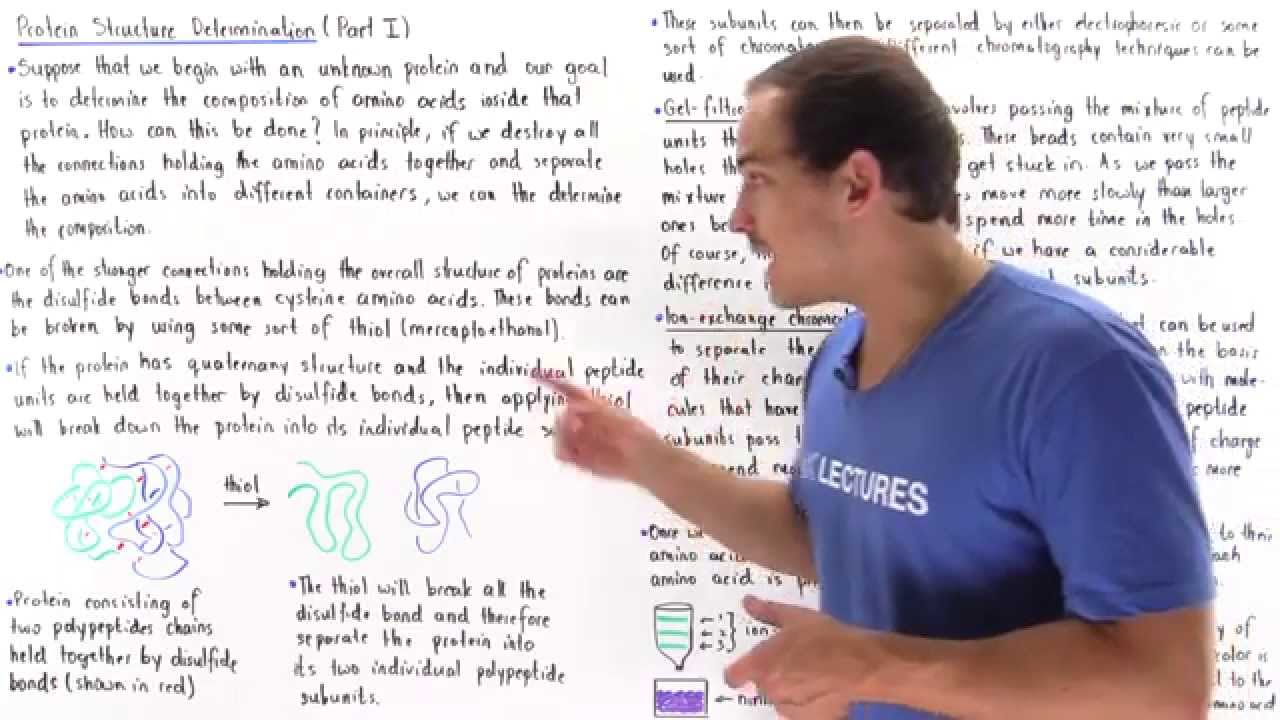
Determining Protein Struture
Keywords
Summary
166 words
Critical Evaluation
Value of the Information & Strength of the Argument
The video provides a solid conceptual foundation for understanding protein composition analysis. It clearly explains the rationale behind each step, from breaking disulfide bonds to chromatographic separation and detection. The argumentation is logical and builds progressively, making it accessible for beginners. However, it lacks depth in discussing practical considerations, such as column types, buffers, and potential pitfalls. The presentation is didactic and well-structured, but it does not critically evaluate alternative methods or discuss limitations in detail.
Scientific Rigor, Source Quality, Title Accuracy
The video is scientifically accurate in its core explanations, but it does not cite specific sources or references. The description includes links to the creator’s website, which may contain additional resources, but no direct citations to research papers or textbooks are provided. The title is slightly misspelled but accurately reflects the content. The video’s educational value is high for an introductory audience, but for rigorous scientific sourcing, it falls short. The creator’s website (aklectures.com) is a legitimate educational platform, but the video itself does not reference primary literature.
179 words
Title / Content Match
The title is slightly misspelled ('Struture' instead of 'Structure') but accurately reflects the content.
Quality & Reliability
7/10
The video provides a clear, step-by-step explanation of protein structure determination methods, but lacks citations to primary literature and simplifies some biochemical details.
Key Moments
Markers derived by PSI from the transcript: the creator did not define chapters.
- Introduction to determining protein structure
- Overview of breaking peptide and disulfide bonds
- Reduction of disulfide bonds with mercaptoethanol
- Separation of polypeptide subunits by gel filtration chromatography
- Separation by ion exchange chromatography based on charge
- Hydrolysis of polypeptides to amino acids
- Detection of amino acids using ninhydrin and spectrometry
- Interpretation of chromatogram to determine amino acid composition
Cited Sources
- AK Lectures - Determining Protein Structure Part I — The video's description links to this lecture page, which likely contains additional details and diagrams.
- AK Lectures Website — The creator's educational platform hosting the lecture and related content.
Concurring Sources
- Protein Structure Determination — General reference on protein structure determination methods.
- Ion-exchange chromatography — Confirms the principle of separating molecules based on charge.
- Size-exclusion chromatography — Confirms the principle of separating molecules based on size.
Contribution & Novelties
The video offers a clear, step-by-step introduction to protein composition analysis, which is valuable for students new to biochemistry. It effectively explains the logic behind each technique, from disulfide bond reduction to chromatographic separation and detection. While it does not present novel research, it serves as a useful educational resource.
Pour aller plus loin :
- Protein structure determination — Overview of methods for determining protein structure.
- Ion-exchange chromatography — Detailed explanation of the technique mentioned in the video.
- Gel filtration chromatography — Also known as size-exclusion chromatography, relevant to the video’s discussion.
- Ninhydrin reaction — The chemical reaction used to detect amino acids.
103 words
Radar Profile
The radar profile shows balanced scores across information quantity, quality, technical level, and reliability, indicating a well-rounded educational video. The technical level is moderate, making it accessible to beginners, while the reliability is good but not excellent due to lack of citations.