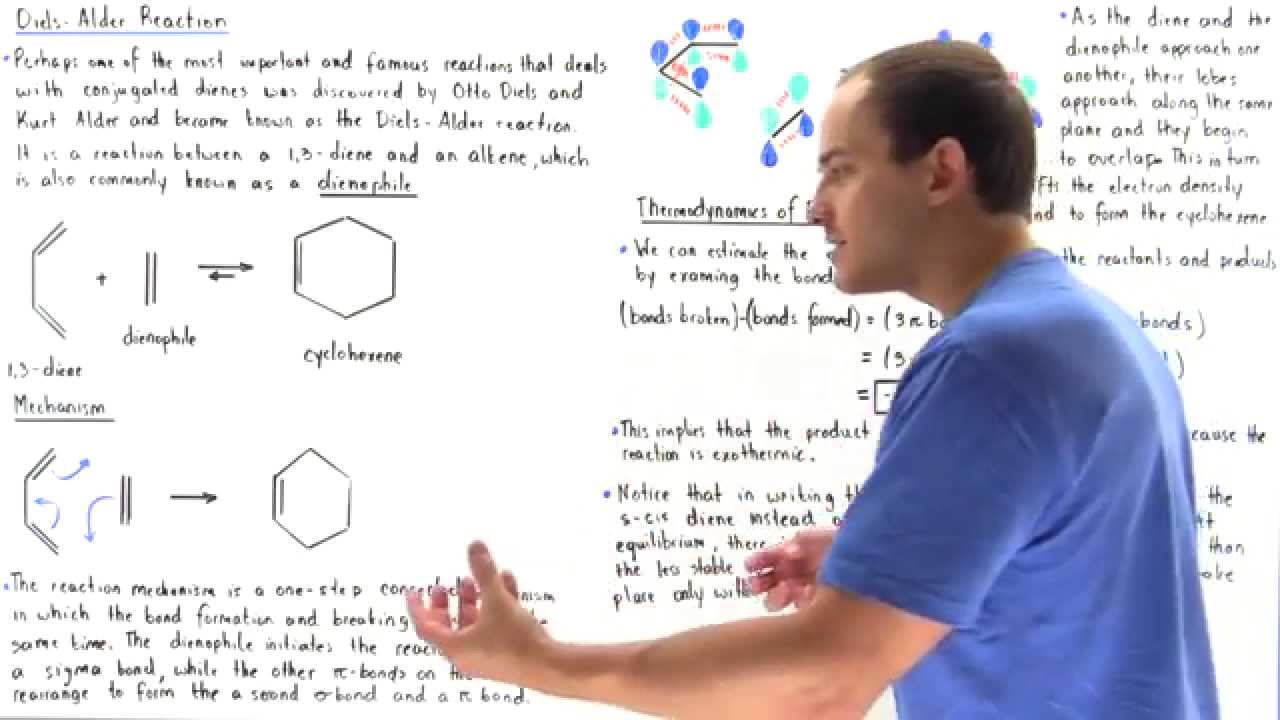
Diels-Alder Reaction
Keywords
Summary
172 words
Critical Evaluation
Value of the Information & Strength of the Argument
The video provides a clear and logical explanation of the Diels-Alder reaction, breaking down the mechanism into understandable steps. The use of orbital diagrams effectively illustrates the electron flow and the necessity of the s-cis conformation. The thermodynamic analysis using bond energies is a practical approach to demonstrate the exothermic nature of the reaction. The argumentation is coherent, building from mechanism to thermodynamics to conformational requirements. However, the video does not discuss stereochemistry, regiochemistry, or the influence of substituents, which are important aspects of the reaction’s synthetic utility. Additionally, the presenter mentions that the next lecture will explain why the mechanism is concerted, but this video only states it as a fact without deeper justification.
Scientific Rigor, Source Quality, Title Accuracy
The scientific content is accurate and aligns with standard organic chemistry textbooks. The video does not cite specific sources, but the information is well-established. The title accurately reflects the content. The description provides links to the creator’s website and lecture page, which may offer additional resources. No comments were provided for analysis.
182 words
Title / Content Match
The title accurately reflects the content, which focuses on the Diels-Alder reaction.
Quality & Reliability
7/10
The video provides a clear and accurate explanation of the Diels-Alder reaction mechanism, orbital interactions, and thermodynamics, but lacks citations to primary literature and does not address stereochemistry or regiochemistry in depth.
Key Moments
Markers derived by PSI from the transcript: the creator did not define chapters.
- Introduction to the Diels-Alder reaction and its discovery.
- Definition of diene and dienophile.
- Overview of the reaction mechanism.
- Detailed explanation of the concerted mechanism.
- Orbital diagram showing electron flow.
- Thermodynamic analysis using bond energies.
- Explanation of why s-cis diene is required.
- Application of Le Chatelier's principle.
- Summary of key points.
Cited Sources
- AK Lectures - Diels-Alder Reaction — Lecture page for this video.
- AK Lectures — General website with educational content.
- Donate to AK Lectures — Donation page.
Concurring Sources
- Organic Chemistry by Clayden et al. — Standard textbook covering Diels-Alder reaction in detail.
Contribution & Novelties
The video provides a concise and accessible introduction to the Diels-Alder reaction, focusing on the fundamental concepts of mechanism, orbital overlap, and thermodynamics. It is particularly useful for students encountering this reaction for the first time. The use of bond energy calculations to demonstrate exothermicity is a practical teaching tool.
Pour aller plus loin :
- Diels–Alder reaction - Wikipedia — Comprehensive overview including history, mechanism, and applications.
- Frontier Molecular Orbital Theory — Explains the orbital interactions underlying the reaction’s regioselectivity.
- Pericyclic reaction - Wikipedia — Contextualizes the Diels-Alder reaction within a broader class of reactions.
95 words
Radar Profile
The radar profile shows balanced scores across all dimensions, with slightly higher quality of information and technical level, indicating a solid educational resource. The lower quantity of information reflects the video's focus on basics rather than comprehensive coverage.