Common Properties of Signal Pathways
Keywords
Summary
111 words
Critical Evaluation
Value of the Information & Strength of the Argument
The video provides a valuable synthesis of key concepts in signal transduction, effectively comparing four major pathways to highlight common principles. The argumentation is logical and well-structured, moving from specific examples to general properties. It reinforces understanding by linking each property to concrete molecular interactions. However, it does not delve into experimental evidence or recent research, limiting its depth for advanced learners. The presentation is clear and accessible, making it a useful educational resource for introductory biochemistry.
Scientific Rigor, Source Quality, Title Accuracy
The scientific rigor is moderate: the content is accurate but presented at an introductory level without citations to primary sources. The video relies on established textbook knowledge, which is reliable but not exhaustive. The title accurately reflects the content, as the video systematically outlines four common properties. The description provides links to the creator’s website and lecture page, but no external references are cited. The video does not include any advertising segments.
164 words
Title / Content Match
The title accurately reflects the content, as the video systematically outlines four common properties of signal transduction pathways.
Quality & Reliability
7/10
The video provides a clear and structured summary of common properties of signal transduction pathways, based on established biochemistry knowledge. It accurately describes key components such as protein kinases, second messengers, and termination mechanisms. However, it lacks citations to primary literature and is presented in a simplified manner, which limits its depth for advanced audiences.
Key Moments
Markers derived by PSI from the transcript: the creator did not define chapters.
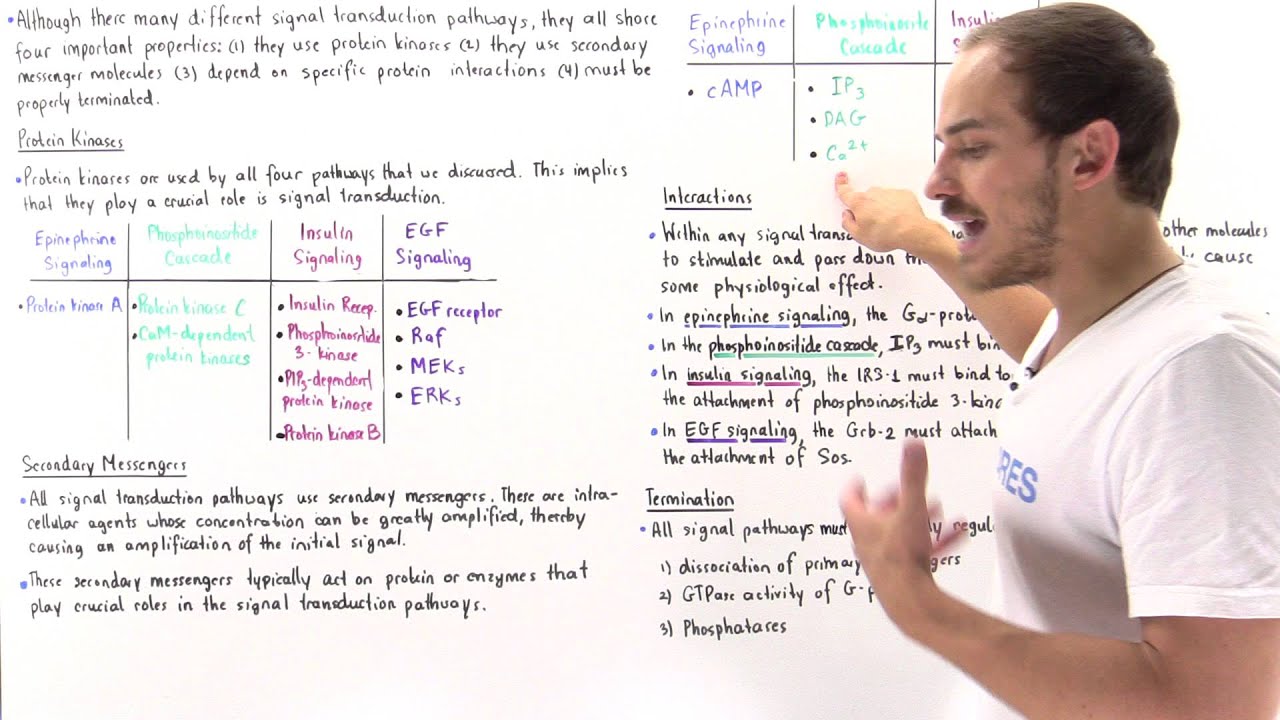
- Introduction to the four common properties of signal transduction pathways.
- Discussion of protein kinases in epinephrine signaling (PKA).
- Protein kinases in phosphoinositide cascade (PKC, calmodulin-dependent kinases).
- Protein kinases in insulin signaling (tyrosine kinase, PI3K, PDK1, PKB/Akt).
- Protein kinases in EGF signaling (RTK, Ras, Raf, MEK, ERK).
- Second messengers in epinephrine (cAMP) and phosphoinositide cascade (IP3, DAG, calcium).
- Second messengers in insulin (PIP3) and EGF (calcium, cAMP).
- Importance of protein interactions and termination mechanisms.
Cited Sources
- AK Lectures Website — General educational resource for biochemistry lectures.
- Donation Page — Support page for the channel.
- Lecture Page for Common Properties of Signal Pathways — Direct link to the lecture content.
Concurring Sources
- Signal transduction - Wikipedia — General reference for signal transduction pathways.
- Protein kinase - Wikipedia — Reference for protein kinases and their classification.
- Second messenger system - Wikipedia — Reference for second messengers in cell signaling.
Contribution & Novelties
The video provides a clear and concise summary of common properties across different signal transduction pathways, which is useful for consolidating knowledge. It highlights the recurring themes of protein kinases, second messengers, protein interactions, and termination, offering a framework for understanding cell signaling. However, it does not present novel research or unique insights; it is a pedagogical summary.
Pour aller plus loin :
- Signal transduction — Overview of signal transduction mechanisms.
- Protein kinase — Detailed information on protein kinases and their roles.
- Second messenger system — Explanation of second messengers like cAMP and calcium.
- G protein-coupled receptor — Relevant to epinephrine signaling.
- Receptor tyrosine kinase — Relevant to insulin and EGF signaling.
112 words
Radar Profile
The radar profile shows moderate scores across all dimensions, with slightly higher scores in information quantity and quality, indicating a balanced but not exceptional educational video. The technical level is moderate, suitable for introductory audiences.