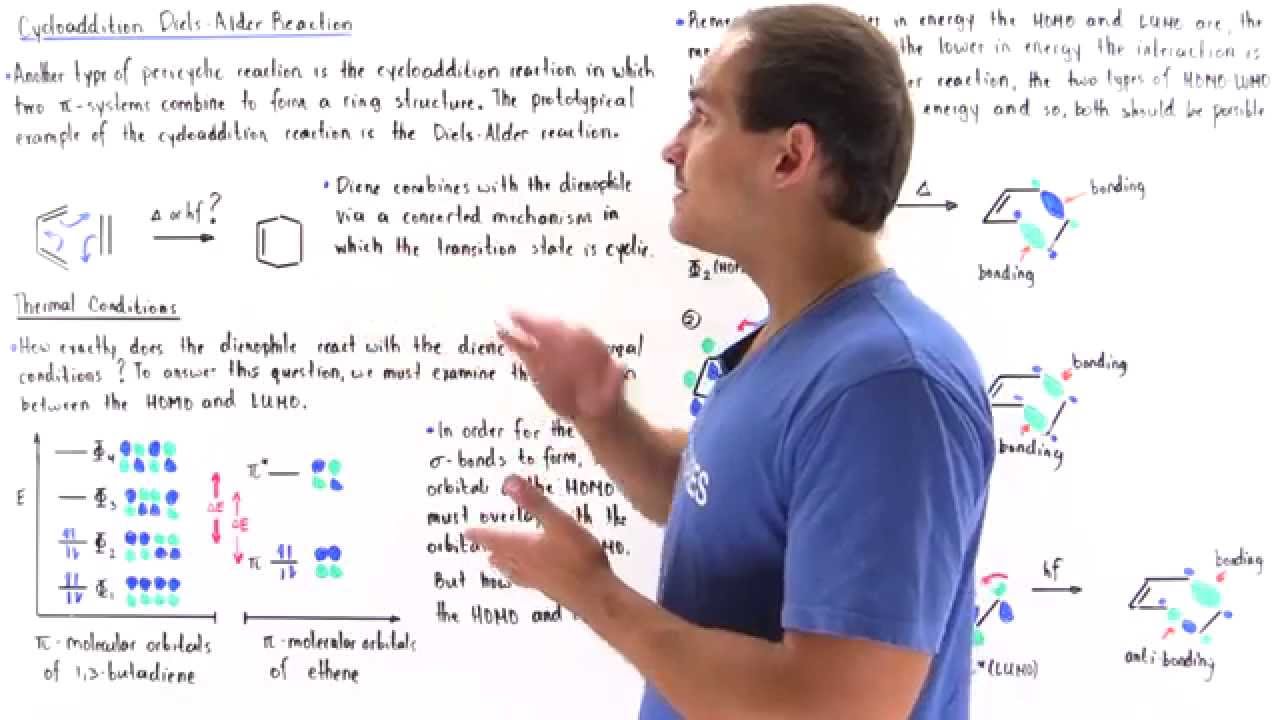
Thermal (4+2) Cycloaddition Reaction
Keywords
Summary
158 words
Critical Evaluation
Value of the Information & Strength of the Argument
The video provides a solid introduction to the Diels-Alder reaction and its orbital basis. It clearly explains the concept of pericyclic reactions and the role of HOMO-LUMO interactions. The argumentation is logical and well-structured, systematically comparing thermal and photochemical conditions. However, it does not discuss the stereochemistry or regiochemistry of the reaction, nor does it mention the concept of aromatic transition states or the Woodward-Hoffmann rules, which are fundamental to understanding pericyclic reactions. The explanation is accessible but lacks depth for advanced learners.
Scientific Rigor, Source Quality, Title Accuracy
The video is scientifically accurate and aligns with standard organic chemistry teachings. It does not cite specific sources, but the content is consistent with established knowledge. The title accurately reflects the content, focusing on the thermal (4+2) cycloaddition. The video is a tutorial, and its quality is adequate for educational purposes, though it would benefit from referencing primary literature or textbooks.
159 words
Title / Content Match
The title accurately reflects the content, which focuses on the thermal (4+2) cycloaddition reaction.
Quality & Reliability
7/10
The video provides a clear and accurate explanation of the Diels-Alder reaction using frontier molecular orbital theory. The reasoning is sound and consistent with standard organic chemistry textbooks. However, it lacks references to primary literature and does not address exceptions or advanced topics.
Key Moments
Markers derived by PSI from the transcript: the creator did not define chapters.
- Introduction to cycloaddition reactions and the Diels-Alder reaction as an example.
- Explanation of the concerted mechanism and formation of two sigma bonds.
- Determination of HOMO and LUMO for ethene and 1,3-butadiene.
- Comparison of energy differences between possible HOMO-LUMO interactions.
- Interaction of diene HOMO with dienophile LUMO under thermal conditions.
- Interaction of diene LUMO with dienophile HOMO under thermal conditions.
- Analysis of photochemical conditions and why the reaction is forbidden.
Cited Sources
- AK Lectures - Thermal (4+2) Cycloaddition Reaction — Video lecture page on AK Lectures website.
- AK Lectures — General website for AK Lectures.
Concurring Sources
- Diels-Alder reaction — Wikipedia article confirming the thermal allowedness of the Diels-Alder reaction.
External References
Contribution & Novelties
The video provides a clear, step-by-step explanation of the Diels-Alder reaction using frontier molecular orbital theory, making it accessible for students. It effectively demonstrates why the reaction is thermally allowed but photochemically forbidden. However, it does not introduce novel concepts beyond standard textbook material.
Pour aller plus loin :
- Woodward-Hoffmann rules — These rules provide a general framework for predicting the stereochemistry of pericyclic reactions, including cycloadditions.
- Diels-Alder reaction — Comprehensive overview of the reaction, including its mechanism and applications.
- Frontier molecular orbital theory — The theory used in the video to explain the reaction’s feasibility.
96 words
Radar Profile
The radar profile shows balanced scores across all dimensions, with slightly higher quality of information and technical level. This indicates a well-structured educational video that is reliable and informative, though not groundbreaking.