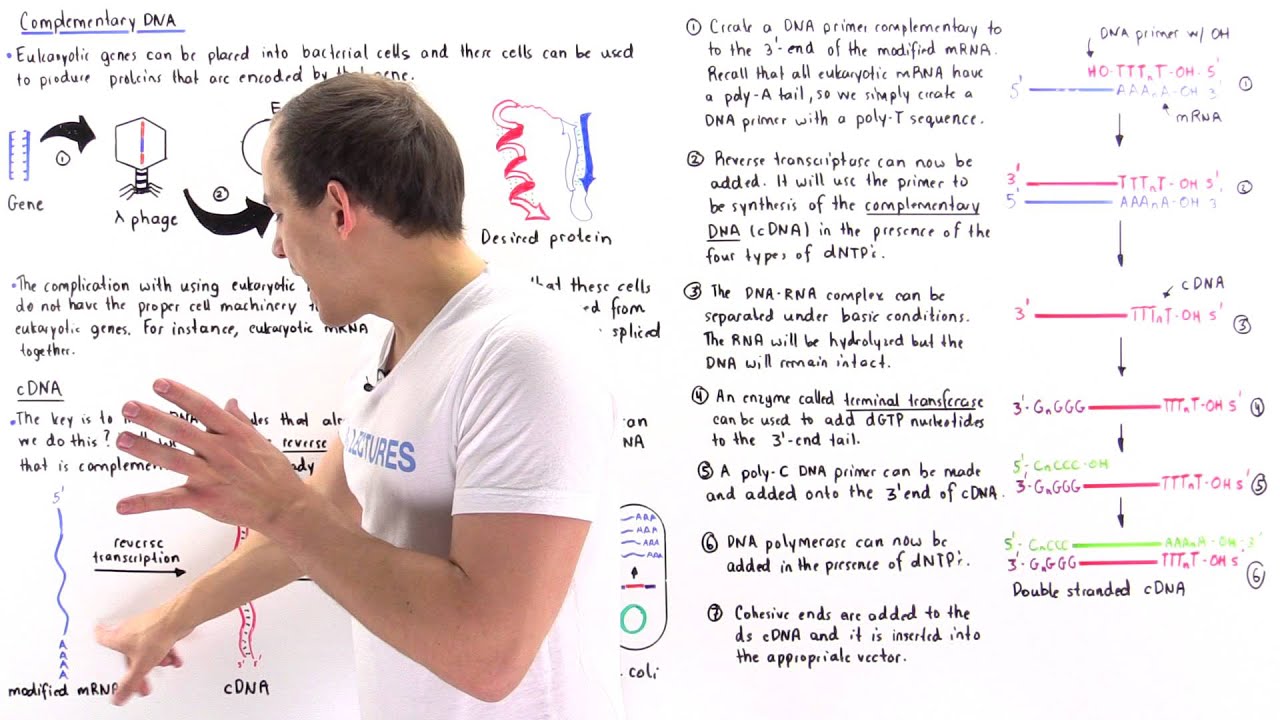
Synthesizing cDNA with Reverse Transcriptase
Keywords
Summary
163 words
Critical Evaluation
Value of the Information & Strength of the Argument
The video provides a clear, step-by-step explanation of cDNA synthesis, which is valuable for students and researchers. The argumentation is logical and well-structured, building from the problem of introns to the solution using reverse transcriptase. The presenter effectively uses diagrams to illustrate each step, enhancing understanding. The explanation of why each step is necessary (e.g., the need for a primer, the use of terminal transferase) is thorough. However, the video does not discuss alternative methods or potential pitfalls in detail, which could be a limitation for advanced learners.
Scientific Rigor, Source Quality, Title Accuracy
The scientific content is accurate and aligns with standard molecular biology textbooks. The video does not cite specific sources, but the information is well-established. The title accurately reflects the content. The description provides links to the lecturer’s website and donation page, but no external references. The video is a tutorial, so it does not present original research. The minor error in the diagram (poly-C vs poly-T) was pointed out by a viewer, but it does not significantly detract from the overall quality.
185 words
Title / Content Match
The title accurately reflects the content, which focuses on the synthesis of cDNA using reverse transcriptase.
Quality & Reliability
8/10
Clear and accurate explanation of cDNA synthesis, consistent with standard molecular biology knowledge. Minor error in the diagram (poly-C vs poly-T) noted by a viewer, but overall reliable.
Key Moments
Markers derived by PSI from the transcript: the creator did not define chapters.
- Introduction to recombinant DNA technology and the problem with eukaryotic genes in prokaryotic cells.
- Explanation of using reverse transcriptase to synthesize cDNA from mature mRNA.
- Step 1: Extracting mRNA and annealing a poly-T primer to the poly-A tail.
- Step 2: Reverse transcriptase synthesizes the first cDNA strand.
- Step 3: Hydrolyzing the RNA strand by increasing pH.
- Step 4: Adding a poly-G tail with terminal transferase.
- Steps 5-7: Annealing poly-C primer, DNA polymerase synthesis, and insertion into vector.
Cited Sources
- AK Lectures - Synthesizing cDNA with Reverse Transcriptase — The video's dedicated lecture page on the AK Lectures website.
- AK Lectures - Donate — Donation page for the AK Lectures channel.
- AK Lectures - Home — Main website of AK Lectures, containing additional educational content.
Concurring Sources
- Molecular Biology of the Cell (Alberts et al.) — Standard textbook reference for molecular biology techniques, including cDNA synthesis.
- Reverse transcriptase - NCBI Bookshelf — NCBI resource providing detailed information on reverse transcriptase and its role in cDNA synthesis.
Contribution & Novelties
The video provides a clear and accessible explanation of cDNA synthesis, which is a fundamental technique in molecular biology. It breaks down the process into seven logical steps, making it easy to follow. The use of diagrams enhances understanding. This tutorial is particularly useful for students preparing for exams like the MCAT.
Pour aller plus loin :
- Reverse transcriptase - Wikipedia — Overview of the enzyme and its applications.
- cDNA library - Wikipedia — Explanation of cDNA libraries and their uses.
- Terminal transferase - Wikipedia — Details on the enzyme used to add nucleotide tails.
95 words
Radar Profile
The radar profile shows high scores in information quantity, quality, and technical level, indicating a comprehensive and accurate tutorial. The reliability score is also high, reflecting the well-established nature of the content. The video is strong in all dimensions, with a slight dip in technical level due to its introductory nature.
💬 Très positif. Sur les 30 commentaires analysés, tous expriment une gratitude et une admiration extrêmes pour la clarté et la qualité pédagogique de l'explication, certains le qualifiant de 'génie' et de 'sauveur' pour leurs examens.