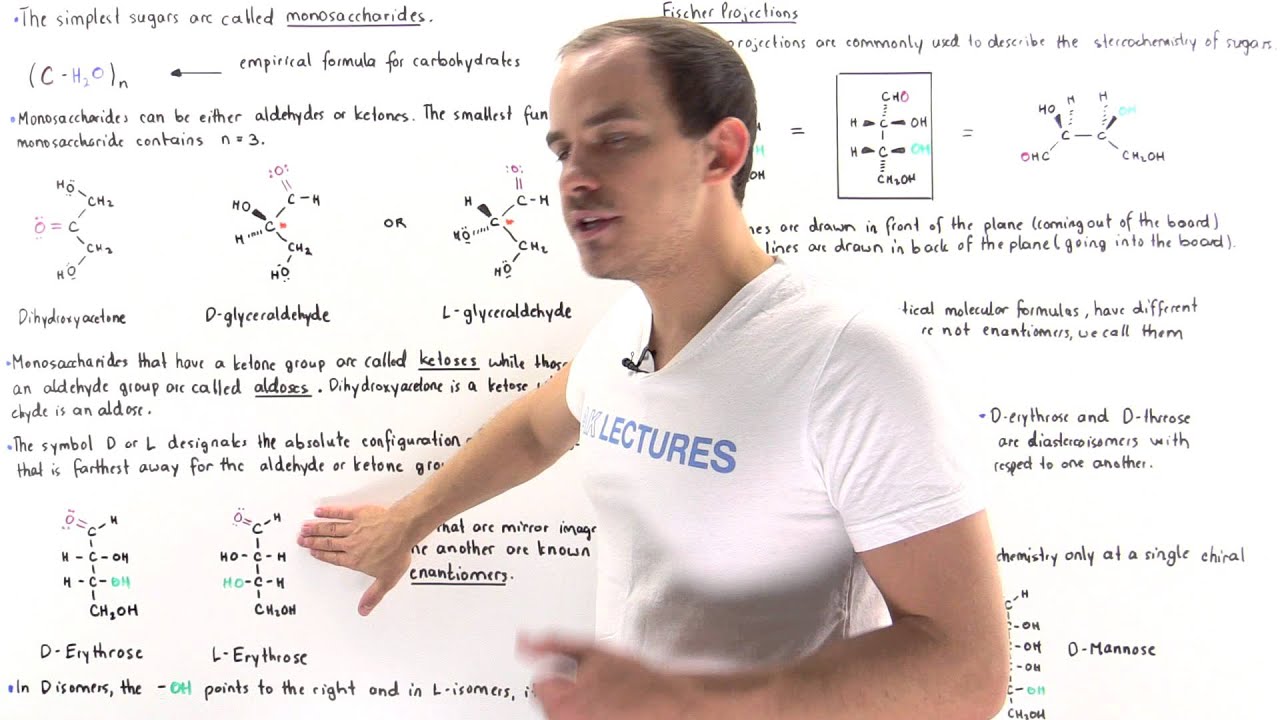
Aldoses, Ketoses, Fischer Projections and Epimers
Keywords
Summary
164 words
Critical Evaluation
Value of the Information & Strength of the Argument
The video provides a solid introduction to key concepts in carbohydrate stereochemistry. It effectively uses visual aids and step-by-step reasoning to explain the differences between aldoses and ketoses, the meaning of D/L designations, and the construction of Fischer projections. The argumentation is logical and builds upon prior knowledge, making it accessible for learners. However, it does not delve into advanced topics such as cyclic forms or mutarotation, and it lacks references to primary sources, which limits its value for deeper scientific inquiry.
Scientific Rigor, Source Quality, Title Accuracy
The scientific rigor is adequate for an introductory tutorial; the information is accurate and consistent with standard biochemistry textbooks. However, no external sources are cited within the video, and the description only provides links to the creator’s website and donation page, which do not serve as authoritative references. The title accurately reflects the content, covering all mentioned topics in a logical sequence. The video does not include any advertising segments.
167 words
Title / Content Match
The title accurately reflects the content, covering all mentioned topics in a logical sequence.
Quality & Reliability
8/10
The video provides a clear and accurate explanation of fundamental concepts in carbohydrate chemistry, using standard definitions and examples. The content is well-structured and pedagogically sound, though it lacks citations to primary literature and does not address any controversies or advanced nuances.
Key Moments
Markers derived by PSI from the transcript: the creator did not define chapters.
- Introduction to carbohydrates and monosaccharides
- Explanation of empirical formula and classification as aldoses/ketoses
- Introduction of D and L isomers using glyceraldehyde
- Explanation of Fischer projections and their representation
- Discussion of enantiomers and diastereoisomers
- Definition of epimers with example of D-glucose and D-mannose
Cited Sources
- AK Lectures Website — The creator's educational website, which hosts additional lectures and resources.
- Lecture Page — The specific lecture page for this video, providing supplementary materials.
Concurring Sources
- Wikipedia: Fischer projection — Confirms the use and representation of Fischer projections.
- Wikipedia: Epimer — Confirms the definition of epimers as diastereoisomers differing at one chiral center.
External References
Contribution & Novelties
The video offers a clear and concise tutorial on fundamental concepts in carbohydrate stereochemistry, which is valuable for students. It does not present novel research but serves as an educational resource. For further exploration, the following concepts are relevant:
Pour aller plus loin :
- Fischer projection — A standard method for depicting three-dimensional structures of molecules.
- Epimer — Definition and examples of epimers in carbohydrate chemistry.
- Monosaccharide — Overview of simple sugars and their classification.
75 words
Radar Profile
The radar profile shows high scores in quality and reliability, with moderate scores in quantity and technical level, indicating a well-explained but introductory tutorial that is accurate and trustworthy.
💬 No comments were provided for analysis.