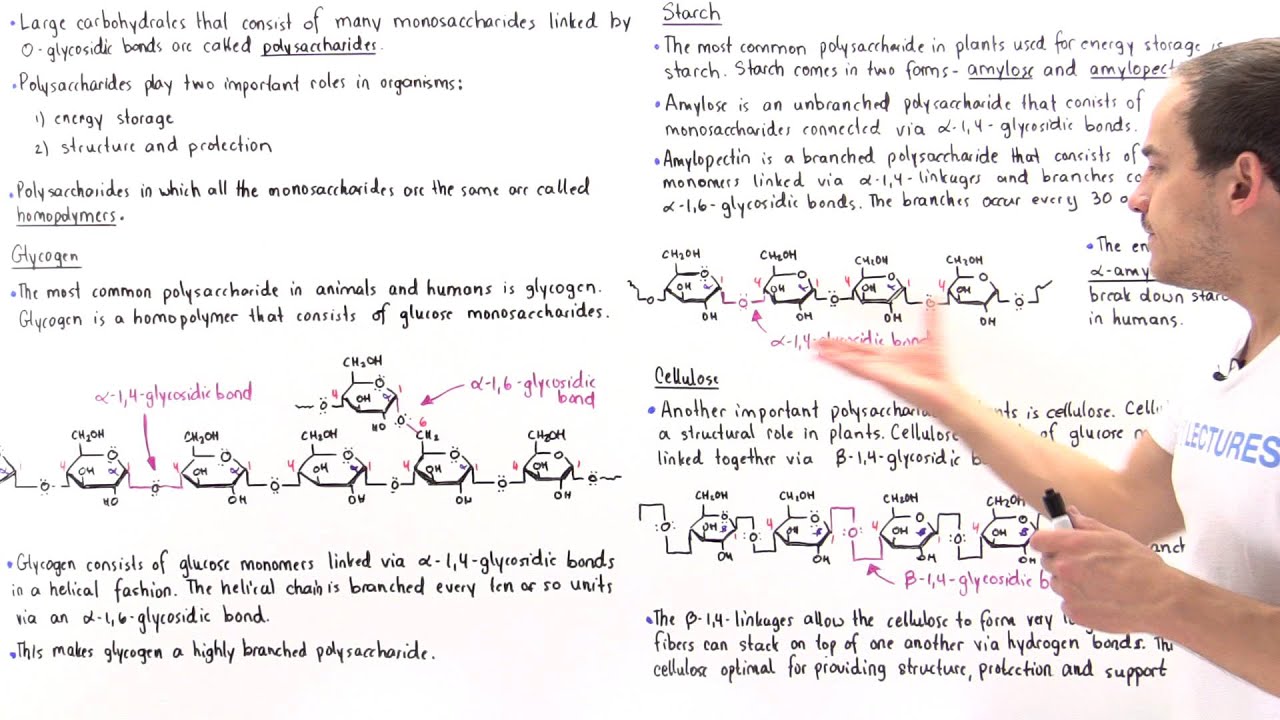
Polysaccharides (Glycogen, Starch and Cellulose)
Keywords
Summary
143 words
Critical Evaluation
Value of the Information & Strength of the Argument
The video provides valuable information on the three main polysaccharides, clearly explaining their structures, bonds, and functions. The argumentation is solid, as it logically progresses from glycogen to starch to cellulose, highlighting differences in bonding and resulting structures. The use of diagrams and step-by-step explanations enhances understanding. The content is accurate and aligns with standard biochemistry knowledge.
Scientific Rigor, Source Quality, Title Accuracy
The scientific rigor is high; the information is accurate and well-presented. The video does not cite external sources, but the content is based on established biochemistry. The title accurately reflects the content. The presentation is clear and methodical, making it a reliable educational resource.
116 words
Title / Content Match
The title accurately reflects the content, covering the three main polysaccharides in detail.
Quality & Reliability
8/10
The video provides a clear and accurate explanation of polysaccharides, focusing on glycogen, starch, and cellulose. The content is scientifically correct, with proper terminology and structural details. The presentation is well-structured and suitable for educational purposes.
Key Moments
Markers derived by PSI from the transcript: the creator did not define chapters.
- Introduction to polysaccharides and their purposes
- Definition of homopolymers and overview of glycogen
- Explanation of alpha-1,4 and alpha-1,6 glycosidic bonds in glycogen
- Description of glycogen's helical structure and branching
- Introduction to starch and its two forms: amylose and amylopectin
- Comparison of amylose and amylopectin structures
- Explanation of cellulose structure and beta-1,4 glycosidic bonds
- Discussion on cellulose's role in plant structure and dietary fiber
Cited Sources
- AK Lectures - Polysaccharides — Video lecture page on AK Lectures website
- AK Lectures — Main website of the lecturer
Concurring Sources
- Glycogen - Wikipedia — Confirms glycogen structure and function
- Starch - Wikipedia — Confirms starch composition and types
- Cellulose - Wikipedia — Confirms cellulose structure and role
External References
Contribution & Novelties
The video provides a clear and concise explanation of polysaccharides, emphasizing the structural differences due to glycosidic bond types. It effectively contrasts glycogen, starch, and cellulose, highlighting their roles in energy storage and structure. The visual aids and step-by-step breakdown make complex concepts accessible.
Pour aller plus loin :
76 words
Radar Profile
The radar profile shows high scores in information quality and reliability, with slightly lower scores in technical depth and quantity, indicating a well-balanced educational video that is accurate and clear but not overly technical.
💬 Très positif. Sur les 30 commentaires analysés, tous expriment une gratitude et une admiration pour la clarté et l'efficacité de l'explication, le qualifiant souvent de meilleur professeur.