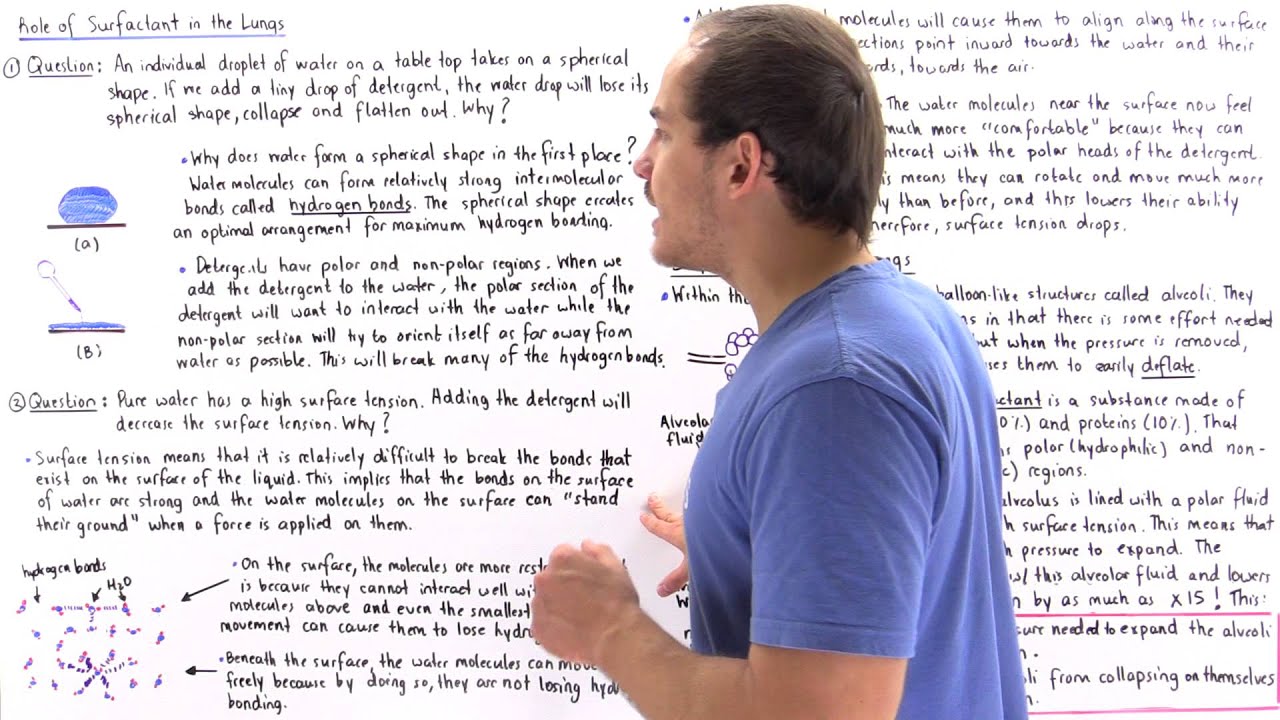
Surfactant in Alveoli and Surface Tension
Keywords
Summary
154 words
Critical Evaluation
Value of the Information & Strength of the Argument
The video provides valuable educational content by breaking down a complex physiological process into understandable steps. It uses a clear analogy (water droplet and detergent) to explain surface tension and then applies it to the alveoli. The argumentation is logical and builds progressively, ensuring comprehension. The explanation of hydrogen bonding and molecular behavior is accurate and well-illustrated. The video effectively conveys the importance of surfactant in reducing the work of breathing and preventing alveolar collapse.
Scientific Rigor, Source Quality, Title Accuracy
The scientific rigor is high for an educational video; the content is accurate and well-structured. However, no specific sources are cited within the video or description, limiting the ability to verify claims. The title accurately reflects the content, and the video stays on topic. The description provides links to the creator’s website and lecture page, which may offer additional resources but are not directly cited as sources.
157 words
Title / Content Match
The title accurately reflects the content, focusing on surfactant in alveoli and its effect on surface tension.
Quality & Reliability
8/10
The video provides a clear, step-by-step explanation of the role of pulmonary surfactant, grounded in basic physics and chemistry principles. The content is accurate and aligns with established medical knowledge, though it lacks citations to primary sources.
Key Moments
Markers derived by PSI from the transcript: the creator did not define chapters.
- Introduction to pulmonary surfactant and its functions
- Question 1: Why detergent breaks water droplet shape
- Explanation of hydrogen bonds and spherical shape of water
- Question 2: Definition of surface tension
- Molecular explanation of surface tension in water
- How detergent reduces surface tension
- Application to alveoli and alveolar fluid
- Role of surfactant in reducing pressure for inhalation
- Prevention of alveolar collapse during exhalation
Cited Sources
- AK Lectures - Surfactant in Alveoli and Surface Tension — Lecture page for this video, providing additional context and resources.
- AK Lectures — Main website of the channel, offering other lectures.
- Donate to AK Lectures — Donation page, not a scientific source.
Concurring Sources
- Pulmonary surfactant - Wikipedia — Confirms the role of surfactant in reducing surface tension and preventing alveolar collapse.
Contribution & Novelties
The video offers a clear, molecular-level explanation of how pulmonary surfactant reduces surface tension, using a relatable analogy. It emphasizes the physical principles behind breathing efficiency.
Pour aller plus loin :
- Pulmonary surfactant - Wikipedia — Provides a comprehensive overview of surfactant composition and function.
- Surface tension - Wikipedia — Explains the physical concept of surface tension in detail.
- Alveolar type II cells - Wikipedia — Details the cells that produce surfactant.
72 words
Radar Profile
The radar profile shows high scores in quality and reliability, with moderate scores in quantity and technical level, indicating a well-explained but not overly detailed tutorial.
💬 Très positif. Sur les 30 commentaires analysés, tous expriment une gratitude et une admiration pour la clarté de l'explication, certains notant que la vidéo a enfin rendu le concept compréhensible.