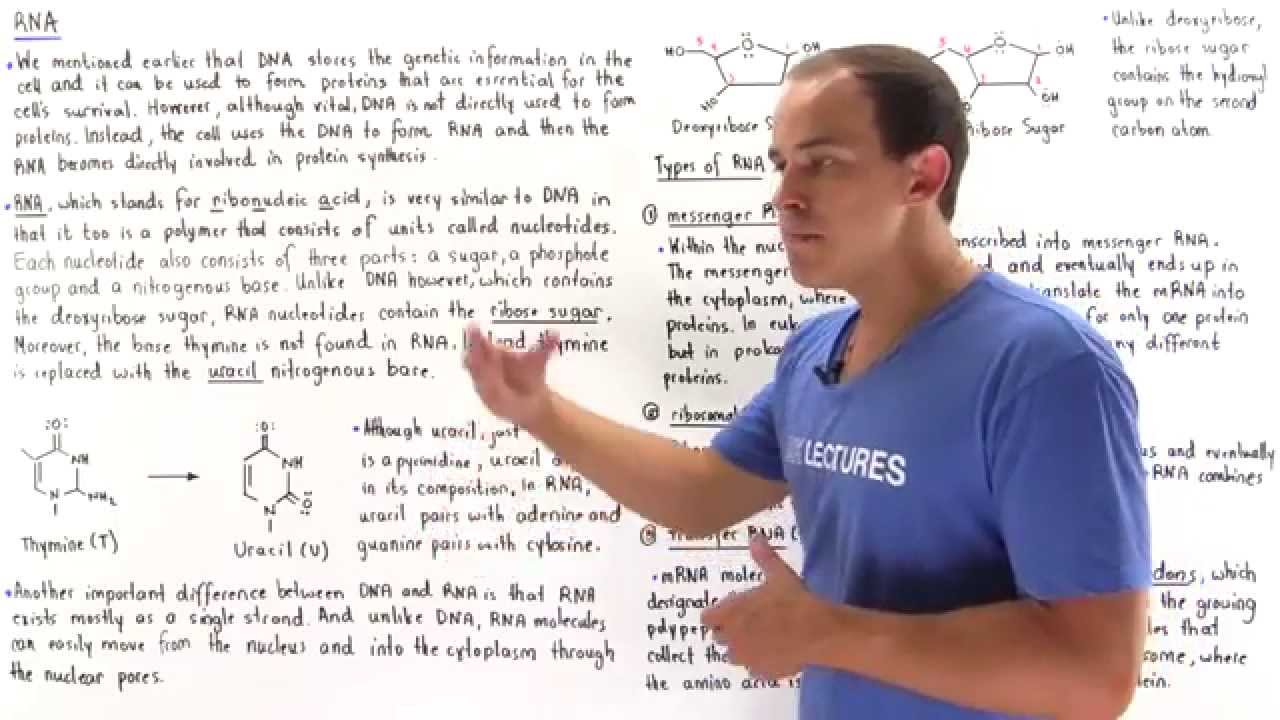
mRNA, rRNA and tRNA
Keywords
Summary
140 words
Critical Evaluation
Value of the Information & Strength of the Argument
The video offers solid educational value for beginners in molecular biology. It clearly explains the roles of mRNA, rRNA, and tRNA in protein synthesis, using simple analogies and diagrams. The argumentation is logical, progressing from general RNA structure to specific functions. However, the presentation is purely descriptive and lacks depth; it does not delve into the molecular mechanisms or regulation of these processes. The explanation of the differences between DNA and RNA is accurate, but the structural error in thymine’s depiction is a minor flaw that could mislead viewers.
Scientific Rigor, Source Quality, Title Accuracy
The video is a tutorial based on standard biochemistry knowledge, but it does not cite specific scientific sources. The presenter’s credentials are not provided, though the content aligns with established textbooks. The title accurately reflects the content, which focuses on the three types of RNA. The main issue is the incorrect thymine structure, which is a factual error. The description includes links to the presenter’s website and donation page, but no external references are provided. Overall, the scientific rigor is moderate, suitable for an introductory lecture but not for advanced study.
195 words
Title / Content Match
The title accurately reflects the content, which focuses on the three types of RNA.
Quality & Reliability
7/10
The video provides a clear and accurate overview of the three main types of RNA, their structures, and functions. However, there is a notable error in the depiction of thymine's structure (as pointed out by several commenters), which slightly reduces the reliability score.
Key Moments
Markers derived by PSI from the transcript: the creator did not define chapters.
- Introduction to RNA and its role in protein synthesis
- Comparison of RNA and DNA: sugar and nitrogenous bases
- Explanation of uracil and base pairing in RNA
- Discussion of single-stranded nature of RNA and nuclear export
- Introduction to messenger RNA (mRNA) and its function
- Explanation of ribosomal RNA (rRNA) and ribosome structure
- Description of transfer RNA (tRNA) and its role in translation
Cited Sources
- AK Lectures - mRNA, rRNA and tRNA — The video's dedicated lecture page on the presenter's website.
- AK Lectures Website — The presenter's educational website hosting additional lectures.
- Donation Page — A page for supporting the channel, mentioned in the video description.
Concurring Sources
- Molecular Biology of the Cell (Alberts et al.) — Standard textbook reference for RNA types and functions.
- RNA - Wikipedia — General overview of RNA structure and types.
Dissenting Sources
- Comment on Thymine structure — Several commenters pointed out that the thymine structure shown in the video is incorrect, as it appears to depict guanine instead. This is a factual error that could mislead viewers.
Contribution & Novelties
The video provides a clear and concise introduction to the three types of RNA, which is particularly helpful for students new to molecular biology. It effectively uses visual aids and simple language to explain complex concepts. However, it does not offer novel insights beyond standard textbook material. The main contribution is its pedagogical clarity.
Pour aller plus loin :
- Transcription (genetics) — Overview of the process by which DNA is transcribed into mRNA.
- Translation (biology) — Detailed explanation of protein synthesis from mRNA.
- Ribosome — Structure and function of ribosomes, including rRNA’s role.
93 words
Radar Profile
The radar profile shows balanced scores across all dimensions, with slightly lower technical level and reliability due to the structural error. The video is strong in clarity and educational value, making it a good introductory resource.
💬 Positif. Sur les 30 commentaires analysés, la grande majorité exprime des remerciements et des éloges pour la clarté de l'explication, bien que plusieurs signalent une erreur dans la structure de la thymine.