RC Circuits, Charging Capacitors and Equation Derivations
Keywords
Summary
163 words
Critical Evaluation
Value of the Information & Strength of the Argument
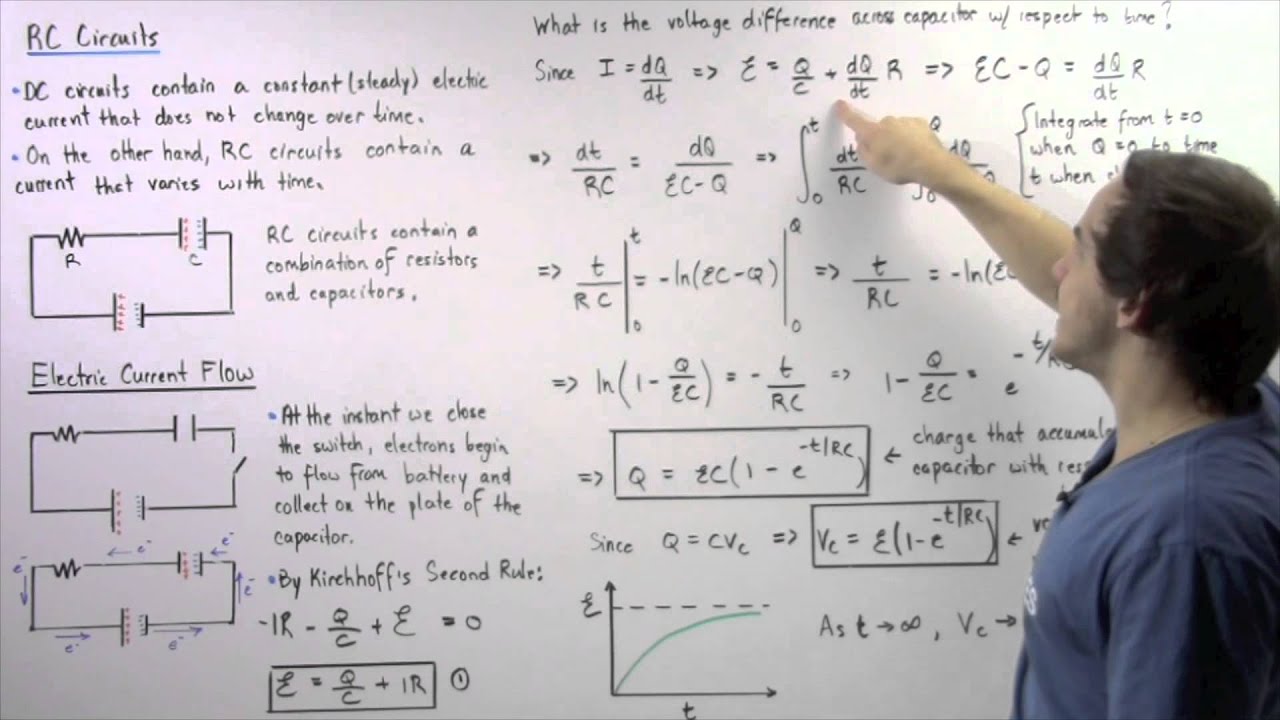
The video offers substantial educational value by systematically deriving the key equations for RC circuits from fundamental principles. It clearly explains each step, from applying Kirchhoff’s voltage law to solving the differential equation via integration. The argumentation is logically sound and builds upon established physics, making it a reliable resource for learners. The use of calculus is appropriate and well-explained, enhancing the depth of understanding. The presenter also provides graphical interpretations, which help visualize the exponential behavior. Overall, the content is accurate and effectively communicates the underlying physics.
Scientific Rigor, Source Quality, Title Accuracy
The scientific rigor is high: the derivations follow standard textbook methods, and the physics is correct. However, the video does not cite any external sources or references, which limits its scholarly depth. The title accurately describes the content, and the presentation is focused and coherent. The lack of citations is a minor weakness, but the material itself is reliable and well-presented.
164 words
Title / Content Match
The title accurately reflects the content, which focuses on RC circuits, capacitor charging, and equation derivations.
Quality & Reliability
8/10
The video provides a clear, step-by-step derivation of the RC circuit charging equations using Kirchhoff's rules and calculus. The physics is standard and correct, with no apparent errors. The presentation is didactic and well-structured, though it lacks references to external sources.
Key Moments
Markers derived by PSI from the transcript: the creator did not define chapters.
- Introduction to RC circuits and their time-dependent current.
- Setup of a series RC circuit with a battery, resistor, and capacitor.
- Application of Kirchhoff's second rule to derive the circuit equation.
- Derivation of the differential equation for charge on the capacitor.
- Integration to find the charge as a function of time.
- Derivation of the voltage across the capacitor as a function of time.
- Derivation of the current as a function of time and its exponential decay.
- Graphical interpretation and summary of the circuit behavior.
Cited Sources
- AK Lectures - Charging Capacitors and RC Circuits — The video is hosted on AK Lectures, and this link provides the lecture page with additional resources.
- AK Lectures Website — The main website of the channel, offering a collection of physics lectures.
Concurring Sources
- RC Circuit - HyperPhysics — Confirms the standard equations for charging and discharging RC circuits.
External References
Contribution & Novelties
The video provides a clear and systematic derivation of the RC circuit charging equations, which is a standard topic in introductory physics. Its originality lies in the step-by-step pedagogical approach, making it accessible for students. It does not introduce new scientific findings but serves as an effective educational tool.
Pour aller plus loin :
- RC circuit - Wikipedia — Provides a comprehensive overview of RC circuits, including time constant and applications.
- Kirchhoff’s circuit laws - Wikipedia — Explains the fundamental laws used in the derivation.
- Exponential decay - Wikipedia — Relevant to the mathematical behavior of current and voltage in the circuit.
102 words
Radar Profile
The radar profile shows high scores in quality and reliability, with moderate scores in quantity and technical level. This indicates a focused, accurate tutorial that may not cover a broad range of topics but excels in depth and clarity.
💬 No comments were provided for analysis.