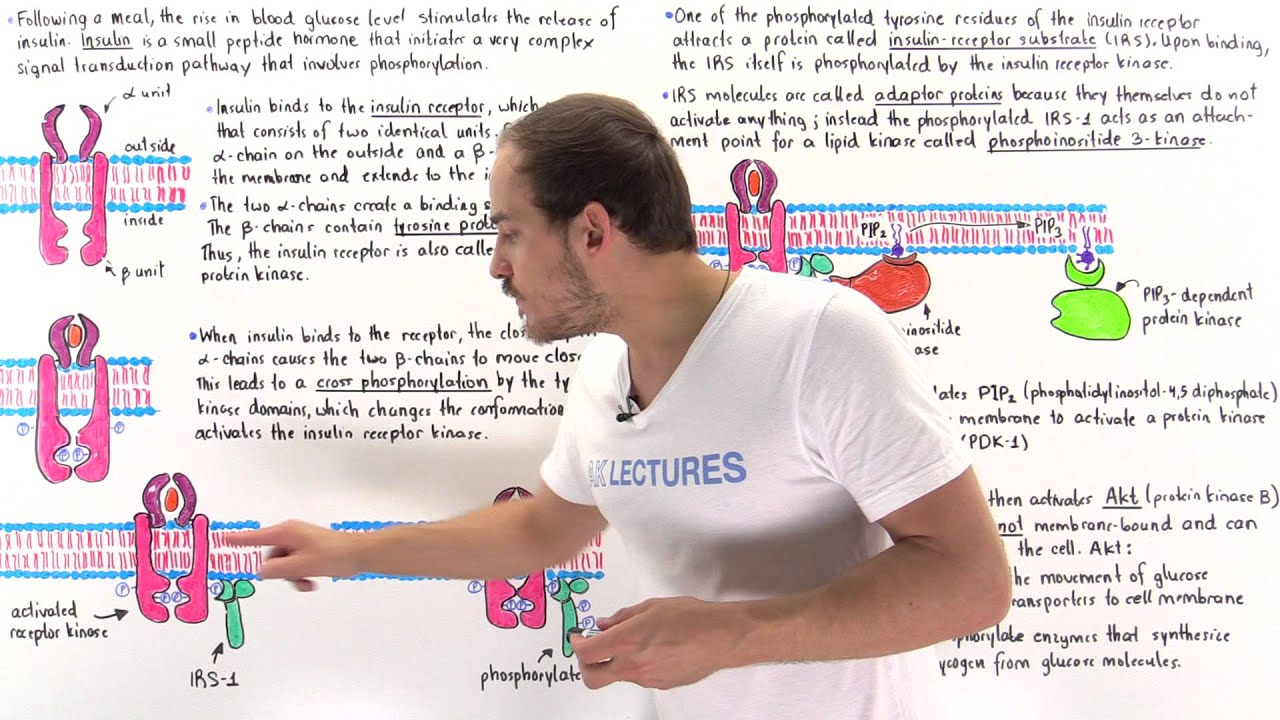
Insulin Signal Transduction Pathway
Keywords
Summary
136 words
Critical Evaluation
Value of the Information & Strength of the Argument
The video provides a comprehensive and logical explanation of the insulin signaling cascade. It builds the pathway step by step, clearly explaining the role of each molecule. The argumentation is solid, based on established biochemical mechanisms. The use of diagrams and clear bullet points enhances understanding. The video does not oversimplify but manages to make a complex pathway accessible. It also contrasts this pathway with GPCR signaling, reinforcing the concept of receptor diversity.
Scientific Rigor, Source Quality, Title Accuracy
The scientific rigor is high for an educational video: the content aligns with standard biochemistry textbooks. However, no specific sources are cited within the video, and the description only links to the lecturer’s website. The title accurately reflects the content. The video is well-structured and pedagogically sound, but it does not address recent research or nuances such as insulin resistance. The absence of citations limits its use as a primary reference, but it serves as an excellent tutorial.
166 words
Title / Content Match
The title accurately reflects the content, which focuses on the insulin signal transduction pathway.
Quality & Reliability
8/10
The video provides a clear, step-by-step explanation of the insulin signaling pathway, based on established biochemical knowledge. The content is accurate and well-structured, though it lacks citations to primary literature and does not discuss recent advances or controversies.
Key Moments
Markers derived by PSI from the transcript: the creator did not define chapters.
- Introduction to insulin and its role in glucose regulation
- Structure of the insulin receptor: alpha and beta subunits
- Insulin binding and receptor autophosphorylation
- IRS-1 recruitment and phosphorylation
- PI3K activation and PIP2 to PIP3 conversion
- PDK1 and Akt activation
- Akt effects: GLUT4 translocation and glycogen synthesis
- Summary and comparison with GPCR pathways
Cited Sources
- AK Lectures website — General educational resource
- Lecture page for insulin signal transduction — Direct link to the video lecture
Concurring Sources
- Insulin signal transduction — NCBI Bookshelf chapter on insulin signaling
External References
Contribution & Novelties
The video offers a clear, step-by-step explanation of the insulin signaling pathway, emphasizing the molecular mechanisms. It is particularly useful for students needing a structured overview. The novelty lies in its pedagogical clarity rather than new scientific insights.
Pour aller plus loin :
- Insulin receptor — Overview of the receptor structure and function.
- PI3K/AKT/mTOR pathway — Detailed description of downstream signaling.
- GLUT4 — Information on the glucose transporter and its regulation.
71 words
Radar Profile
The radar profile shows high scores in information quantity, quality, and reliability, with a slightly lower technical level, indicating a well-balanced educational resource that is accessible yet comprehensive.
💬 Très positif. Sur les 30 commentaires analysés, tous expriment une gratitude extrême et une grande satisfaction, soulignant la clarté et l'efficacité pédagogique de la vidéo.