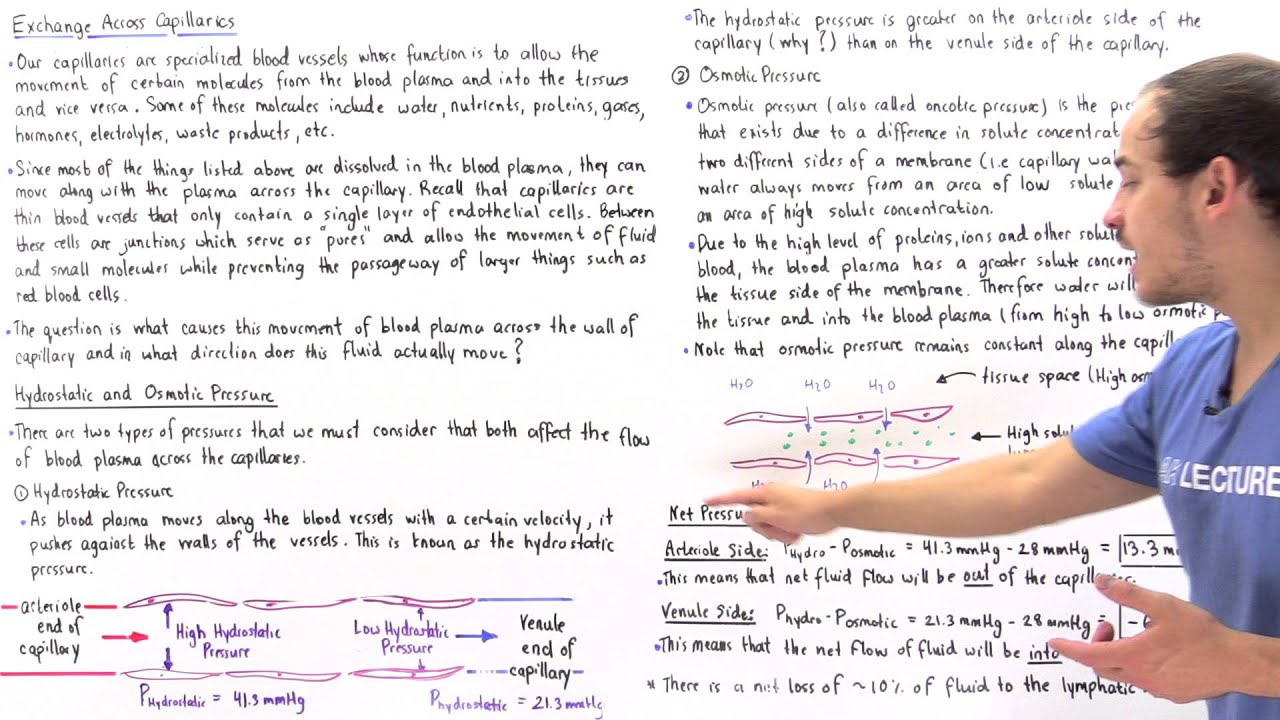
Exchange Across Capillaries
Keywords
Summary
193 words
Critical Evaluation
Value of the Information & Strength of the Argument
The video provides a solid introduction to capillary exchange, clearly explaining the roles of hydrostatic and osmotic pressures. The argumentation is logical and builds step-by-step, using quantitative examples (pressures in mmHg) to illustrate the net fluid movement at arterial and venous ends. The presenter effectively uses analogies (e.g., gravitational potential) to explain osmotic potential, aiding comprehension. However, the video does not discuss the concept of colloid osmotic pressure in detail, nor does it mention the role of the lymphatic system beyond a brief note. The explanation is simplified and may not cover all nuances, but it is accurate and well-structured for an introductory audience.
Scientific Rigor, Source Quality, Title Accuracy
The video is scientifically accurate, aligning with standard physiological principles (Starling forces). However, it does not cite specific sources or references, relying on general knowledge. The title accurately reflects the content, which is focused on capillary exchange. The video is a tutorial, and its educational value is high, but the lack of citations reduces its scholarly rigor. The presenter uses clear diagrams and examples, but the absence of references to primary literature or textbooks is a limitation for those seeking deeper verification.
201 words
Title / Content Match
The title accurately reflects the content, which focuses on the mechanisms of fluid and solute exchange across capillary walls.
Quality & Reliability
8/10
The video provides a clear and accurate explanation of capillary exchange, based on established physiological principles (Starling forces). The content is consistent with standard medical textbooks, though it simplifies some aspects (e.g., average capillary pressures). No sources are cited in the video, but the explanation is scientifically sound.
Key Moments
Markers derived by PSI from the transcript: the creator did not define chapters.
- Introduction to capillary exchange and the structure of capillary walls.
- Explanation of hydrostatic pressure and its variation along the capillary.
- Discussion of osmotic pressure and its role in fluid movement.
- Calculation of net pressure at arterial and venous ends.
- Explanation of net fluid loss and the role of the lymphatic system.
Cited Sources
- AK Lectures - Exchange Across Capillaries — The video's dedicated lecture page on the AK Lectures website.
- AK Lectures Website — Main website hosting the lecture and other educational content.
Concurring Sources
- Starling equation - Wikipedia — The video's explanation aligns with the Starling equation, which describes the net filtration pressure across capillaries.
External References
Contribution & Novelties
The video offers a clear and concise explanation of capillary exchange, using quantitative examples to illustrate the balance of hydrostatic and osmotic pressures. It is particularly useful for students who benefit from step-by-step calculations. The video does not introduce new research but serves as an effective educational tool.
Pour aller plus loin :
- Starling equation — The mathematical formulation of fluid movement across capillary walls, directly related to the video’s content.
- Capillary — Overview of capillary structure and function, providing broader context.
- Lymphatic system — Explanation of the system that returns excess fluid to circulation, mentioned in the video.
99 words
Radar Profile
The radar profile shows high scores in quality and reliability, with moderate scores in quantity and technical level, indicating a focused and accurate educational video that may not delve into advanced details.