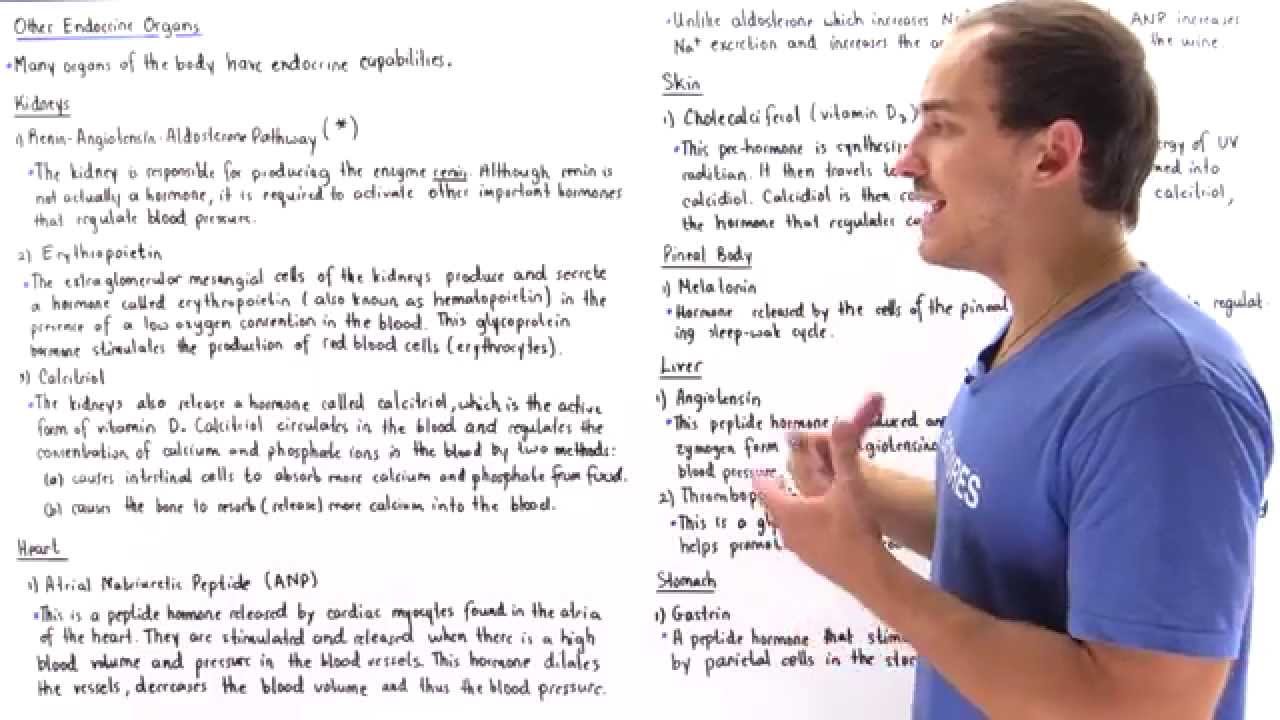
Endocrine Ability of Heart, Kidney, Liver and Skin
Keywords
Summary
128 words
Critical Evaluation
Value of the Information & Strength of the Argument
The video provides a clear and structured overview of the endocrine functions of several organs, highlighting key hormones and their roles. The argumentation is logical, progressing from organ to organ, and each hormone’s function is explained in relation to physiological regulation. However, the depth is limited; for instance, the regulation of erythropoietin by hypoxia is mentioned but not elaborated, and the feedback mechanisms are simplified. The value lies in its educational clarity for introductory physiology, but it does not offer novel insights or critical analysis.
Scientific Rigor, Source Quality, Title Accuracy
The scientific content is accurate and aligns with standard medical knowledge, though no specific sources are cited within the video. The description provides links to the creator’s website and lecture page, but these are not direct references to primary literature. The title accurately reflects the content, though it omits the pineal gland and stomach, which are also covered. Overall, the rigor is acceptable for an educational overview, but the lack of citations and the presence of minor transcription errors (e.g., ‘urethropoietin’ instead of ’erythropoietin’) slightly reduce its reliability.
188 words
Title / Content Match
The title accurately reflects the content, which covers the endocrine functions of heart, kidney, liver, and skin, though it also includes the pineal gland and stomach.
Quality & Reliability
7/10
The content is scientifically accurate and aligns with established medical knowledge, but it lacks citations and depth, and contains minor transcription errors.
Key Moments
Markers derived by PSI from the transcript: the creator did not define chapters.
- Introduction to endocrine capabilities of various organs.
- Discussion of kidney hormones: renin, erythropoietin, and calcitriol.
- Explanation of erythropoietin's role in red blood cell production.
- Calcitriol and its role in calcium regulation.
- Heart's atrial natriuretic peptide (ANP) and its effects on blood pressure.
- Skin's production of cholecalciferol and its conversion to calcitriol.
- Pineal gland and melatonin's role in sleep-wake cycle.
- Liver's production of angiotensinogen and thrombopoietin.
- Stomach's release of gastrin and its function in digestion.
Cited Sources
- AK Lectures - Endocrine Ability of Heart, Kidney, Liver and Skin — The video's dedicated lecture page on the creator's website.
- AK Lectures — The creator's educational website with additional lectures.
- Donate page — Support page for the creator's educational content.
Concurring Sources
- AK Lectures - Endocrine Ability of Heart, Kidney, Liver and Skin — The video's dedicated lecture page on the creator's website.
Contribution & Novelties
The video offers a concise educational overview of the endocrine functions of non-classical organs, which is useful for students. It synthesizes information from various sources into a single lecture, but does not present original research or novel perspectives. Its contribution is primarily pedagogical.
Pour aller plus loin :
- Renin-angiotensin system — Overview of the pathway involving renin, angiotensin, and aldosterone.
- Erythropoietin — Detailed information on the hormone’s production and function.
- Calcitriol — The active form of vitamin D and its role in calcium homeostasis.
- Atrial natriuretic peptide — Hormone secreted by the heart and its effects on blood pressure.
- Thrombopoietin — Hormone regulating platelet production.
105 words
Radar Profile
The radar profile shows balanced scores across all dimensions, with slightly higher scores in information quantity and quality, indicating a solid educational resource. The technical level is moderate, suitable for beginners, and reliability is good but not exceptional due to lack of citations.