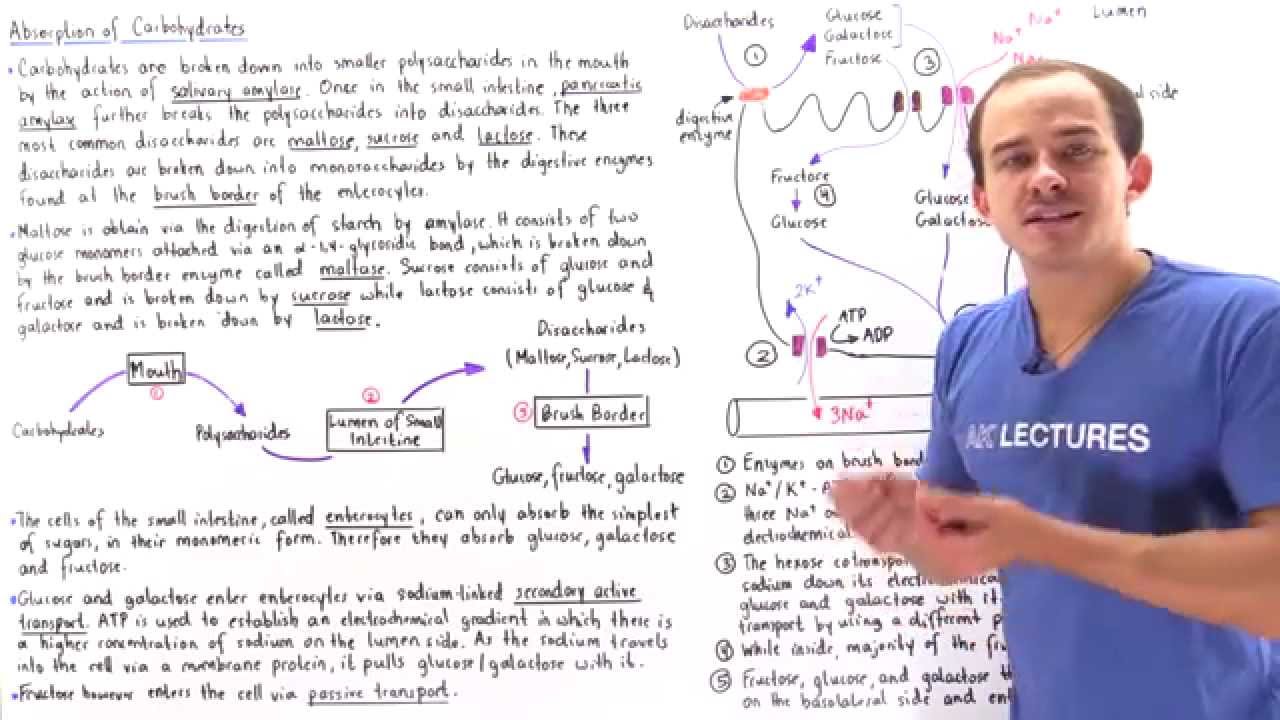
Absorption of Carbohydrates in Small Intestine
Keywords
Summary
163 words
Critical Evaluation
Value of the Information & Strength of the Argument
The video provides a clear and structured explanation of carbohydrate absorption, breaking down complex processes into understandable steps. It uses diagrams and summaries to reinforce key points. The argumentation is logical, starting from digestion and moving to transport mechanisms, and it correctly distinguishes between the different pathways for glucose/galactose and fructose. The explanation of secondary active transport is particularly well done, emphasizing the role of the Na+/K+ ATPase pump in establishing the gradient. However, the video could benefit from more depth on the regulation of these processes and clinical implications, but for an introductory level, it is highly effective.
Scientific Rigor, Source Quality, Title Accuracy
The scientific content is accurate and consistent with established biochemistry. The video does not cite specific sources, but the information aligns with standard textbooks. The title accurately reflects the content. The description provides links to the creator’s website and lecture page, but no external references. The video is a tutorial-style explanation, and the lack of citations is typical for such content. The adequacy between title and content is high.
183 words
Title / Content Match
The title accurately reflects the content, which focuses on the mechanisms of carbohydrate absorption in the small intestine.
Quality & Reliability
8/10
Clear and accurate explanation of carbohydrate digestion and absorption, consistent with established biochemistry. Minor simplifications but no factual errors.
Key Moments
Markers derived by PSI from the transcript: the creator did not define chapters.
- Introduction to carbohydrate digestion in the mouth and small intestine.
- Explanation of brush border enzymes and breakdown of disaccharides.
- Overview of the three common disaccharides and their enzymes.
- Introduction to transport mechanisms: sodium-linked secondary active transport and facilitated diffusion.
- Detailed explanation of the Na+/K+ ATPase pump and cotransporter.
- Summary of the entire process and final transport into the bloodstream.
Cited Sources
- AK Lectures - Absorption of Carbohydrates by Small Intestine — The video is hosted on this lecture page, which may contain additional resources.
- AK Lectures Website — General website of the creator, providing access to other lectures.
Concurring Sources
- Textbook of Medical Physiology — Standard physiology textbooks describe the same mechanisms of carbohydrate absorption.
External References
Contribution & Novelties
The video provides a clear and concise explanation of carbohydrate absorption, making complex physiological processes accessible. It effectively uses diagrams and step-by-step summaries to enhance understanding. While it does not present new research, it serves as a valuable educational resource.
Pour aller plus loin :
- Sodium-glucose transport proteins — Overview of SGLT proteins involved in glucose absorption.
- Brush border — Description of microvilli and their role in absorption.
- Secondary active transport — Explanation of the mechanism used for glucose and galactose uptake.
82 words
Radar Profile
The radar profile shows high scores in information quantity, quality, and reliability, with a slightly lower technical level, indicating a well-balanced educational video suitable for a broad audience.
💬 Sur les 0 commentaires analysés, aucune tendance n'a pu être dégagée.