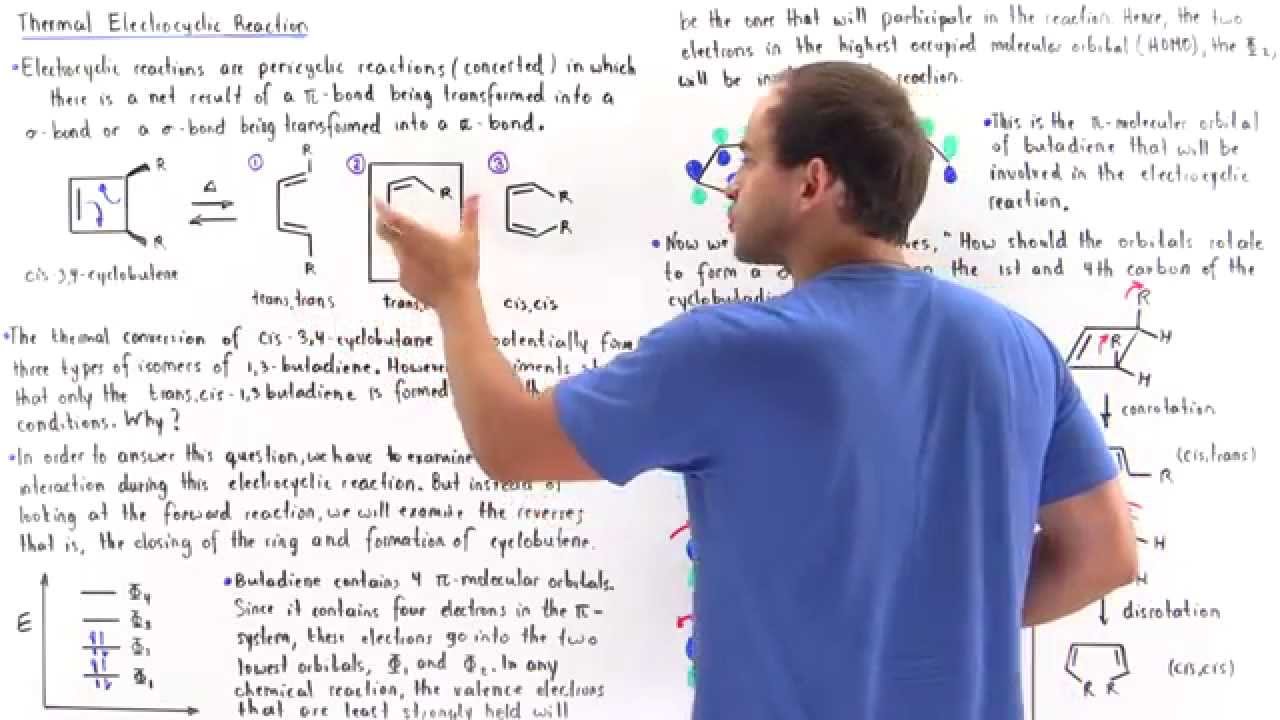
Thermal Electrocyclic Reaction
Keywords
Summary
125 words
Critical Evaluation
Value of the Information & Strength of the Argument
The video provides a clear and logical explanation of the stereochemical outcome of thermal electrocyclic reactions. It effectively uses molecular orbital theory to justify why conrotation is favored. The argumentation is solid, building from the definition of electrocyclic reactions to the specific example and the orbital analysis. The explanation is accessible and well-structured, making it valuable for students learning pericyclic reactions.
Scientific Rigor, Source Quality, Title Accuracy
The video is scientifically accurate and aligns with standard organic chemistry teachings. However, it does not cite specific sources or references, relying on established knowledge. The title accurately reflects the content. No comments were provided for analysis.
113 words
Title / Content Match
The title accurately reflects the content, which is a focused lecture on thermal electrocyclic reactions.
Quality & Reliability
7/10
The video provides a clear and accurate explanation of thermal electrocyclic reactions, focusing on the orbital interactions and the conrotatory vs disrotatory pathways. The content is consistent with standard organic chemistry textbooks, though it lacks citations to primary literature and does not address potential exceptions or advanced nuances.
Key Moments
Markers derived by PSI from the transcript: the creator did not define chapters.
- Introduction to electrocyclic reactions and distinction between thermal and photochemical.
- Definition of electrocyclic reaction and example of cyclobutene to butadiene.
- Explanation of possible isomers and the preference for trans,cis under thermal conditions.
- Introduction to molecular orbitals of butadiene and identification of HOMO.
- Analysis of orbital rotation possibilities: conrotation vs disrotation.
- Conclusion that conrotation is required for bond formation in thermal reactions.
- Application to the forward reaction and explanation of product stereochemistry.
Cited Sources
- AK Lectures — General website for the lecture series.
- Lecture page — Specific lecture page for this video.
- Donation page — Support page for the channel.
Concurring Sources
- Organic Chemistry (textbook) — Standard textbooks such as Clayden or Carey & Sundberg cover electrocyclic reactions with similar explanations.
Contribution & Novelties
The video offers a clear pedagogical explanation of thermal electrocyclic reactions, emphasizing the role of orbital symmetry. It is particularly useful for students who need a visual and step-by-step understanding of why conrotation is favored. The lecture builds on prior knowledge of molecular orbitals, making it a good resource for organic chemistry courses.
Pour aller plus loin :
- Woodward-Hoffmann rules — These rules provide a theoretical framework for predicting the stereochemistry of pericyclic reactions, including electrocyclic reactions.
- Pericyclic reaction — Overview of pericyclic reactions, including electrocyclic, cycloaddition, and sigmatropic reactions.
- Molecular orbital theory — Background on molecular orbitals, essential for understanding the orbital interactions discussed.
105 words
Radar Profile
The radar profile shows balanced scores across information quantity, quality, technical level, and reliability, indicating a well-rounded educational video. The high quality and technical level suggest it is suitable for advanced undergraduate students.