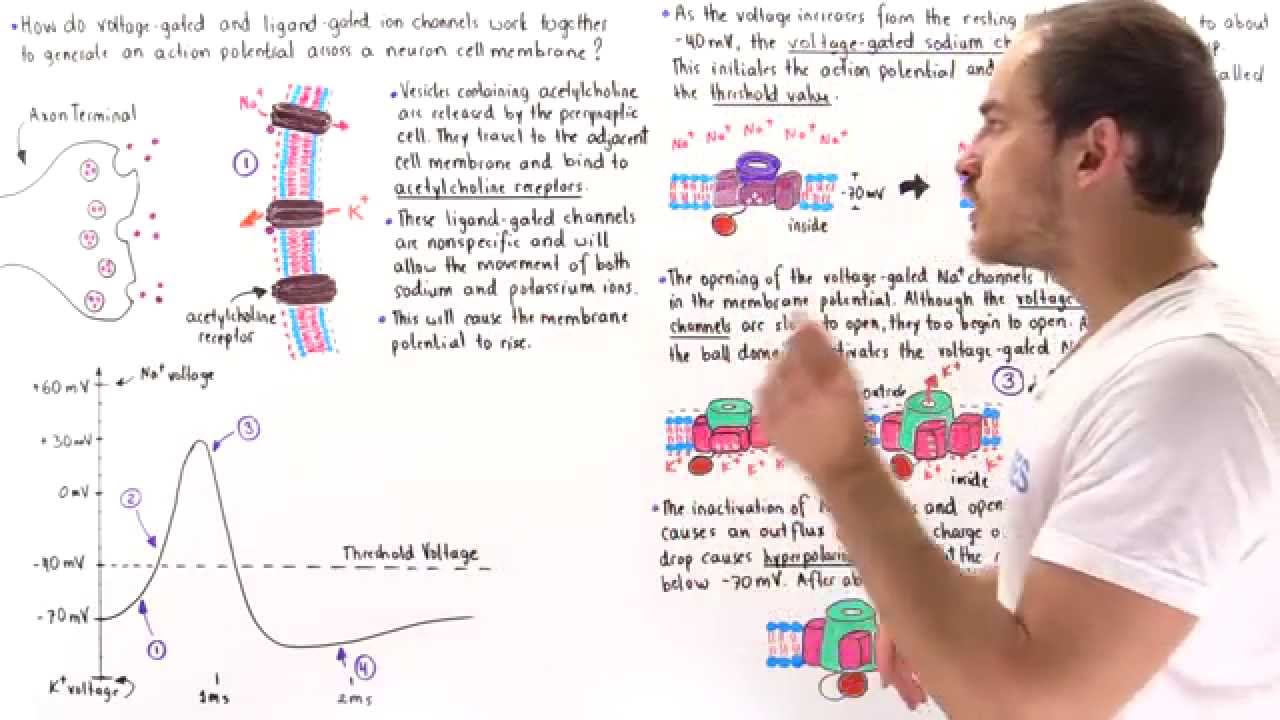
Generation of Action Potential
Keywords
Summary
164 words
Critical Evaluation
Value of the Information & Strength of the Argument
The video provides a clear and systematic explanation of the action potential mechanism, breaking down the process into distinct phases: depolarization, repolarization, and hyperpolarization. It effectively uses diagrams to illustrate the conformational changes of voltage-gated channels and the movement of ions. The argumentation is logical and builds on previous knowledge of ion channels, making it accessible for learners. The explanation of the threshold voltage and the all-or-none principle is accurate and well-illustrated. The video also correctly describes the inactivation of sodium channels and the slower opening of potassium channels, which are key to the action potential waveform.
Scientific Rigor, Source Quality, Title Accuracy
The video is scientifically accurate and aligns with standard neuroscience textbooks. However, it does not cite specific sources or references, which limits its scholarly rigor. The title accurately reflects the content, and the video is well-structured. The description provides links to the creator’s website and lecture page, but no external references are given. The content is presented as a tutorial, and the lack of citations is a minor weakness for a scientific audience.
185 words
Title / Content Match
The title accurately reflects the content, which focuses on the generation of action potentials in neurons.
Quality & Reliability
8/10
The video provides a clear and accurate explanation of the action potential mechanism, consistent with established neuroscience knowledge. It uses standard diagrams and models (e.g., ball-and-chain inactivation) and correctly describes ion movements and voltage changes. The content is educational and well-structured, though it lacks citations to primary literature.
Key Moments
Markers derived by PSI from the transcript: the creator did not define chapters.
- Introduction to the generation of action potential, showing pre- and post-synaptic neurons.
- Explanation of acetylcholine release and binding to ligand-gated channels.
- Description of the threshold voltage and the opening of voltage-gated sodium channels.
- Depolarization phase: rapid sodium influx and rise to +30 mV.
- Inactivation of sodium channels and slow opening of potassium channels.
- Repolarization and hyperpolarization due to potassium efflux.
- Closure of potassium channels and restoration of resting membrane potential.
- Summary of the entire action potential process.
Cited Sources
- AK Lectures - Generation of Action Potential — The video is hosted on this lecture page, which may contain additional resources.
- AK Lectures — The creator's website, which hosts a collection of educational videos.
Concurring Sources
- Purves et al., Neuroscience (textbook) — Standard neuroscience textbook that covers action potential generation in detail.
External References
Contribution & Novelties
The video provides a clear, step-by-step tutorial on the generation of action potentials, integrating the roles of ligand-gated and voltage-gated channels. It effectively uses diagrams to illustrate the conformational changes and ion movements, making complex concepts accessible. The explanation of the threshold voltage and the all-or-none principle is particularly well done.
Pour aller plus loin :
- Action potential - Wikipedia — Comprehensive overview of action potentials.
- Voltage-gated sodium channel - Wikipedia — Detailed information on sodium channel structure and function.
- Ball-and-chain inactivation - Wikipedia — Explanation of the inactivation mechanism mentioned in the video.
94 words
Radar Profile
The radar profile shows high scores in information quantity, quality, and reliability, with a slightly lower technical level, indicating a well-balanced educational video suitable for a broad audience.