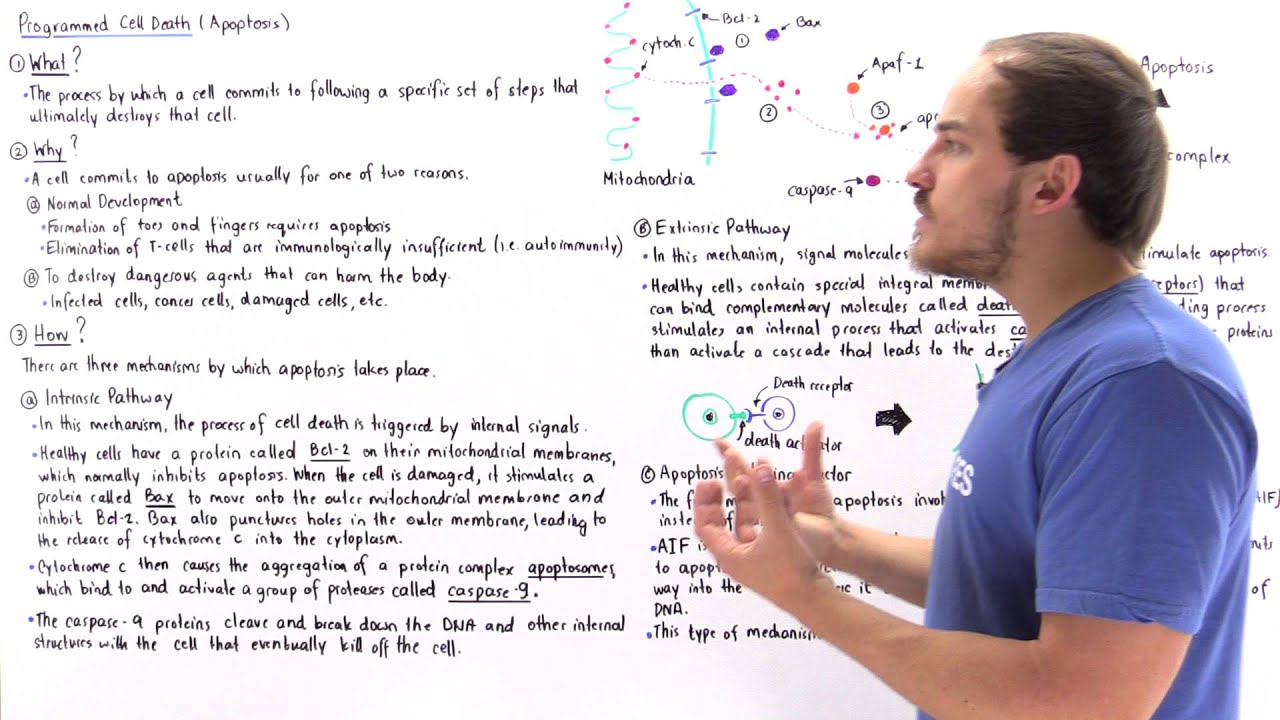
Apoptosis (Programmed Cell Death)
Keywords
Summary
154 words
Critical Evaluation
Value of the Information & Strength of the Argument
The video provides a solid foundational explanation of apoptosis, covering its definition, physiological importance, and the three main pathways. The argumentation is logical and well-structured, progressing from ‘what’ and ‘why’ to ‘how’. The explanations are clear and use helpful analogies (e.g., cell suicide) and visual aids. The content is accurate and aligns with standard biological knowledge, making it valuable for students and those seeking a basic understanding. However, it lacks depth in discussing regulation and pathological implications, which could be a limitation for advanced learners.
Scientific Rigor, Source Quality, Title Accuracy
The video demonstrates scientific rigor by presenting established concepts in apoptosis without introducing speculative or unverified information. The sources cited are the lecturer’s own website (aklectures.com) and the video itself, which are not primary research sources but serve as educational references. The title accurately reflects the content, and the video’s structure is coherent. No external sources are referenced, but the information is consistent with textbook knowledge. The adequacy between title and content is high, as the video directly addresses the topic of apoptosis.
183 words
Title / Content Match
The title accurately reflects the content, which focuses on the definition, purpose, and mechanisms of apoptosis.
Quality & Reliability
8/10
Clear and accurate explanation of apoptosis mechanisms, consistent with established biological knowledge. The video is educational, well-structured, and uses appropriate terminology. Minor simplifications for clarity but no major errors.
Key Moments
Markers derived by PSI from the transcript: the creator did not define chapters.
- Introduction to apoptosis and its definition as programmed cell death.
- Explanation of why cells undergo apoptosis: embryological development and immune system development.
- Discussion of apoptosis in immune system, specifically T-cell selection in the thymus.
- Introduction to the three mechanisms of apoptosis: intrinsic, extrinsic, and AIF-mediated.
- Detailed explanation of the intrinsic pathway, including the roles of Bcl-2, Bax, cytochrome c, and the apoptosome.
- Explanation of the extrinsic pathway, involving death receptors and death activators, and activation of caspase-8.
- Description of the third mechanism using apoptosis-inducing factor (AIF) and its role in neurons.
- Summary of the three mechanisms and conclusion.
Cited Sources
- AK Lectures - Apoptosis (Programmed Cell Death) — The video is hosted on this page, providing additional resources and context.
- AK Lectures Website — The lecturer's website, offering a collection of educational videos.
Concurring Sources
- Apoptosis - Wikipedia — Confirms the general mechanisms and pathways described in the video.
External References
Contribution & Novelties
The video provides a clear and accessible explanation of apoptosis, breaking down complex mechanisms into understandable segments. It effectively uses diagrams and step-by-step narration to illustrate the intrinsic and extrinsic pathways, as well as the AIF-mediated mechanism. The educational value is high for students, but it does not introduce novel scientific insights.
Pour aller plus loin :
- Apoptosis - Wikipedia — Comprehensive overview of apoptosis, including molecular details and clinical relevance.
- Caspase - Wikipedia — Detailed information on caspases, the proteases central to apoptosis.
- Bcl-2 family - Wikipedia — Explanation of the Bcl-2 protein family and its role in regulating apoptosis.
101 words
Radar Profile
The radar profile shows high scores in quality and reliability, with moderate scores in quantity and technical depth. This indicates a well-explained but not exhaustive overview, suitable for introductory learning.
💬 Très positif : Sur les 30 commentaires analysés, tous expriment une gratitude et une appréciation pour la clarté et la qualité pédagogique de la vidéo, la qualifiant souvent de 'parfaite' ou 'excellente'.