Centripetal Acceleration
Keywords
Summary
134 words
Critical Evaluation
Value of the Information & Strength of the Argument
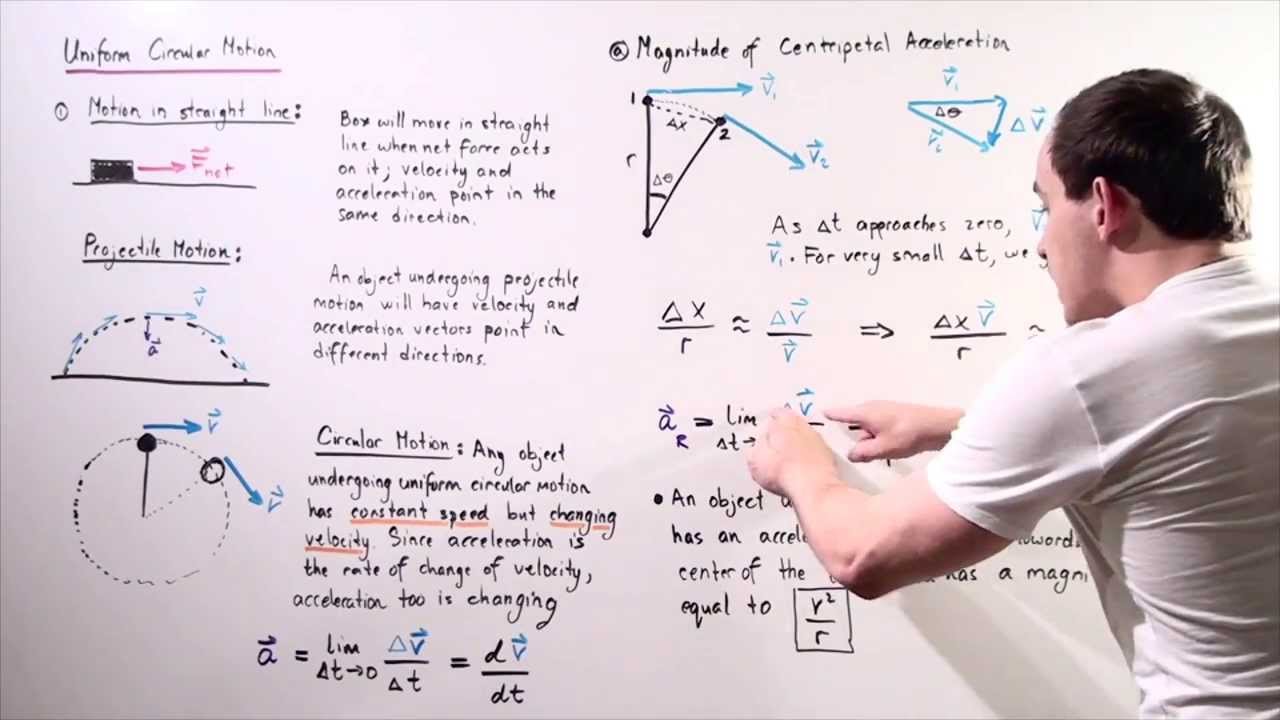
The video provides a solid conceptual foundation for understanding centripetal acceleration. It clearly explains why an object moving in a circle at constant speed is accelerating, addressing a common misconception. The derivation is logical and rigorous, using similar triangles and the definition of acceleration as a limit. The argumentation is coherent and builds step by step, making it accessible to learners. However, the video lacks real-world examples or applications, which could enhance the practical value. The focus is purely on the mathematical derivation, which is valuable for theoretical understanding but may not engage all viewers.
Scientific Rigor, Source Quality, Title Accuracy
The scientific rigor is high; the derivation is mathematically sound and aligns with standard physics textbooks. The video does not cite external sources, but it is a self-contained tutorial. The title accurately reflects the content, which is entirely about centripetal acceleration. The video is part of a series of lectures by the same author, and the description includes links to the author’s website for further resources. No comments were provided for analysis.
182 words
Title / Content Match
The title accurately reflects the content, which focuses on deriving and explaining centripetal acceleration in uniform circular motion.
Quality & Reliability
8/10
Clear derivation of centripetal acceleration using calculus and geometry, with correct physics principles. Minor lack of real-world examples and limited depth, but the core content is accurate and well-explained.
Key Moments
Markers derived by PSI from the transcript: the creator did not define chapters.
- Introduction to motion in one and two dimensions, contrasting net force and velocity directions.
- Introduction to uniform circular motion, defining constant speed but changing velocity.
- Explanation that acceleration is the rate of change of velocity, so circular motion implies acceleration.
- Derivation using similar triangles to relate change in velocity to velocity and radius.
- Taking the limit as time interval approaches zero, showing acceleration points toward center.
- Final formula a = v^2/r derived and discussed, with dependence on velocity and radius.
Cited Sources
- AK Lectures - Centripetal Acceleration — The video's dedicated lecture page on the author's website.
- AK Lectures — The author's educational website hosting the video and related content.
- Donate page — Support page for the author's educational content.
Concurring Sources
- HyperPhysics - Centripetal Acceleration — A reliable physics resource that confirms the formula and explanation.
Contribution & Novelties
The video provides a clear and rigorous derivation of centripetal acceleration, which is a fundamental concept in physics. Its contribution lies in its pedagogical approach, breaking down the derivation into understandable steps using geometric and calculus reasoning. It reinforces the idea that acceleration arises from direction change, not just speed change.
Pour aller plus loin :
- Uniform circular motion — For broader context on circular motion and related quantities.
- Centripetal force — To understand the force that causes centripetal acceleration.
- Derivative — To review the calculus concept used in the derivation.
91 words
Radar Profile
The radar profile shows high scores in quality and reliability, with moderate scores in quantity and technical level. This indicates a focused, accurate tutorial that is technically sound but not exhaustive in scope.