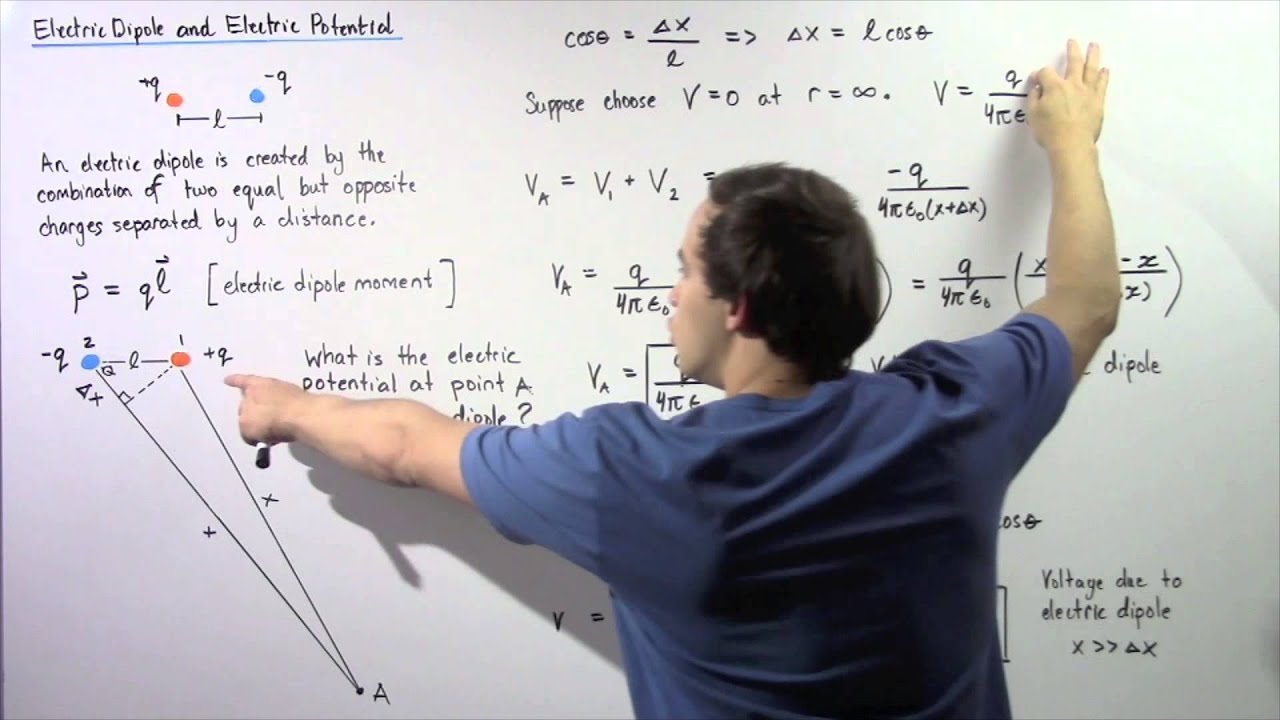
Voltage due to Electric Dipoles
Keywords
Summary
164 words
Critical Evaluation
Value of the Information & Strength of the Argument
The video provides a clear and systematic derivation of the electric potential due to an electric dipole. It starts from fundamental definitions and builds up to the final formula, ensuring that each step is logically justified. The argumentation is solid, relying on standard electrostatic principles such as superposition and the definition of dipole moment. The use of a right triangle to relate Δx to L and θ is well explained. The approximation for far distances is justified with a concrete example. Overall, the value lies in its pedagogical clarity and step-by-step approach, which is effective for learners.
Scientific Rigor, Source Quality, Title Accuracy
The scientific rigor is acceptable for an introductory lecture: the derivation follows standard physics textbooks, and the formulas are correct. However, the video does not cite any external sources or references, relying solely on the instructor’s explanation. The title accurately reflects the content, which is entirely focused on deriving the voltage due to an electric dipole. The description provides links to the instructor’s website and donation page, but no specific references to textbooks or papers. The video is self-contained and does not engage with conflicting viewpoints or alternative derivations.
201 words
Title / Content Match
Title accurately reflects content, which focuses on deriving the voltage due to an electric dipole.
Quality & Reliability
7/10
Clear derivation with standard physics formulas, but lacks citations and external verification.
Key Moments
Markers derived by PSI from the transcript: the creator did not define chapters.
- Introduction to electric dipole and dipole moment.
- Setup of two point charges and point A.
- Recall of voltage formula for point charge.
- Superposition principle applied to find total voltage.
- Combining terms and simplifying expression.
- Approximation for far distances (x >> Δx).
- Using trigonometry to relate Δx to L and θ.
- Substituting dipole moment p = QL.
- Final formula for voltage due to dipole.
- Summary and conclusion.
Cited Sources
- AK Lectures - Electric Potential due to Electric Dipoles — Lecture page with additional resources.
- AK Lectures Website — General website for the lecture series.
Concurring Sources
- Electric Dipole - HyperPhysics — Concordant explanation of electric dipole potential.
External References
Contribution & Novelties
The video provides a clear, step-by-step derivation of the electric potential due to an electric dipole, which is a fundamental concept in electrostatics. It is particularly useful for students who need a detailed walkthrough of the mathematical steps. The presentation is accessible and does not assume prior knowledge beyond basic physics.
Pour aller plus loin :
- Electric dipole moment — Wikipedia article providing background and applications.
- Electric potential — Wikipedia article on electric potential.
- Superposition principle — Wikipedia article explaining the principle used in the derivation.
86 words
Radar Profile
The radar profile shows high scores in quality and technical level, with moderate scores in quantity and reliability. This indicates a focused, well-explained tutorial that lacks extensive external references but is internally consistent.