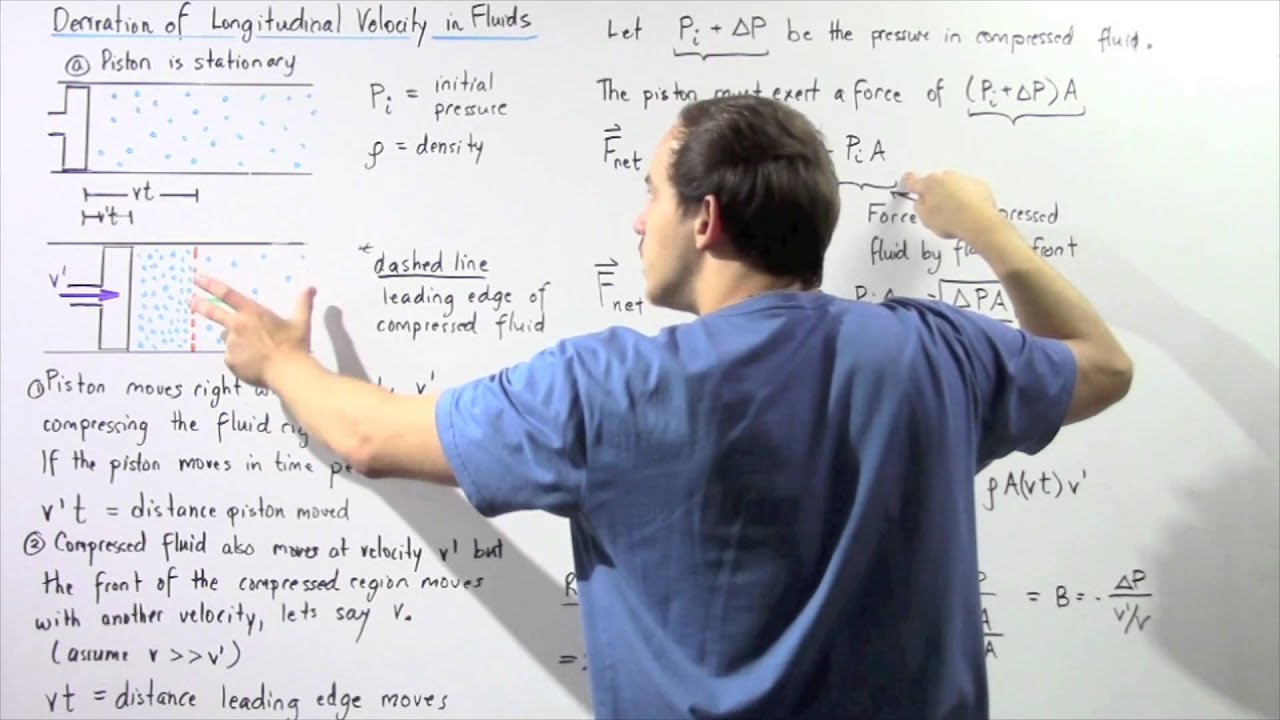
Derivation of Velocity of Longitudinal Wave in Fluids
Keywords
Summary
150 words
Critical Evaluation
Value of the Information & Strength of the Argument
The video provides a clear and logical derivation of the wave velocity formula, which is a fundamental concept in physics. The argumentation is solid, as it builds from basic principles (force, impulse, momentum) to the final result. The step-by-step approach helps in understanding the physical reasoning behind the formula. However, the video does not discuss the limitations of the assumptions or provide experimental verification, which could enhance its value.
Scientific Rigor, Source Quality, Title Accuracy
The video is scientifically rigorous in its derivation, following standard textbook methods. However, it does not cite any external sources or references, which limits its scholarly depth. The title accurately reflects the content, and the video is well-structured. The lack of citations is a minor weakness, but the derivation itself is reliable.
136 words
Title / Content Match
The title accurately describes the content, which is a step-by-step derivation of the wave velocity formula in fluids.
Quality & Reliability
8/10
The derivation is mathematically rigorous and follows standard physics methodology. The presentation is clear, with step-by-step logic. However, the video lacks references to external sources or experimental validation, and the assumptions (e.g., V >> V') are not discussed in depth.
Key Moments
Markers derived by PSI from the transcript: the creator did not define chapters.
- Introduction: recaps the formula for wave velocity in fluids.
- Sets up the physical scenario with a piston and fluid in a tube.
- Defines the velocities: piston velocity V' and leading edge velocity V.
- Calculates the net force on the compressed fluid.
- Applies impulse-momentum theorem to relate pressure change to velocities.
- Introduces bulk modulus and its definition.
- Substitutes and simplifies to derive the final formula.
Cited Sources
- AK Lectures - Derivation of Velocity of Longitudinal Wave in Fluids — The video's dedicated lecture page, which may contain additional resources.
- AK Lectures - Main Website — The channel's website with more educational content.
Concurring Sources
- Physics LibreTexts - Speed of Sound in Fluids — A standard physics textbook that derives the same formula for the speed of sound in fluids.
External References
Contribution & Novelties
The video provides a clear, step-by-step derivation of the wave velocity formula, which is a standard result in physics. It is particularly useful for students who want to understand the derivation rather than just memorize the formula. The approach is pedagogical and accessible.
Pour aller plus loin :
- Longitudinal wave - Wikipedia — Provides an overview of longitudinal waves and their properties.
- Bulk modulus - Wikipedia — Explains the concept of bulk modulus and its role in wave propagation.
- Speed of sound - Wikipedia — Discusses the speed of sound in various media, including fluids, and its relation to bulk modulus and density.
103 words
Radar Profile
The radar profile shows high scores in quality, technical level, and reliability, with a slightly lower score in quantity of information due to the focused nature of the derivation. The video is a solid educational resource for physics students.