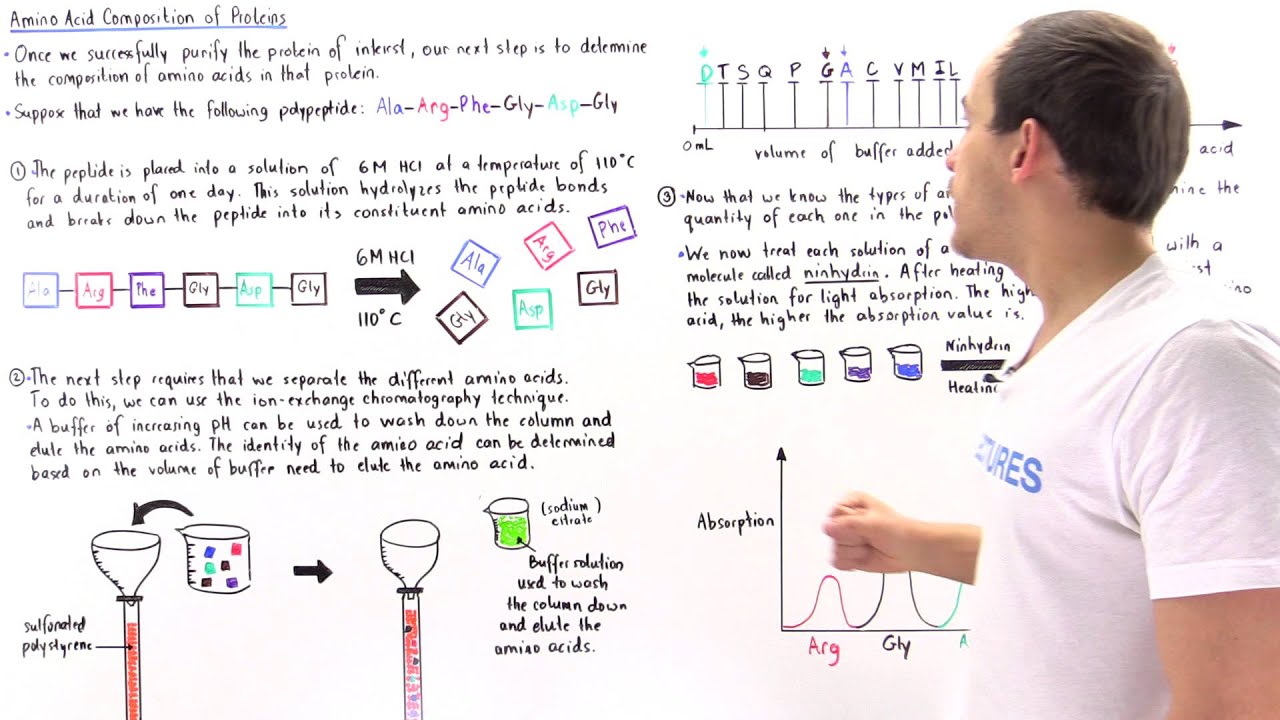
Determination of Amino Acid Composition
Keywords
Summary
161 words
Critical Evaluation
Value of the Information & Strength of the Argument
The video provides a clear and logical explanation of the method, using a concrete example to illustrate each step. The argumentation is sound, as it builds from hydrolysis to separation to quantification, and explains the underlying principles (charge-based separation, absorbance-based quantification). The value lies in its pedagogical clarity, making complex biochemical techniques accessible. However, it does not discuss potential pitfalls, such as degradation of certain amino acids during hydrolysis or the need for internal standards, which would enhance its scientific rigor.
90 words
Title / Content Match
The title accurately reflects the content, which focuses on determining the amino acid composition of a protein.
Quality & Reliability
8/10
The video presents a clear, step-by-step explanation of a standard biochemical technique (acid hydrolysis, ion exchange chromatography, ninhydrin reaction) with accurate scientific principles. The method is well-established and the explanation is consistent with textbook knowledge. However, the video lacks citations to primary sources and does not discuss limitations or variations of the method.
Key Moments
Markers derived by PSI from the transcript: the creator did not define chapters.
- Introduction: goal is to determine amino acid composition of a purified protein.
- Example of a six-amino-acid polypeptide (Ala, Arg, Phe, Gly, Asp, Gly).
- Step 1: Hydrolysis of peptide bonds using 6 M HCl at 110°C for 24 hours.
- Step 2: Separation of amino acids using ion exchange chromatography with negatively charged beads.
- Elution with sodium citrate buffer of increasing pH; amino acids elute at different rates.
- Identification of amino acids by comparing elution volume and pH to textbook values.
- Step 3: Quantification using ninhydrin reaction and spectrophotometry.
- Plotting absorbance vs. amino acid type to determine relative amounts.
Cited Sources
- AK Lectures - Amino Acid Composition in Proteins — Lecture page on the lecturer's website, likely containing additional notes and diagrams.
- AK Lectures — General website of the lecturer, providing access to other lectures.
Concurring Sources
- Biochemistry Textbook (e.g., Lehninger Principles of Biochemistry) — Standard biochemistry textbooks describe similar procedures for amino acid analysis.
External References
Contribution & Novelties
The video provides a clear, step-by-step tutorial on a classic biochemical technique, which is valuable for students. It does not present new research but serves as an educational resource. The explanation is concise and uses a concrete example to illustrate the principles.
Pour aller plus loin :
- Ion-exchange chromatography — Overview of the separation technique used in the video.
- Ninhydrin — Chemical reagent used for amino acid detection and quantification.
- Protein hydrolysis — Background on the hydrolysis step.
- Amino acid analysis — General overview of methods for determining amino acid composition.
91 words
Radar Profile
The radar profile shows high scores in quality and reliability, moderate in quantity and technical level, indicating a focused and accurate tutorial that may lack depth for advanced audiences.