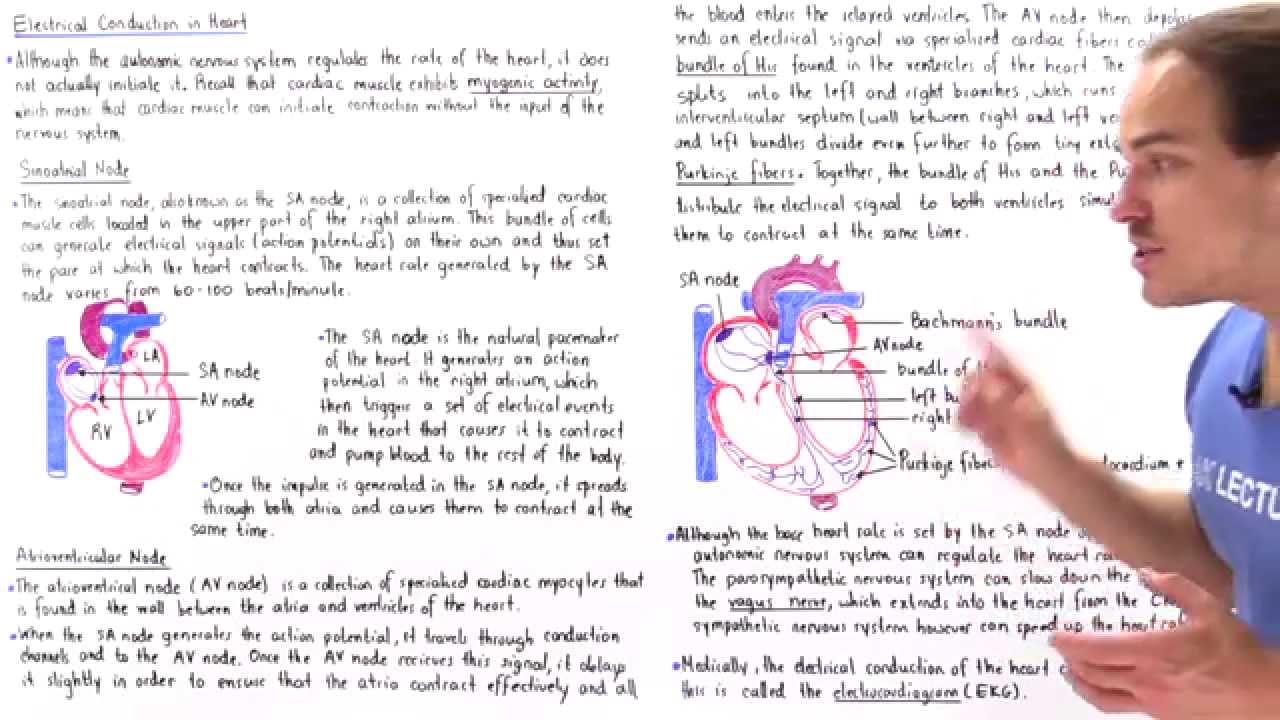
Electrical Conduction in the Heart
Keywords
Summary
161 words
Critical Evaluation
Value of the Information & Strength of the Argument
The video provides a solid foundational explanation of cardiac electrical conduction, valuable for students and those seeking a basic understanding. The argumentation is logical and sequential, building from the SA node to the ventricles. It correctly emphasizes the myogenic nature of cardiac muscle and the regulatory role of the autonomic nervous system. However, the presentation is largely descriptive and lacks critical analysis or discussion of clinical implications beyond a brief mention of ECG. The argumentation is straightforward but not deeply nuanced, and it does not address potential controversies or variations in the field.
Scientific Rigor, Source Quality, Title Accuracy
The scientific rigor is acceptable for an introductory lecture. The content aligns with standard medical knowledge, but no specific sources are cited within the video. The description provides links to the creator’s website and donation page, but these are not primary references. The title accurately reflects the content, and the video stays on topic throughout. No comments were provided for analysis, so public reception cannot be assessed.
175 words
Title / Content Match
The title accurately reflects the content, which focuses on the electrical conduction system of the heart.
Quality & Reliability
7/10
The video provides a clear and accurate overview of cardiac electrical conduction, consistent with established medical knowledge. It explains the roles of the SA node, AV node, bundle of His, and Purkinje fibers, and mentions the autonomic regulation. However, it lacks citations to primary sources and does not discuss pathological conditions in depth.
Key Moments
Markers derived by PSI from the transcript: the creator did not define chapters.
- Introduction to the heart's electrical signal and myogenic activity.
- Explanation of the SA node as the natural pacemaker.
- Role of the AV node and its delay mechanism.
- Pathway through the bundle of His and Purkinje fibers.
- Autonomic nervous system regulation of heart rate.
- Introduction to electrocardiogram and its clinical use.
Cited Sources
- AK Lectures Website — General educational resource by the video creator.
- Donation Page — Support page for the channel.
- Lecture Page for Electrical Conduction in the Heart — Direct link to the lecture content on the creator's website.
Concurring Sources
- Cardiac conduction system - Wikipedia — General reference confirming the described pathway.
Contribution & Novelties
The video offers a clear and concise explanation of cardiac electrical conduction, suitable for beginners. It effectively uses diagrams to illustrate the pathway. While it does not present new research, it serves as a useful educational resource.
Pour aller plus loin :
- Cardiac action potential — Detailed explanation of the cellular mechanisms.
- Electrocardiography — Overview of ECG and its clinical applications.
- Autonomic nervous system — Further reading on the regulation of heart rate.
73 words
Radar Profile
The radar profile shows balanced scores across information quantity, quality, technical level, and reliability, indicating a well-rounded educational video. The technical level is moderate, making it accessible to a broad audience.