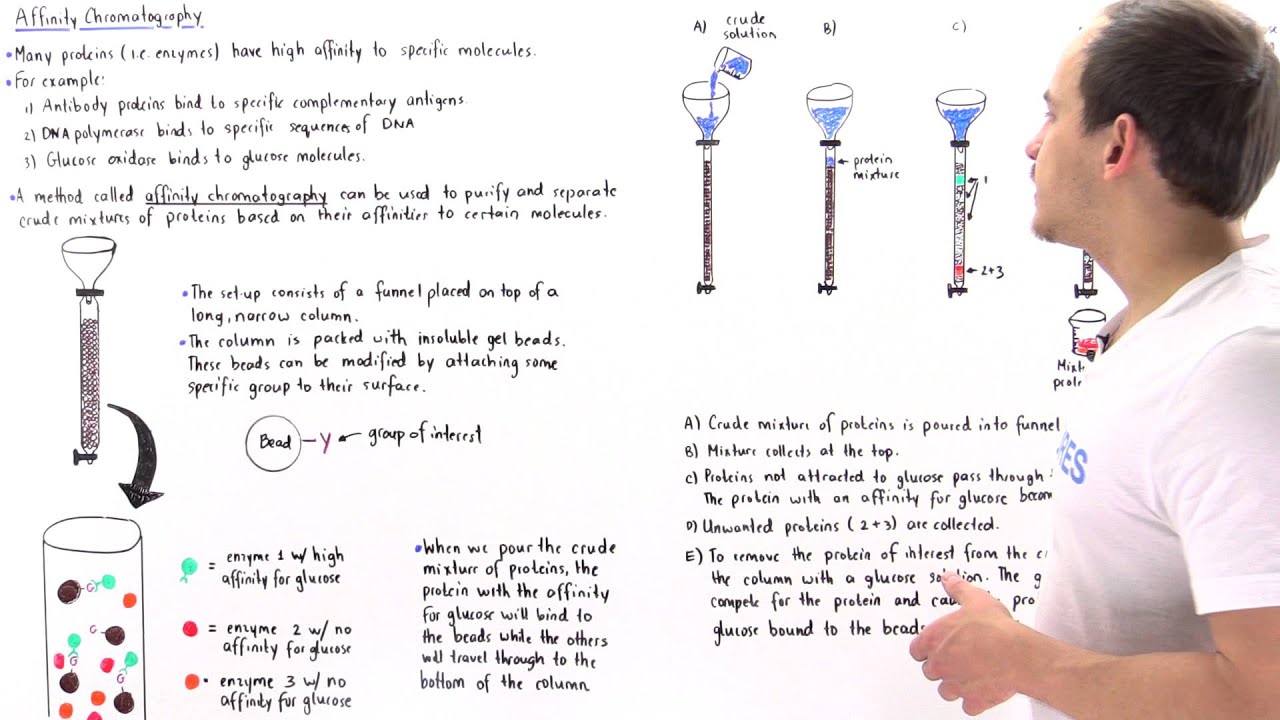
Affinity Chromatography
Keywords
Summary
198 words
Critical Evaluation
Value of the Information & Strength of the Argument
The video provides a clear and valuable explanation of affinity chromatography, a key technique in protein purification. It effectively uses analogies and visual diagrams to illustrate the principle, making it accessible to learners. The argumentation is logically structured: it starts with a recap of prior methods, introduces the concept of protein affinity, and then walks through the experimental procedure step by step. The use of a concrete example (glucose oxidase binding to glucose) helps solidify understanding. The explanation of the elution step, where free glucose competes with bound glucose, is particularly well done. However, the video does not delve into more advanced topics such as different types of affinity tags (e.g., His-tag, GST-tag) or the choice of matrix and linker chemistry, which could be considered a limitation for more advanced audiences. Overall, the value lies in its pedagogical clarity and accurate foundational content.
Scientific Rigor, Source Quality, Title Accuracy
The scientific rigor is high for an introductory educational video. The content is accurate and aligns with standard biochemistry textbooks. The presenter does not cite specific sources within the video, but the description provides links to the AK Lectures website, which may contain additional resources. The title accurately reflects the content, which is focused solely on affinity chromatography. The video is well-structured and free of errors. The lack of explicit citations is a minor weakness, but the information is presented in a way that is consistent with established knowledge. The video does not include any advertising or sponsored content. The comments are overwhelmingly positive, with viewers praising the clarity and helpfulness of the explanation, indicating that the video effectively meets its educational purpose.
281 words
Title / Content Match
The title accurately reflects the content, which focuses exclusively on affinity chromatography.
Quality & Reliability
8/10
Clear, accurate explanation of affinity chromatography principles, with relevant biological examples. The content is well-structured and scientifically sound, though it lacks detailed references and advanced nuances.
Key Moments
Markers derived by PSI from the transcript: the creator did not define chapters.
- Introduction and recap of previous protein purification methods.
- Introduction to affinity chromatography and examples of proteins with high affinity (enzymes, antibodies, DNA polymerase).
- Explanation of the column setup with gel beads and attached specific molecules.
- Step-by-step demonstration of pouring the protein mixture and binding of target protein.
- Elution step: adding free glucose to release the bound protein.
- Conclusion: conditions for effective use of affinity chromatography and limitations.
Cited Sources
- AK Lectures — Website of the video creator, providing additional lectures and resources.
- AK Lectures - Affinity Chromatography — Direct link to the lecture page for this video, possibly with supplementary materials.
Concurring Sources
- Affinity chromatography - Wikipedia — General reference confirming the principles and applications of affinity chromatography.
External References
Contribution & Novelties
The video provides a clear and concise introduction to affinity chromatography, emphasizing the principle of specific binding. It is particularly effective for beginners in biochemistry, as it uses simple diagrams and a step-by-step example. The main contribution is its pedagogical clarity, making a complex technique accessible. However, it does not introduce novel concepts beyond standard textbook material.
Pour aller plus loin :
- Affinity chromatography - Wikipedia — Provides a comprehensive overview, including applications and variations.
- His-tag - Wikipedia — Discusses a common affinity tag used in protein purification.
- GST fusion protein - Wikipedia — Another widely used affinity tag for purification.
101 words
Radar Profile
The radar profile shows high scores in quality and reliability, with moderate scores in quantity and technical level. This indicates a well-explained, accurate video that is suitable for introductory learning, but may not cover advanced details or extensive information.
💬 Très positif : Sur les 30 commentaires analysés, tous sont positifs, exprimant gratitude et éloges pour la clarté et l'efficacité de l'enseignement, avec des mentions de réussite aux examens et d'utilisation dans des carrières en biotechnologie.