Activation of Fatty Acids
Keywords
Summary
146 words
Critical Evaluation
Value of the Information & Strength of the Argument
The video provides a clear and detailed explanation of the biochemical pathway, breaking down each step with diagrams and logical progression. The argumentation is solid, as it builds on previous knowledge and explains the purpose of each molecule and enzyme. The value lies in its educational clarity, making complex processes accessible. However, it lacks discussion of regulation or clinical relevance, which could enhance depth.
Scientific Rigor, Source Quality, Title Accuracy
The scientific rigor is high, as the content aligns with standard biochemistry knowledge. However, no specific sources are cited within the video, and the description only provides links to the creator’s website and donation page. The title accurately reflects the content. The video is a tutorial, and its quality is consistent with educational materials from established channels.
136 words
Title / Content Match
The title accurately reflects the content, which focuses on the activation of fatty acids and their subsequent transport into mitochondria.
Quality & Reliability
8/10
The video provides a clear and accurate explanation of fatty acid activation and mitochondrial transport, based on established biochemical knowledge. The content is well-structured and aligns with standard biochemistry textbooks. Minor limitations include lack of citations and a simplified presentation, but overall it is reliable for educational purposes.
Key Moments
Markers derived by PSI from the transcript: the creator did not define chapters.
- Introduction to the three stages of fatty acid metabolism and focus on stage two.
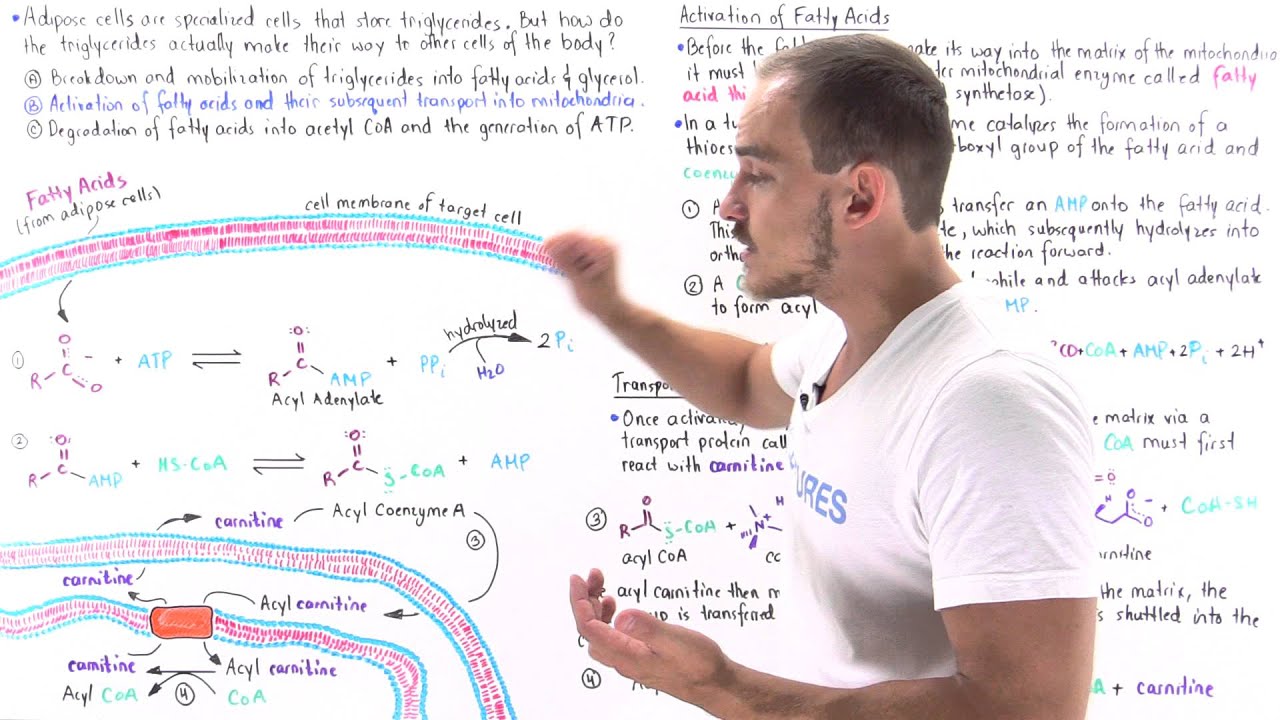
- Explanation of fatty acid activation by fatty acyl-CoA synthetase on the outer mitochondrial membrane.
- Step one of activation: ATP transfers AMP to fatty acid, forming acyl-adenylate and releasing pyrophosphate.
- Role of pyrophosphatase in hydrolyzing pyrophosphate to drive the reaction forward.
- Step two: coenzyme A attacks acyl-adenylate, forming acyl-CoA and releasing AMP.
- Net reaction of activation and the need for transport into mitochondria.
- Conversion of acyl-CoA to acyl-carnitine by carnitine acyltransferase I.
- Transport of acyl-carnitine across the inner membrane by translocase.
- Regeneration of acyl-CoA in the matrix by carnitine acyltransferase II and recycling of carnitine.
- Summary of the entire process and its importance for ATP generation.
Cited Sources
- AK Lectures - Activation of Fatty Acids — The video's dedicated lecture page on the creator's website.
- AK Lectures — Main website of the educational platform.
Concurring Sources
- Biochemistry Textbook (e.g., Lehninger) — Standard biochemistry textbooks describe the same pathway.
External References
Contribution & Novelties
The video provides a clear and concise tutorial on fatty acid activation and transport, which is a fundamental topic in biochemistry. Its originality lies in its step-by-step visual explanation, making it accessible for students. For deeper exploration, consider the following:
Pour aller plus loin :
- Carnitine shuttle - Wikipedia — Overview of the carnitine shuttle system.
- Fatty acid metabolism - Wikipedia — Comprehensive overview of fatty acid breakdown.
- Acyl-CoA synthetase - Wikipedia — Details on the enzyme family.
- Mitochondrial transport proteins - Wikipedia — General information on mitochondrial transporters.
89 words
Radar Profile
The radar profile shows high scores in information quantity, quality, and reliability, with a slightly lower technical level, indicating a well-balanced educational resource that is accurate and informative but not overly advanced.