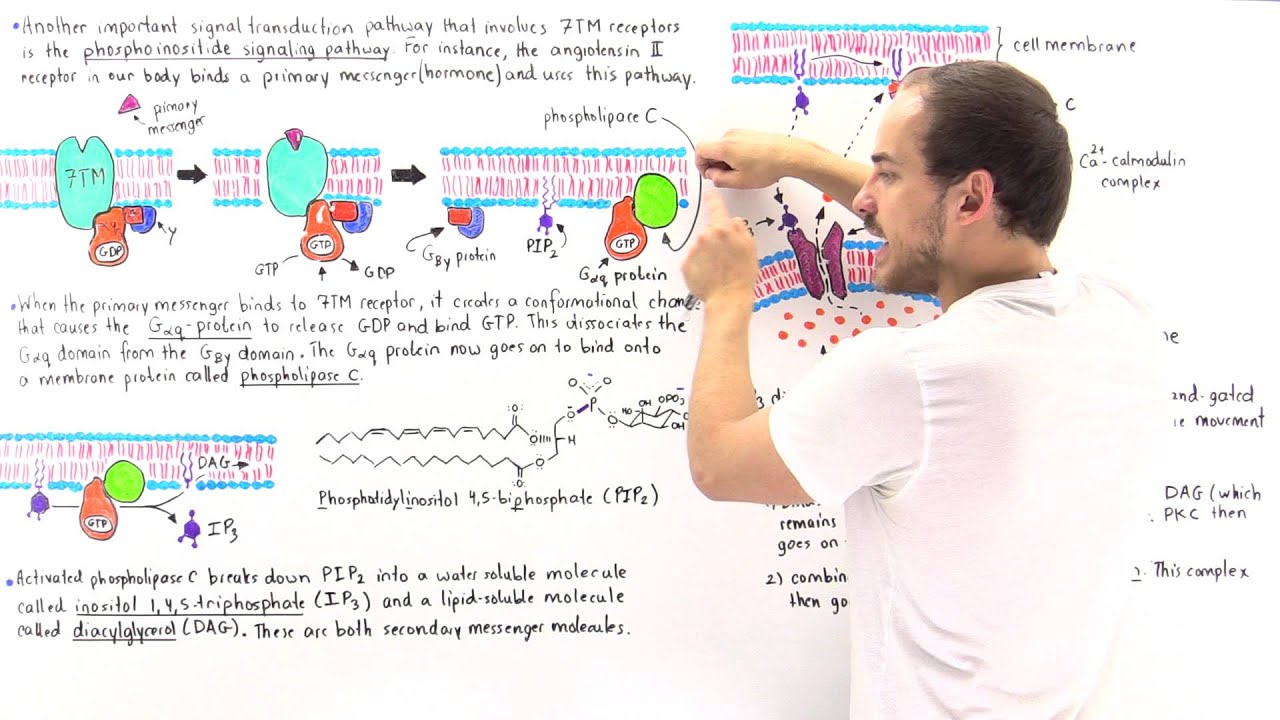
Phosphoinositide Signal Pathway
Keywords
Summary
141 words
Critical Evaluation
Value of the Information & Strength of the Argument
The video provides a comprehensive and accurate walkthrough of the phosphoinositide pathway, highlighting the key molecular players and their interactions. The argumentation is logical and sequential, building from receptor activation to downstream effects. It effectively uses diagrams and analogies to clarify complex concepts, making the information accessible without oversimplifying. The inclusion of a specific example (angiotensin II receptor) helps contextualize the pathway’s physiological relevance. However, the video does not discuss regulatory mechanisms or pathological implications, which would enhance its depth.
Scientific Rigor, Source Quality, Title Accuracy
The scientific content is accurate and aligns with standard biochemistry textbooks. The video does not cite specific sources, but the information is well-established. The title accurately reflects the content. The description provides links to the creator’s website and lecture page, which may offer additional resources. No comments were provided for analysis.
146 words
Title / Content Match
The title accurately reflects the content, which focuses exclusively on the phosphoinositide signal pathway.
Quality & Reliability
8/10
The video provides a clear and accurate explanation of the phosphoinositide signal transduction pathway, consistent with established biochemical knowledge. The content is well-structured and pedagogically sound, though it lacks citations to primary literature and does not address recent advances or nuances.
Key Moments
Markers derived by PSI from the transcript: the creator did not define chapters.
- Introduction to the phosphoinositide signal pathway and its relation to GPCRs.
- Example of angiotensin II receptor using this pathway.
- Structure of the G protein and GDP/GTP exchange.
- Activation of phospholipase C and cleavage of PIP2.
- Formation of IP3 and DAG as second messengers.
- IP3-induced calcium release from the ER.
- Calcium binding to calmodulin and protein kinase C.
- Role of calcium ATPase in maintaining gradient and summary.
Cited Sources
- AK Lectures - Phosphoinositide Signal Pathway — Lecture page for this video, likely containing additional notes.
- AK Lectures — General website of the creator, offering educational content.
- Donate page — Support page for the channel.
Concurring Sources
- Biochemistry (Stryer et al.) — Standard biochemistry textbook covering signal transduction pathways.
Contribution & Novelties
The video offers a clear and systematic explanation of the phosphoinositide signal pathway, making it a valuable educational resource for students. It effectively breaks down the cascade into manageable steps and uses visual aids to enhance understanding. While it does not present novel research, it consolidates existing knowledge in an accessible format.
Pour aller plus loin :
- G protein-coupled receptor — Overview of GPCRs, the receptor family involved.
- Phospholipase C — Enzyme that cleaves PIP2, central to this pathway.
- Inositol trisphosphate receptor — The calcium channel activated by IP3.
89 words
Radar Profile
The radar profile shows high scores in quality and reliability, with moderate scores in quantity and technical level. This indicates a well-explained, accurate tutorial that may not delve into advanced details but is solid for introductory understanding.