Ion Specificy and Structure of Ion Channels
Keywords
Summary
125 words
Critical Evaluation
Value of the Information & Strength of the Argument
The video provides a clear and logical explanation of ion channel selectivity, using the potassium channel as a model. It effectively argues that ion specificity arises from the energetic balance between dehydration and interactions with the selectivity filter. The argument is well-structured, starting with the channel structure and then explaining the selectivity mechanism. However, it does not discuss alternative hypotheses or experimental evidence, such as the role of conformational changes or the precise coordination number. The presentation is accessible but lacks depth for advanced audiences.
Scientific Rigor, Source Quality, Title Accuracy
The video is scientifically accurate but does not cite specific sources. The title matches the content well. The description provides links to the lecturer’s website and the specific lecture page, but no external references. The content aligns with established knowledge in biochemistry, but the lack of citations reduces its scientific rigor. The video does not address potential controversies or alternative models in the field.
164 words
Title / Content Match
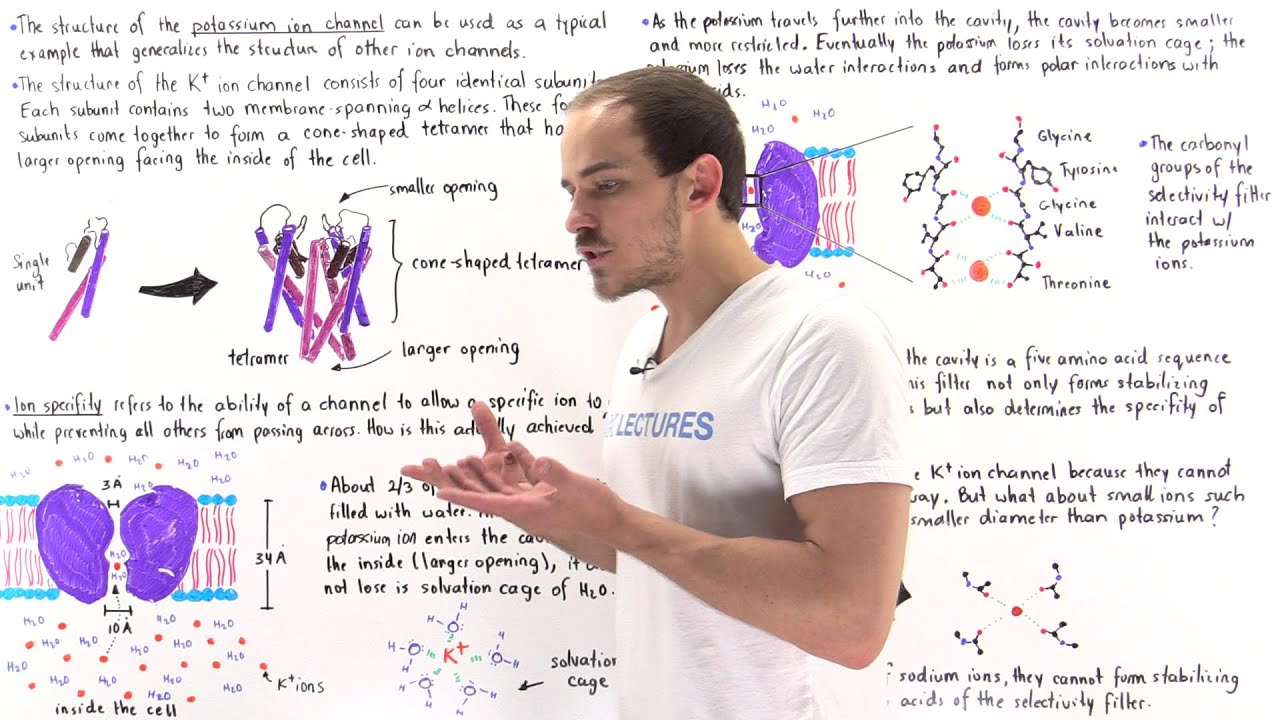
The title accurately reflects the content, which focuses on ion specificity and the structural basis of potassium ion channels.
Quality & Reliability
7/10
The video provides a clear and accurate explanation of the structure and ion selectivity of potassium ion channels, based on established biochemical knowledge. It correctly describes the tetrameric structure, the selectivity filter, and the role of hydration shells. However, it lacks citations to primary literature and does not discuss experimental evidence or alternative models.
Key Moments
Markers derived by PSI from the transcript: the creator did not define chapters.
- Introduction to potassium ion channels and their function.
- Description of the tetrameric structure with four identical subunits.
- Explanation of the cone shape and the internal cavity.
- Introduction to ion specificity and the role of the hydration shell.
- Detailed explanation of the selectivity filter and its amino acid sequence.
- Comparison of potassium and sodium ion radii and their interactions with the filter.
- Energetic explanation of why sodium cannot pass through the potassium channel.
- Conclusion summarizing the mechanism of ion selectivity.
Cited Sources
- AK Lectures - Ion Specificity and Structure of Ion Channels — Lecture page for this video, containing additional resources.
- AK Lectures - Home — Main website of the lecturer, offering a collection of educational videos.
- AK Lectures - Donate — Donation page, not a scientific source.
Concurring Sources
- Potassium channel — General information on potassium channels, consistent with the video's content.
- Selectivity filter — Detailed description of the selectivity filter, supporting the video's explanation.
Contribution & Novelties
The video provides a clear and accessible explanation of the structural basis of ion selectivity in potassium channels, emphasizing the energetic trade-off between dehydration and interactions with the selectivity filter. It effectively illustrates the concept with diagrams and analogies, making it useful for educational purposes.
Pour aller plus loin :
- Potassium channel — Overview of potassium channels, including structure and function.
- Selectivity filter — Detailed description of the selectivity filter and its role.
- Hydration shell — Explanation of solvation shells and their importance in ion transport.
86 words
Radar Profile
The radar profile shows high scores in quality of information and reliability, with moderate scores in quantity and technical level. This indicates a well-explained but not overly technical presentation, suitable for educational purposes.