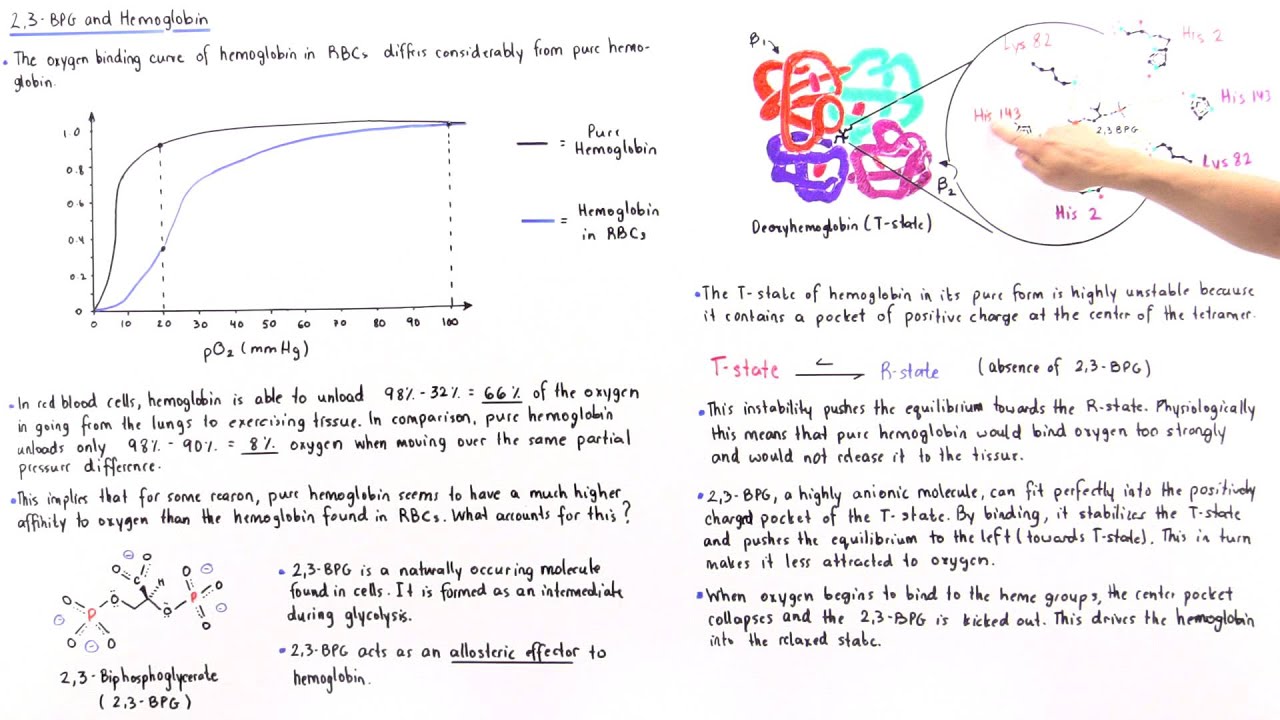
Effect of 2,3-BPG on Hemoglobin
Keywords
Summary
180 words
Critical Evaluation
Value of the Information & Strength of the Argument
The video provides a clear and accurate explanation of the molecular mechanism underlying the effect of 2,3-BPG on hemoglobin. It uses a quantitative comparison of oxygen unloading to illustrate the physiological significance, which strengthens the argument. The explanation of the allosteric regulation is well-structured, starting with the observation of the curve shift and then delving into the structural basis. The presenter effectively uses diagrams to visualize the binding pocket and the electrostatic interactions. The argument is logically coherent and aligns with established biochemical knowledge.
Scientific Rigor, Source Quality, Title Accuracy
The scientific content is accurate and consistent with standard biochemistry textbooks. However, the video does not cite specific scientific sources, relying instead on general knowledge. The title accurately reflects the content, and the video is well-organized. The description provides links to the presenter’s website, which may contain additional resources, but no direct references to primary literature are given. Overall, the rigor is adequate for an educational tutorial, but the lack of explicit sources limits its scientific depth.
176 words
Title / Content Match
The title accurately reflects the content, which focuses on the effect of 2,3-BPG on hemoglobin's oxygen affinity.
Quality & Reliability
8/10
The video provides a clear, accurate explanation of the effect of 2,3-BPG on hemoglobin, based on established biochemical principles. The presenter uses a diagram to illustrate the oxygen binding curves and explains the molecular mechanism in detail. The content aligns with textbook knowledge, though no specific scientific sources are cited.
Key Moments
Markers derived by PSI from the transcript: the creator did not define chapters.
- Introduction to the difference between oxygen binding curves of pure hemoglobin and hemoglobin in red blood cells.
- Graph showing the rightward shift of the curve for hemoglobin in red blood cells.
- Calculation of oxygen unloading in lungs and tissues for both types of hemoglobin.
- Introduction of 2,3-BPG as the molecule responsible for the rightward shift.
- Explanation of the T-state instability and the role of positive charges in the central pocket.
- Binding of 2,3-BPG to the pocket and stabilization of the T-state.
- Conformational change upon oxygen binding and expulsion of 2,3-BPG.
- Summary of the cycle and physiological significance.
Cited Sources
- AK Lectures - Effect of 2,3-BPG on Hemoglobin — Video lecture page on the presenter's website.
- AK Lectures — General website of the presenter.
Concurring Sources
- Biochemistry (Stryer et al.) — Standard biochemistry textbook that covers the effect of 2,3-BPG on hemoglobin.
External References
Contribution & Novelties
The video provides a clear and accessible explanation of the effect of 2,3-BPG on hemoglobin, emphasizing the molecular mechanism and its physiological importance. It effectively uses quantitative examples to illustrate the difference in oxygen unloading. The explanation of the T-state stabilization and the role of electrostatic interactions is particularly well done.
Pour aller plus loin :
- Hemoglobin - Wikipedia — Overview of hemoglobin structure and function.
- 2,3-Bisphosphoglyceric acid - Wikipedia — Details on 2,3-BPG and its role.
- Allosteric regulation - Wikipedia — General concept of allosteric regulation.
87 words
Radar Profile
The radar profile shows high scores in information quantity, quality, and technical level, indicating a well-structured and informative tutorial. The reliability score is also high, reflecting the accuracy of the content. The overall profile suggests a solid educational resource.
💬 Sur les 0 commentaires analysés, aucune tendance n'est disponible.