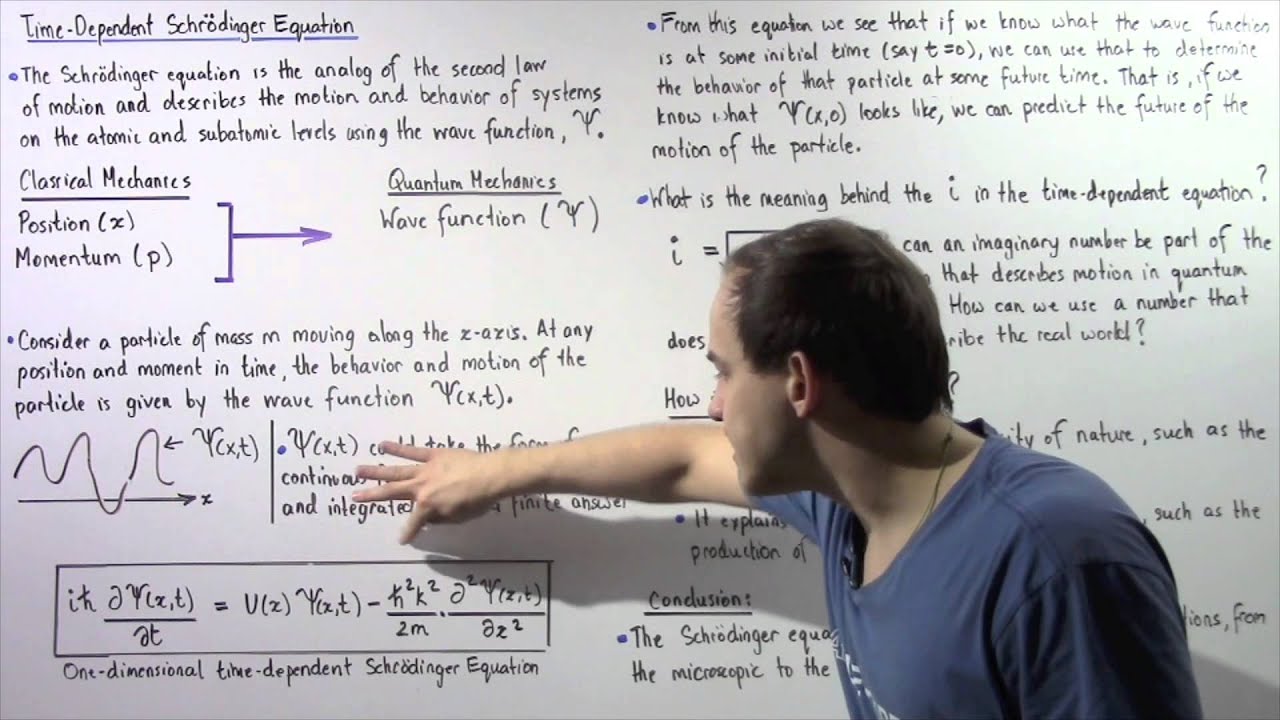
Wave Function and Schrodinger's Equation
Keywords
Summary
162 words
Critical Evaluation
Value of the Information & Strength of the Argument
The video provides a clear and accessible explanation of the wave function and the time-dependent Schrödinger equation, making it valuable for beginners. It effectively uses analogies to classical mechanics to build understanding. The argumentation is logical and coherent, but it does not delve into mathematical derivations or provide rigorous justifications. The explanation of the imaginary unit i is somewhat superficial, and the video does not address potential criticisms or alternative interpretations. Overall, the content is informative but lacks depth for advanced learners.
Scientific Rigor, Source Quality, Title Accuracy
The video does not cite specific scientific sources, but it is based on well-established quantum mechanics principles. The title accurately reflects the content. The description provides links to the creator’s website and lecture page, which may contain additional resources. The video’s scientific rigor is moderate: it correctly states key concepts but omits detailed derivations and references. The lack of citations reduces its credibility for academic purposes, but it is suitable for introductory education.
170 words
Title / Content Match
The title accurately reflects the content, which focuses on explaining the wave function and the Schrödinger equation.
Quality & Reliability
7/10
The video provides a clear and accurate introduction to the wave function and the time-dependent Schrödinger equation, grounded in established quantum mechanics. It correctly explains the role of the wave function, the uncertainty principle, and the equation's components. However, it lacks depth in derivations and does not cite specific sources, limiting its scientific rigor.
Key Moments
Markers derived by PSI from the transcript: the creator did not define chapters.
- Introduction to the Schrödinger equation as the quantum analog of Newton's second law.
- Explanation of the wave function and its role in quantum mechanics.
- Discussion of the uncertainty principle and why position and momentum cannot be used.
- Introduction to the time-dependent Schrödinger equation and its components.
- Explanation of the imaginary unit i and its significance.
- Discussion of how the equation is used to predict future behavior.
- Conclusion and preview of the time-independent Schrödinger equation.
Cited Sources
- AK Lectures Website — General website for the lecture series.
- Donation Page — Support page for the creator.
- Lecture Page: Time-Dependent Schrödinger Equation — Specific lecture page for this video.
Concurring Sources
- Schrödinger equation - Wikipedia — Confirms the form and interpretation of the time-dependent Schrödinger equation.
- Wave function - Wikipedia — Supports the description of the wave function as a fundamental quantity in quantum mechanics.
Contribution & Novelties
The video offers a clear pedagogical introduction to the wave function and the time-dependent Schrödinger equation, using analogies to classical mechanics to make the concepts accessible. It does not present new scientific findings but serves as an educational resource.
Pour aller plus loin :
- Schrödinger equation - Wikipedia — Comprehensive overview of the equation and its variants.
- Wave function - Wikipedia — Detailed explanation of the wave function and its interpretation.
- Uncertainty principle - Wikipedia — Background on Heisenberg’s uncertainty principle.
81 words
Radar Profile
The radar profile shows moderate scores across all dimensions, indicating a balanced but not exceptional educational video. The highest score is in fiabilite_globale, reflecting the accuracy of the content, while quantite_information is lower due to the introductory nature and lack of depth.