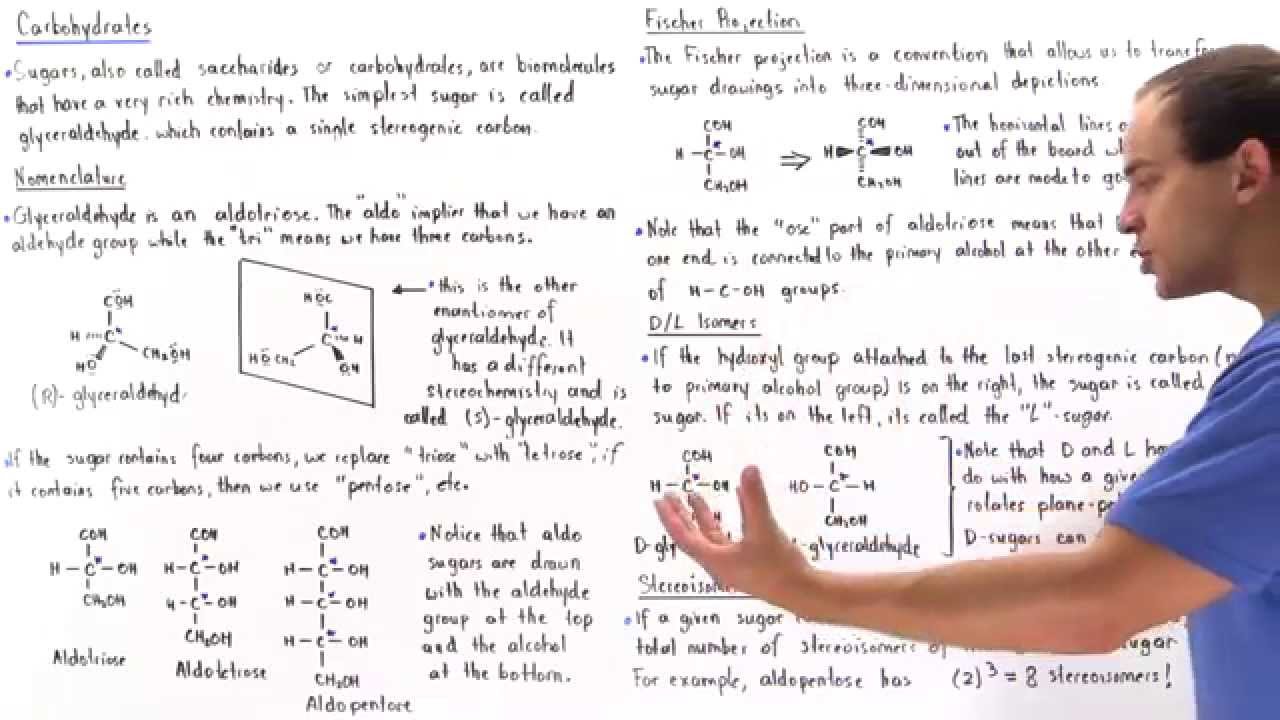
Nomenclature and Stereochemistry of Carbohydrates
Keywords
Summary
151 words
Critical Evaluation
Value of the Information & Strength of the Argument
The video provides a solid foundational explanation of carbohydrate nomenclature and stereochemistry. It clearly defines key terms such as stereogenic carbon, aldose, ketose, and Fischer projection, and uses glyceraldehyde as a concrete example. The argumentation is logical and step-by-step, building from simple to more complex sugars. The explanation of the 2^n rule for stereoisomers is straightforward and correctly applied. However, the video does not delve into exceptions or nuances, such as the existence of meso compounds or the limitations of Fischer projections for complex sugars. The presentation is accurate but lacks critical discussion of the material.
Scientific Rigor, Source Quality, Title Accuracy
The video is scientifically accurate and well-structured, but it does not cite any external sources or references. The content is based on standard organic chemistry knowledge, and the explanations are consistent with textbook treatments. The title accurately reflects the content, which focuses on nomenclature and stereochemistry. The video is a tutorial, so it does not present original research or a review of literature. The lack of citations reduces its rigor, but the information is reliable for an introductory level. The description provides links to the creator’s website and donation page, but no specific references to scientific literature.
208 words
Title / Content Match
The title accurately reflects the content, which focuses on naming conventions and stereochemical aspects of carbohydrates.
Quality & Reliability
7/10
The video provides a clear and accurate introduction to carbohydrate nomenclature and stereochemistry, with correct use of Fischer projections and the 2^n rule for stereoisomers. However, it lacks citations to primary literature and does not address potential exceptions or advanced topics.
Key Moments
Markers derived by PSI from the transcript: the creator did not define chapters.
- Introduction to carbohydrates and their role in energy storage.
- Definition of glyceraldehyde and its classification as an aldotriose.
- Explanation of aldose vs. ketose nomenclature based on aldehyde or ketone group.
- Introduction to Fischer projections and how to interpret them.
- Discussion of D and L isomers based on the position of the hydroxyl group on the last stereogenic carbon.
- Clarification that D/L does not indicate optical rotation direction.
- Introduction to the formula 2^n for calculating the number of stereoisomers.
- Examples of calculating stereoisomers for aldotriose, aldotetrose, and aldopentose.
Cited Sources
- AK Lectures Website — General resource for the video content.
- Lecture Page — Direct link to the lecture page.
Concurring Sources
- AK Lectures Website — The website provides additional lectures and resources that align with the video content.
External References
Contribution & Novelties
The video provides a clear and concise introduction to carbohydrate nomenclature and stereochemistry, making it accessible to beginners. It effectively explains the Fischer projection and the 2^n rule for stereoisomers. While it does not present new research, it serves as a useful educational resource.
Pour aller plus loin :
- Fischer projection — Overview of the Fischer projection and its applications.
- Carbohydrate nomenclature — Detailed rules for naming carbohydrates.
- Stereoisomerism — General concept of stereoisomers and types.
76 words
Radar Profile
The radar profile shows a balanced performance with high scores in quality of information and reliability, moderate scores in quantity and technical level. This indicates a solid educational video that is accurate but not highly detailed or advanced.