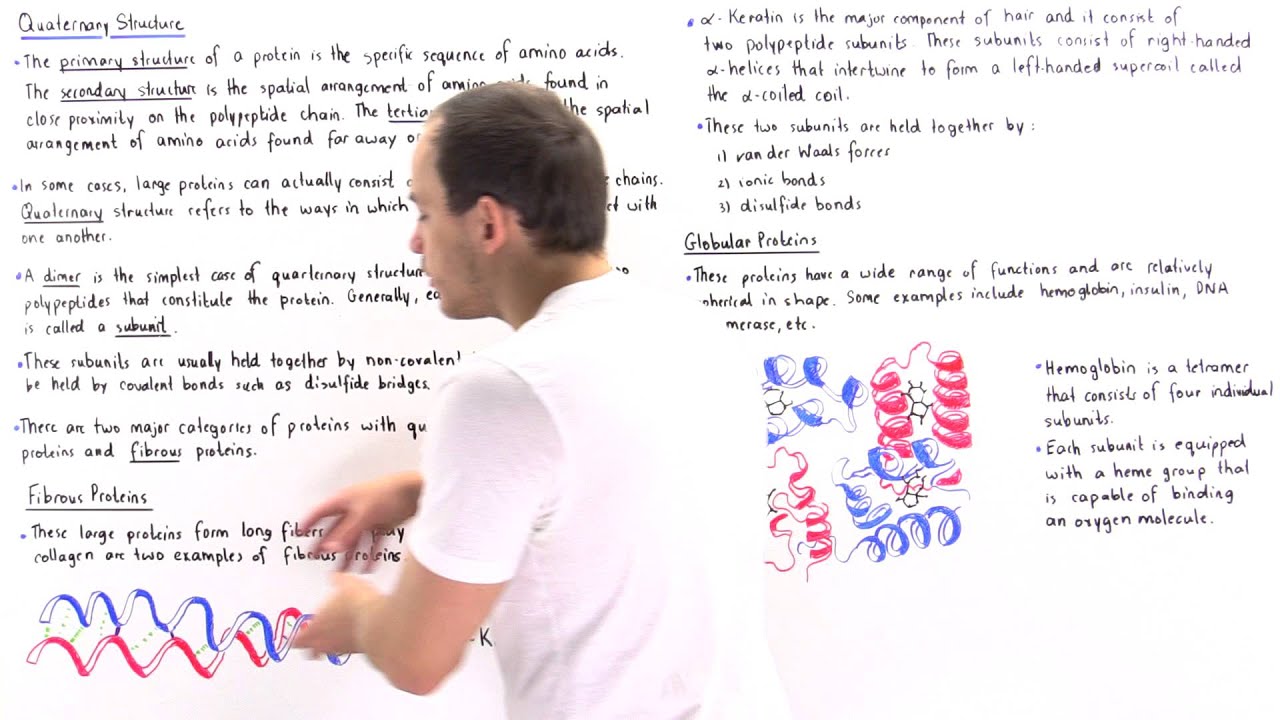
Quaternary Structure of Proteins
Keywords
Summary
179 words
Critical Evaluation
Value of the Information & Strength of the Argument
The video offers valuable educational content by systematically explaining the concept of quaternary structure, using well-known examples to illustrate key points. The argumentation is logical and builds on previous knowledge, making it accessible for learners. It correctly emphasizes the types of interactions (covalent and non-covalent) that stabilize subunits and highlights the functional significance of quaternary structure in proteins like hemoglobin. However, it does not delve into advanced topics such as cooperative binding or allosteric regulation, which are important for a deeper understanding. The presentation is clear and well-structured, but lacks critical evaluation of the evidence or alternative viewpoints.
Scientific Rigor, Source Quality, Title Accuracy
The scientific rigor is adequate for an introductory lecture: the information is accurate and aligns with standard biochemistry textbooks. However, no specific sources are cited within the video, and the description only provides links to the creator’s website and donation page, not to primary literature. The title accurately reflects the content, and the video stays on topic. The lack of citations reduces its value as a research reference, but it is reliable for basic educational purposes.
189 words
Title / Content Match
The title accurately reflects the content, which focuses exclusively on the quaternary structure of proteins.
Quality & Reliability
7/10
The video provides a clear and accurate overview of protein quaternary structure, using standard examples like alpha-keratin and hemoglobin. It correctly distinguishes between fibrous and globular proteins and explains the types of bonds involved. However, it lacks citations to primary literature and simplifies some aspects (e.g., cooperative binding in hemoglobin is only hinted at).
Key Moments
Markers derived by PSI from the transcript: the creator did not define chapters.
- Introduction to protein structure levels and recap of primary, secondary, tertiary.
- Definition of quaternary structure and subunits; examples of dimers, trimers, tetramers.
- Introduction to fibrous and globular proteins; examples of fibrous proteins.
- Detailed explanation of alpha-keratin structure and interactions holding subunits together.
- Introduction to globular proteins and examples; focus on hemoglobin.
- Hemoglobin structure: tetramer with heme groups and oxygen binding.
- Comparison with myoglobin and summary of four levels of protein structure.
Cited Sources
- AK Lectures - Quaternary Structure of Proteins — Video lecture page with additional resources.
- AK Lectures Website — General website for the lecture series.
Concurring Sources
- Protein Structure - NCBI Bookshelf — Authoritative source on protein structure, confirming the levels of organization.
External References
Contribution & Novelties
The video provides a clear and concise introduction to quaternary protein structure, using classic examples to illustrate key concepts. Its originality lies in its pedagogical approach, breaking down complex ideas into digestible segments. However, it does not present novel research or unique insights beyond standard textbook material.
Pour aller plus loin :
- Protein quaternary structure - Wikipedia — Provides a comprehensive overview, including examples and significance.
- Hemoglobin - Wikipedia — Detailed information on hemoglobin structure and function, including cooperative binding.
- Alpha-keratin - Wikipedia — Explains the structure and role of alpha-keratin in detail.
93 words
Radar Profile
The radar profile shows balanced scores across information quantity, quality, technical level, and reliability, with a slight emphasis on quality and reliability. This indicates a well-rounded educational video that is accurate and informative, though not highly technical or exhaustive.