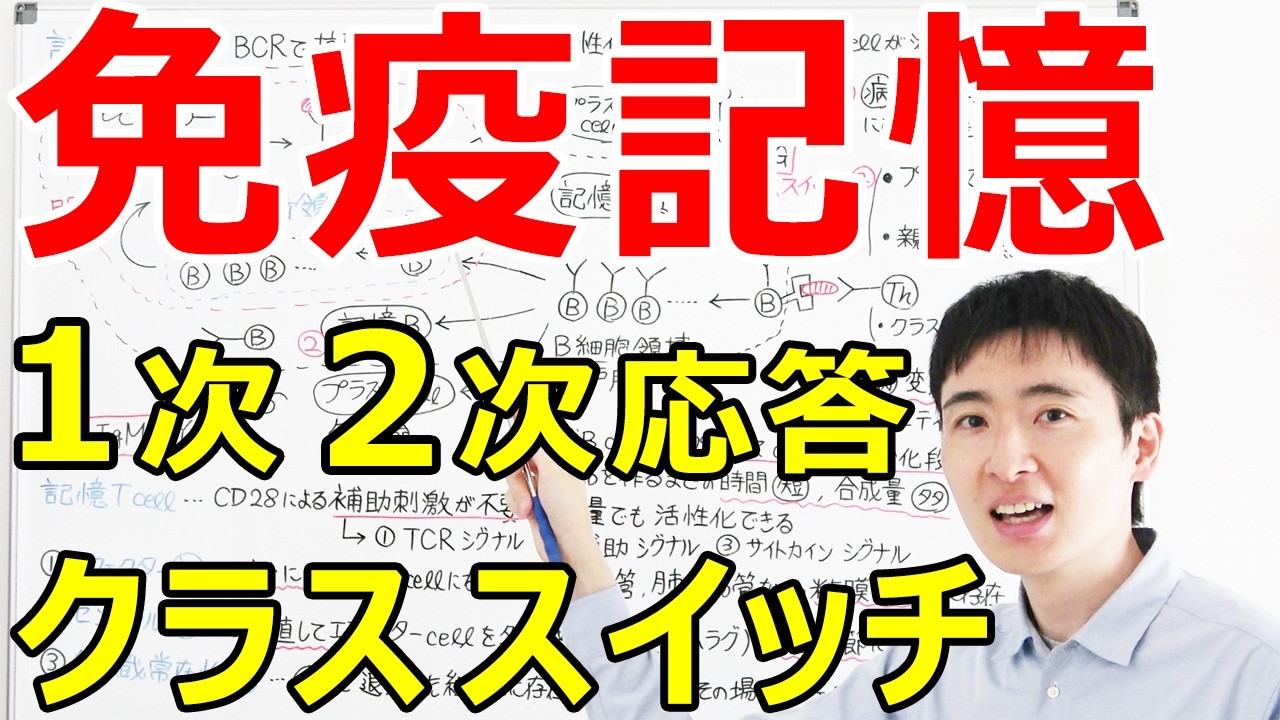
【大学・薬学部の免疫学】免疫記憶での記憶細胞の役割と抗体のクラススイッチ(IgM→IgG)【過去の出会いは忘れない】
Keywords
Summary
155 words
Critical Evaluation
Value of the Information & Strength of the Argument
The video provides substantial educational value, clearly explaining complex immunological concepts with logical progression. The argumentation is solid, using diagrams and analogies to reinforce understanding. The explanation of why secondary responses are faster and stronger is well-argued, linking memory cell presence and class switching to the observed kinetics. The discussion of vaccine types and their immune induction is accurate and practical. The video also addresses nuanced points, such as the reason for preserving lower-affinity memory B cells, which demonstrates depth of understanding.
Scientific Rigor, Source Quality, Title Accuracy
The scientific rigor is high; the content aligns with established immunology textbooks. The creator’s credentials (PhD in pharmacy) lend credibility. However, no direct citations to primary literature are provided; the video relies on the creator’s expertise and references to other videos in the series. The title accurately reflects the content, and the video is well-structured. No comments were provided for analysis.
158 words
Title / Content Match
The title accurately reflects the content, focusing on the role of memory cells and class switching in immune memory.
Quality & Reliability
8/10
The video provides a detailed and accurate explanation of immunological memory, memory cells, and class switching, consistent with established immunology. The creator, a pharmacist with a PhD, demonstrates expertise. The content is well-structured and pedagogically sound, though it lacks direct citations to primary literature.
Key Moments
Markers derived by PSI from the transcript: the creator did not define chapters.
- Introduction to immune memory and the primary vs secondary response graph
- Explanation of why IgG takes longer than IgM in primary response due to affinity maturation
- Generation of memory cells from effector cells and their role in faster secondary response
- Vaccine types: live, inactivated, toxoid, and their immune induction
- Discussion on memory cell lifespan differences (influenza vs measles)
- Memory B cell differentiation pathways and affinity maturation in germinal centers
- Memory T cell types: effector, central, tissue-resident, and their locations
- Signals required for T cell activation and why memory T cells need fewer signals
Cited Sources
- B細胞による獲得免疫の流れとリンパ節での親和性成熟 — Referenced for detailed flow of B cell activation and affinity maturation.
- ヘルパーT細胞による獲得免疫の流れとMHCクラスⅡを使った抗原提示 — Referenced for helper T cell activation and antigen presentation.
- 免疫制御のアクセルとブレーキ(制御性T細胞Treg、クローン除去、アナジーとは?) — Referenced for regulatory T cells and immune tolerance.
- 抗体とTCRの多様性獲得機構と遺伝子再構成 — Referenced for diversity generation and selection.
- MHCの構造と拒絶反応の成立、抗原提示までの抗原ペプチドのプロセッシング — Referenced for MHC structure and antigen processing.
- キラーT細胞によるMHCクラスⅠを使った細胞性免疫とNK細胞の活性化 — Referenced for cytotoxic T cell response.
- 補体の役割と活性化経路 — Referenced for complement system.
- 抗体と細胞外の病原体への体液性免疫の流れ — Referenced for humoral immunity.
- 自然免疫の流れと食細胞による病原体認識 — Referenced for innate immunity.
- 自然免疫、獲得免疫に入る前に免疫細胞・組織の役割と分類を知る — Referenced for immune cells and tissues.
Concurring Sources
- Immunological memory — General concept of immune memory.
- Memory B cell — Role of memory B cells.
- Class switch recombination — Mechanism of class switching.
External References
Contribution & Novelties
The video provides a comprehensive and pedagogically effective explanation of immune memory, integrating concepts of memory B and T cells, class switching, and vaccine mechanisms. It clarifies the rationale behind the kinetics of primary and secondary responses and the strategic preservation of lower-affinity memory B cells. The video also distinguishes between memory T cell subsets and their locations, offering a nuanced understanding.
Pour aller plus loin :
- Immunological memory — Overview of immune memory.
- Germinal center — Site of affinity maturation and class switching.
- Memory T cell — Subtypes and functions.
- Vaccine — Types and mechanisms.
96 words
Radar Profile
The radar profile shows high scores in information quantity, quality, and reliability, with a slightly lower technical level, indicating a well-balanced educational video that is both informative and accessible.