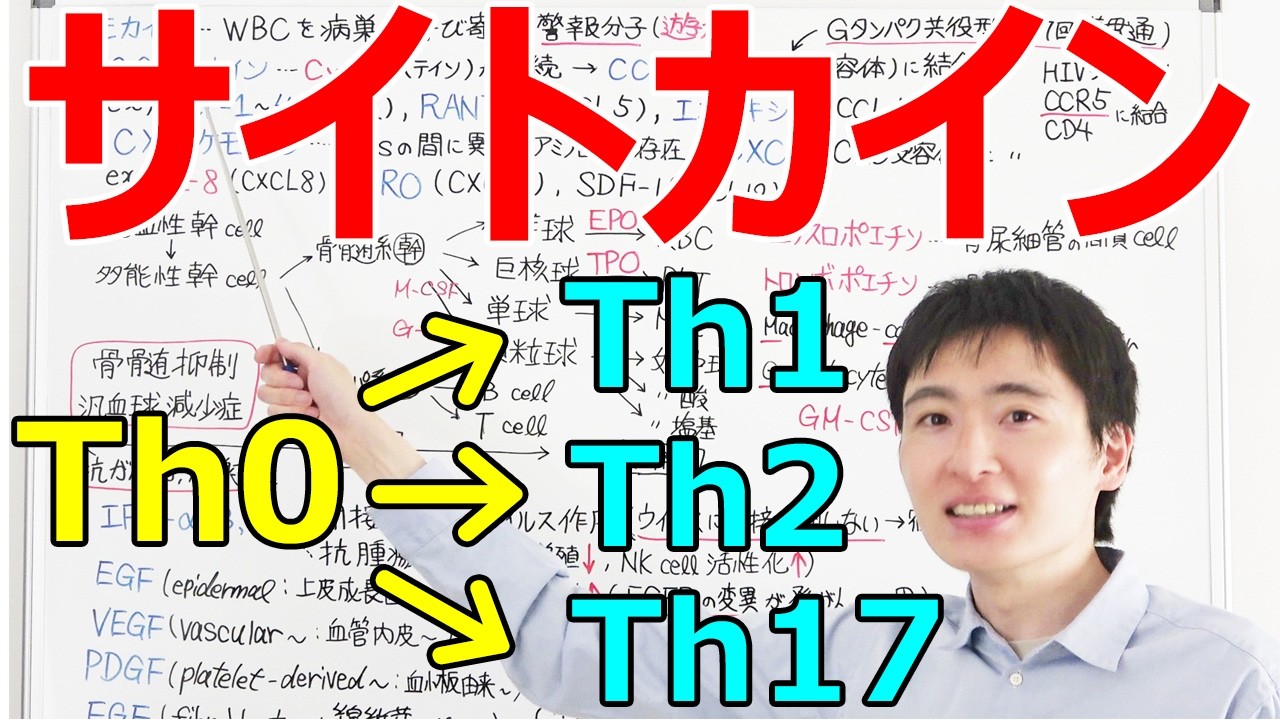
【大学・薬学部の免疫学】ナイーブT細胞(Th0)からエフェクターT細胞(Th1/Th2/Th17/Tfh/Treg)へのサイトカインシグナルとその分類【ケモカインは警報分子】
Keywords
Summary
215 words
Critical Evaluation
Value of the Information & Strength of the Argument
The video provides a high value of information by systematically organizing the complex topic of cytokines and T cell differentiation. It uses clear analogies and visual aids to explain concepts, making it accessible for pharmacy and medical students. The argumentation is solid, as it builds from basic principles (e.g., three signals for T cell activation) to specific cytokine functions, and connects them to clinical applications (e.g., NSAIDs for fever, cancer therapy side effects). The presenter’s explanations are logically structured and consistent with established immunology.
Scientific Rigor, Source Quality, Title Accuracy
The scientific rigor is good for an educational video: the content is accurate and up-to-date, but it lacks explicit citations to primary literature. The creator’s credentials (PhD) lend credibility. The title accurately reflects the content, focusing on cytokine signaling and classification. The video is part of a series on immunology, and the description provides links to related videos, which serve as additional resources. No external sources are cited within the video itself.
171 words
Title / Content Match
The title accurately reflects the content, focusing on cytokine signaling in naive T cell differentiation and classification, including chemokines as alarm molecules.
Quality & Reliability
8/10
The video provides a detailed and structured explanation of cytokines, their classification, and signaling pathways in T cell differentiation. The content is accurate and aligns with established immunology knowledge, though it is presented in a simplified manner for educational purposes. The creator has a PhD and appears knowledgeable, but the video lacks citations to primary literature.
Key Moments
Markers derived by PSI from the transcript: the creator did not define chapters.
- Introduction to cytokines and their receptors, including the exception of chemokines using G-protein coupled receptors.
- Explanation of the three types of cytokine secretion: paracrine, autocrine, and endocrine, with examples.
- Overview of pro-inflammatory cytokines (IL-1, TNF-α, IL-6) and their roles in fever and inflammation.
- Description of the three signals required for T cell activation: MHC-peptide-TCR, co-stimulation, and cytokine signaling.
- Differentiation of Th1 cells via IL-12, and their secretion of IL-2 and IFN-γ for cellular immunity.
- Differentiation of Th2 cells via IL-4, and their secretion of IL-4, IL-5, and IL-13 for humoral immunity and allergic responses.
- Differentiation of Th17 cells via TGF-β, and their role in mucosal immunity and neutrophil recruitment.
- Differentiation of Tfh cells via IL-21, and their help to B cells for class switching to IgG.
- Differentiation of Treg cells and their secretion of IL-10 and TGF-β as anti-inflammatory cytokines.
- Introduction to chemokines, their classification into CC and CXC types, and their role as alarm molecules.
Cited Sources
- Related video: Regulatory T cells and immune tolerance — Mentioned in the description as a related video on Treg cells and immune tolerance.
- Related video: Humoral immunity and antibodies — Mentioned in the description as a related video on humoral immunity.
- Related video: Mucosal immunity and IgA — Mentioned in the description as a related video on mucosal immunity and IgA.
- Related video: MHC structure and antigen presentation — Mentioned in the description as a related video on MHC and antigen presentation.
- Related video: Complement system — Mentioned in the description as a related video on complement.
- Related video: Innate immunity and phagocytes — Mentioned in the description as a related video on innate immunity.
- Related video: Cytotoxic T cells and NK cells — Mentioned in the description as a related video on cytotoxic T cells and NK cells.
- Related video: B cell activation and affinity maturation — Mentioned in the description as a related video on B cell activation.
- Related video: T cell receptor diversity and gene rearrangement — Mentioned in the description as a related video on TCR diversity.
- Related video: Immune cells and tissues — Mentioned in the description as a related video on immune cells and tissues.
- Related video: Helper T cells and MHC class II — Mentioned in the description as a related video on helper T cells.
- Related video: Memory cells and class switching — Mentioned in the description as a related video on memory cells and class switching.
Concurring Sources
- Janeway's Immunobiology — Standard immunology textbook that covers cytokine signaling and T cell differentiation in detail.
- Kuby Immunology — Another standard textbook providing comprehensive information on cytokines and immune responses.
External References
Contribution & Novelties
The video provides a clear and structured educational overview of cytokines and T cell differentiation, which is valuable for students. It synthesizes complex information into an accessible format, using analogies and clinical correlations. The main novelty is the pedagogical approach, not new scientific findings.
Pour aller plus loin :
- T helper cell — Overview of T helper cell subsets and their functions.
- Cytokine — General information on cytokines and their classification.
- Chemokine — Detailed explanation of chemokines and their receptors.
- Interleukin-12 — Specific cytokine driving Th1 differentiation.
- Regulatory T cell — Role of Tregs in immune regulation.
97 words
Radar Profile
The radar profile shows high scores in information quantity and technical level, indicating a dense and detailed educational content. The quality and reliability scores are also high, reflecting accurate and well-structured information. The overall balance suggests a solid educational resource for advanced students.