Rota Verde: App for Monitoring CO2 Footprint in Urban Displacements
Keywords
Summary
115 words
Critical Evaluation
Value of the Information & Strength of the Argument
The presentation provides a clear rationale for the app’s development, linking it to environmental concerns and the need for awareness. The methodology is straightforward: multiplying distance by emission factors. The argumentation is coherent, but the presentation lacks critical analysis of the accuracy of the emission estimates and the app’s effectiveness in changing behavior. The value lies in its educational context and potential for future development, but it does not offer novel scientific insights.
Scientific Rigor, Source Quality, Title Accuracy
The project uses official INMETRO data, which is a reliable source for vehicle emissions in Brazil. The presentation mentions references but does not provide specific citations. The title accurately reflects the content. The work is a student project, so the scientific rigor is limited by the scope and lack of peer review. The description includes a link to a FAPESQ article, which adds some credibility.
153 words
Title / Content Match
The title accurately reflects the content, which focuses on the development of an app for monitoring CO2 emissions in urban travel.
Quality & Reliability
6/10
The presentation describes a student project with a clear methodology and use of official data (INMETRO), but lacks peer review and detailed validation. The claims are plausible but not independently verified.
Key Moments
Markers derived by PSI from the transcript: the creator did not define chapters.
- Introduction and context of the project
- Explanation of the methodology for estimating emissions
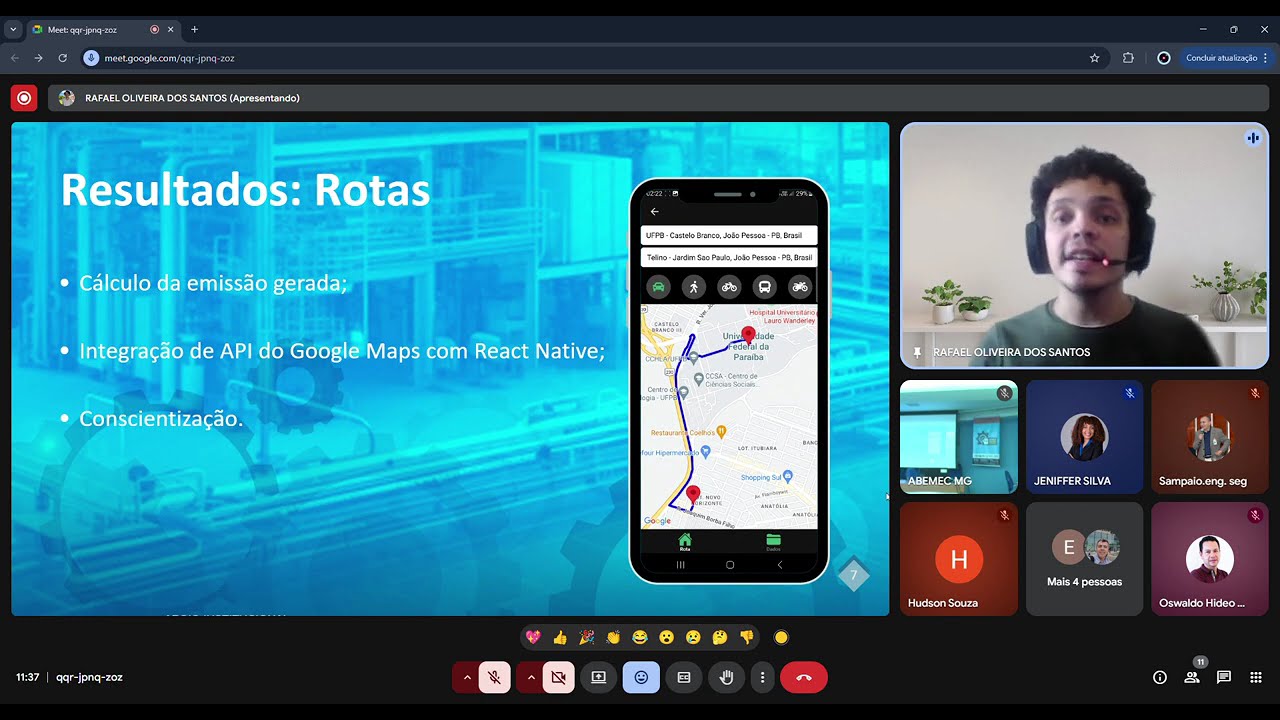
- Demonstration of the app's interface and features
- Discussion of data sources, specifically INMETRO
- Video demonstration of the app in action
- Results and recognition of the project
- Limitations and future expansions
Cited Sources
- Aplicativo de monitoramento da pegada de carbono no deslocamento urbano de estudantes da UFPB — News article from FAPESQ highlighting the project's relevance.
Concurring Sources
- FAPESQ article — Supports the project's existence and recognition.
Contribution & Novelties
The app provides a practical tool for individuals to estimate their carbon footprint from urban travel, using official data. Its novelty lies in its integration of INMETRO data with Google Maps and its educational context. The project demonstrates how engineering students can apply their skills to sustainability challenges.
Pour aller plus loin :
- Carbon footprint — Provides background on the concept.
- Project-Based Learning — Educational approach used in the project.
- INMETRO — Official Brazilian metrology institute, source of emission data.
80 words
Radar Profile
The radar profile shows moderate scores across all dimensions, indicating a balanced but not exceptional presentation. The app's practical application and use of official data are strengths, but the lack of validation and limited novelty keep the overall score moderate.