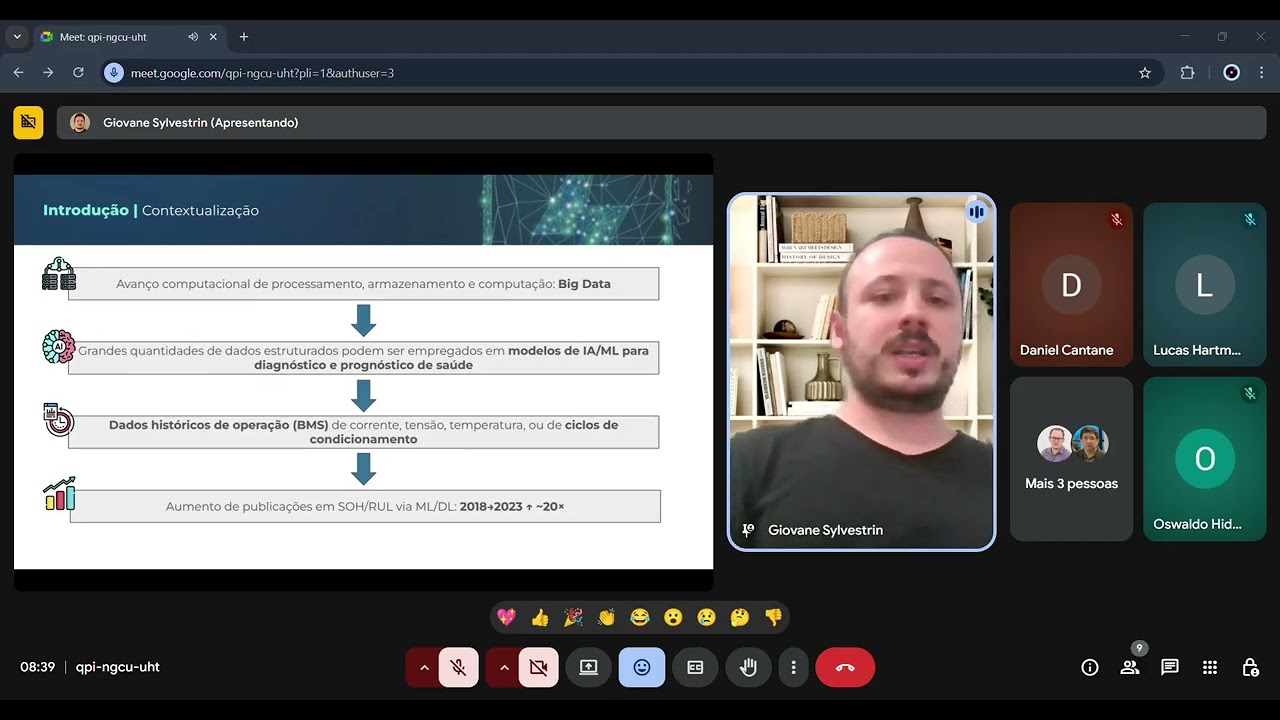
Defesa de Tese: Aprendizado de Máquina Aplicado ao Prognóstico e Estado de Saúde de Células de Armazenamento de Energia
Keywords
Summary
216 words
Critical Evaluation
Value of the Information & Strength of the Argument
The value of the information is high, as the research addresses a relevant problem (battery second-life) and provides a systematic, reproducible methodology. The argumentation is solid, supported by a systematic review, a large-scale feature engineering approach, and rigorous evaluation on a public dataset. The presentation clearly explains the motivation, gaps, methodology, and results, and the conclusions are well-aligned with the evidence presented.
Scientific Rigor, Source Quality, Title Accuracy
The scientific rigor is high, with a systematic review methodology (Proknow-C) and the use of a public dataset (MIT Battery Dataset) for reproducibility. The sources cited are primarily academic papers identified in the review, and the presentation does not rely on unverified claims. The title accurately reflects the content, and the presentation is well-structured and transparent about the methods and limitations.
138 words
Title / Content Match
The title accurately reflects the content, which focuses on machine learning for battery state-of-health prognosis and estimation.
Quality & Reliability
8/10
The thesis defense presents a systematic and reproducible methodology, including a systematic review (Proknow-C), a large-scale feature engineering pipeline, and rigorous evaluation on a public dataset (MIT Battery Dataset). The results are quantified (MAPE <1% for capacity, ~6% for RUL) and compared with literature. The presentation is detailed and transparent about methods and limitations.
Key Moments
Markers derived by PSI from the transcript: the creator did not define chapters.
- Introduction and presentation outline
- Context: growth of electric vehicles and battery demand
- Second-use batteries and challenges in state-of-health estimation
- Research gaps: limited feature scope, lack of scalable pipelines, short history evaluation
- Research objectives and proposed pipeline
- Methodology: systematic review with Proknow-C
- Feature engineering pipeline and selection methods
- Model development: boosting, deep learning, and stacking ensemble
- Results: capacity prediction and RUL estimation
- Conclusions and future work
Cited Sources
- MIT Battery Dataset — Public dataset used for training and evaluation of the models.
Concurring Sources
- MIT Battery Dataset — Public dataset used for training and evaluation of the models.
Contribution & Novelties
The thesis contributes a systematic and reproducible pipeline for battery state-of-health estimation, integrating multiple feature domains and demonstrating that a stacking ensemble of boosting and deep learning can achieve competitive RUL prediction with a short history of cycles. The systematic review using Proknow-C provides a comprehensive overview of the field, and the feature engineering pipeline is a valuable resource for future research.
Pour aller plus loin :
- Proknow-C methodology — The systematic review methodology used in the thesis.
- Remaining Useful Life prediction — Overview of RUL prediction concepts.
- State of Health (SOH) of batteries — Definition and estimation methods.
99 words
Radar Profile
The radar profile shows high scores across all dimensions, indicating a well-rounded and rigorous presentation. The quantitative and qualitative information are balanced, with a strong technical level and high reliability.