CURS 1 Cap 1 FRA 25 26
Keywords
Summary
136 words
Critical Evaluation
Value of the Information & Strength of the Argument
The video provides a comprehensive overview of infectious disease management in veterinary medicine, covering key concepts such as diagnosis, prevention, and treatment. However, the argumentation is weak, as it lacks critical analysis and evidence-based justification. The content is presented as a list of facts without supporting data or references. The lecture does not engage with controversies or alternative viewpoints, and the historical accounts are simplified. The value of the information is limited by the lack of depth and the absence of practical examples or case studies.
Scientific Rigor, Source Quality, Title Accuracy
The scientific rigor is low: the video does not cite any sources, and the transcription contains numerous errors that undermine its reliability. The title is not descriptive and does not match the content. The lecture covers historical facts that are generally accurate but presented without citations. The lack of references and the presence of transcription errors (e.g., ‘TDE’ for ‘One Health’, ’eoses’ for ‘zoonoses’) reduce the credibility of the content. No comments were provided for analysis.
177 words
Title / Content Match
The title 'CURS 1 Cap 1 FRA 25 26' is cryptic and does not reflect the content, which is an introductory lecture on infectious diseases in veterinary medicine.
Quality & Reliability
4/10
The video is a lecture with low production quality, containing numerous transcription errors and inaccuracies (e.g., 'TDE' for 'One Health', 'eoses' for 'zoonoses', 'entraquexe' for 'anthrax'). It lacks citations and references, and the content is presented without critical evaluation. The historical and factual claims are generally accurate but not sourced.
Key Moments
Markers derived by PSI from the transcript: the creator did not define chapters.
- Introduction to the lecture on infectious diseases in veterinary medicine.
- General objectives: knowledge of microbial diseases, control, and prevention.
- Specific objectives: generating suspicions, confirming diagnoses, and prophylaxis.
- Methods for confirming suspicions: laboratory diagnostics, imaging, and molecular techniques.
- Prevention and control methods: vaccination, biosecurity, and treatment.
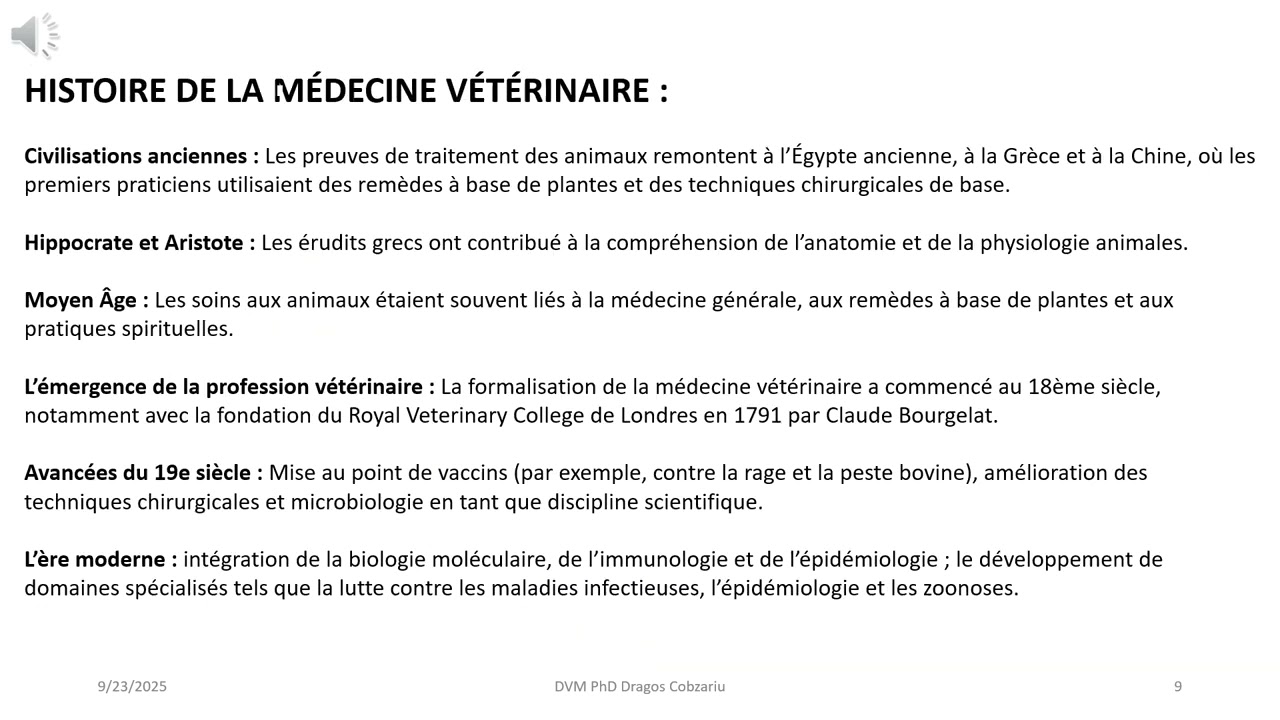
- History of veterinary medicine from ancient civilizations to modern era.
- History of vaccines: from variolation to modern mRNA vaccines.
- History of veterinary medicine in Romania.
- Learning methods for infectious diseases: clinical observation, lab, epidemiology.
- Evaluation methods for students: written exams, practical, case studies.
Contribution & Novelties
The video provides a basic introductory overview of infectious diseases in veterinary medicine, but it does not offer new insights or original research. It is a compilation of standard knowledge. The historical sections are informative but not novel. The lecture could be useful for students as a starting point, but it lacks depth and critical analysis.
Pour aller plus loin :
- One Health — Concept central to the lecture, linking human, animal, and environmental health.
- Vaccination — History and mechanisms of vaccines, relevant to the prevention strategies discussed.
- Polymerase chain reaction — Key diagnostic technique mentioned in the lecture.
- Zoonosis — Diseases transmissible between animals and humans, a focus of the course.
112 words
Radar Profile
The radar profile shows moderate scores in information quantity and technical level, but low scores in quality and reliability, indicating a lecture that covers many topics but lacks depth and scientific rigor.