CURS 3 Cap3 Fièvre aphteuse FRA 25 26
Keywords
Summary
134 words
Critical Evaluation
Value of the Information & Strength of the Argument
The lecture provides a comprehensive and detailed overview of foot-and-mouth disease, covering virology, epidemiology, clinical aspects, and control strategies. The information is presented systematically, with clear explanations of complex concepts such as antigenic diversity and the difference between structural and non-structural proteins. The argumentation is solid, based on established scientific knowledge, and the lecture effectively explains the rationale behind diagnostic and vaccination strategies. The value lies in its educational content, offering a thorough understanding of FMD for veterinary students and practitioners.
Scientific Rigor, Source Quality, Title Accuracy
The lecture demonstrates scientific rigor by presenting accurate and up-to-date information on FMD, consistent with current veterinary knowledge. However, it does not explicitly cite specific sources or studies, which limits the verifiability of the information. The title accurately reflects the content, focusing on FMD and related vesicular diseases. The lecture is well-structured and technically detailed, suitable for an academic audience. No comments were provided for analysis.
162 words
Title / Content Match
The title indicates a course on foot-and-mouth disease, and the content thoroughly covers this topic, including related vesicular diseases, matching the title.
Quality & Reliability
7/10
The lecture is based on established veterinary knowledge, with detailed descriptions of the foot-and-mouth disease virus, its epidemiology, and control measures. The content aligns with standard scientific understanding, though it lacks explicit citations to recent studies or sources.
Key Moments
Markers derived by PSI from the transcript: the creator did not define chapters.
- Introduction to the course and list of transboundary diseases covered.
- Overview of foot-and-mouth disease: definition, impact, and global distribution.
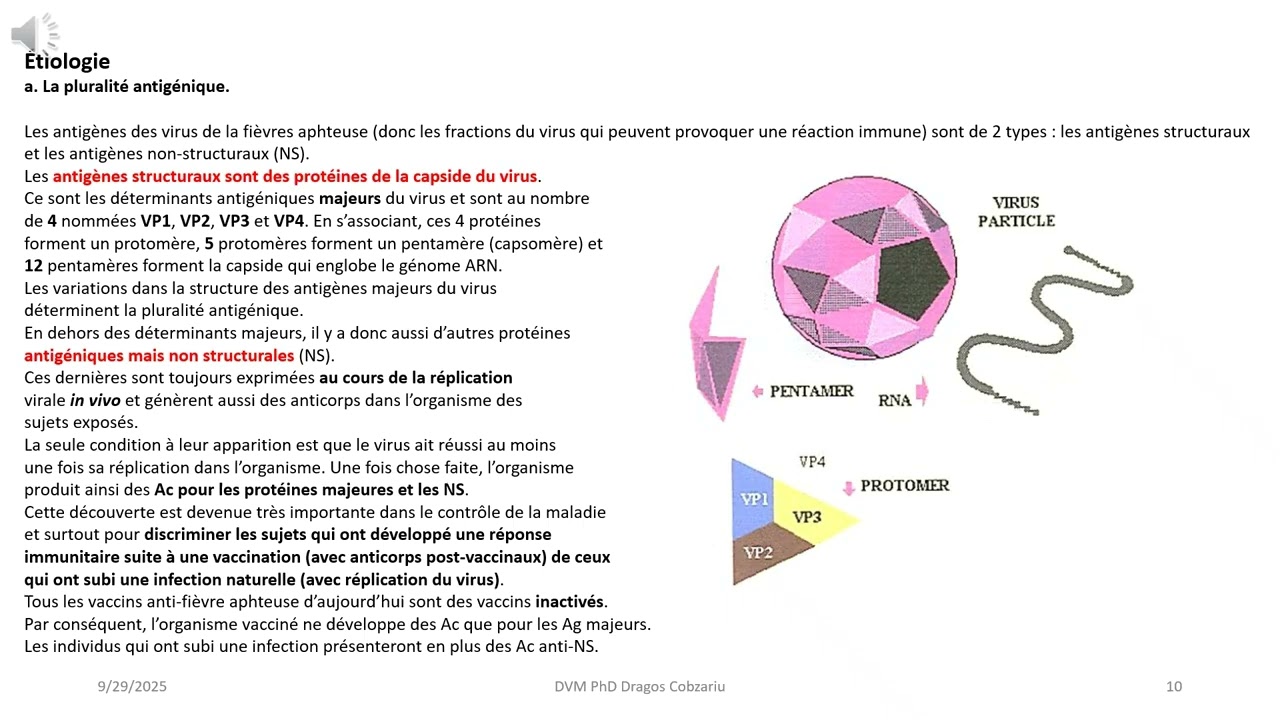
- Virology: virus structure, serotypes, and antigenic diversity.
- Virus resistance and inactivation methods.
- Epidemiology: host range, transmission routes, and carrier state.
- Clinical signs, morbidity, and mortality in different species.
- Diagnosis: sample collection and laboratory methods.
- Control and prevention: vaccination, biosecurity, and stamping out.
- Discussion on other vesicular diseases (swine vesicular disease, etc.).
- Conclusion and summary of key points.
Contribution & Novelties
The lecture provides a comprehensive educational resource on foot-and-mouth disease, synthesizing current knowledge into a structured format. It clarifies the antigenic diversity and its implications for vaccination, which is crucial for disease control. The lecture also highlights the role of carrier animals and the importance of biosecurity. For further exploration, consider the following:
- Foot-and-mouth disease - Wikipedia — Provides a general overview and references.
- OIE Terrestrial Animal Health Code — Official guidelines for FMD control.
- FAO FMD resources — International perspectives on FMD management.
84 words
Radar Profile
The radar profile shows high scores in information quantity and technical level, indicating a dense and detailed lecture. The quality and reliability scores are moderate, reflecting the lack of explicit citations. Overall, the lecture is a valuable educational resource for veterinary professionals.