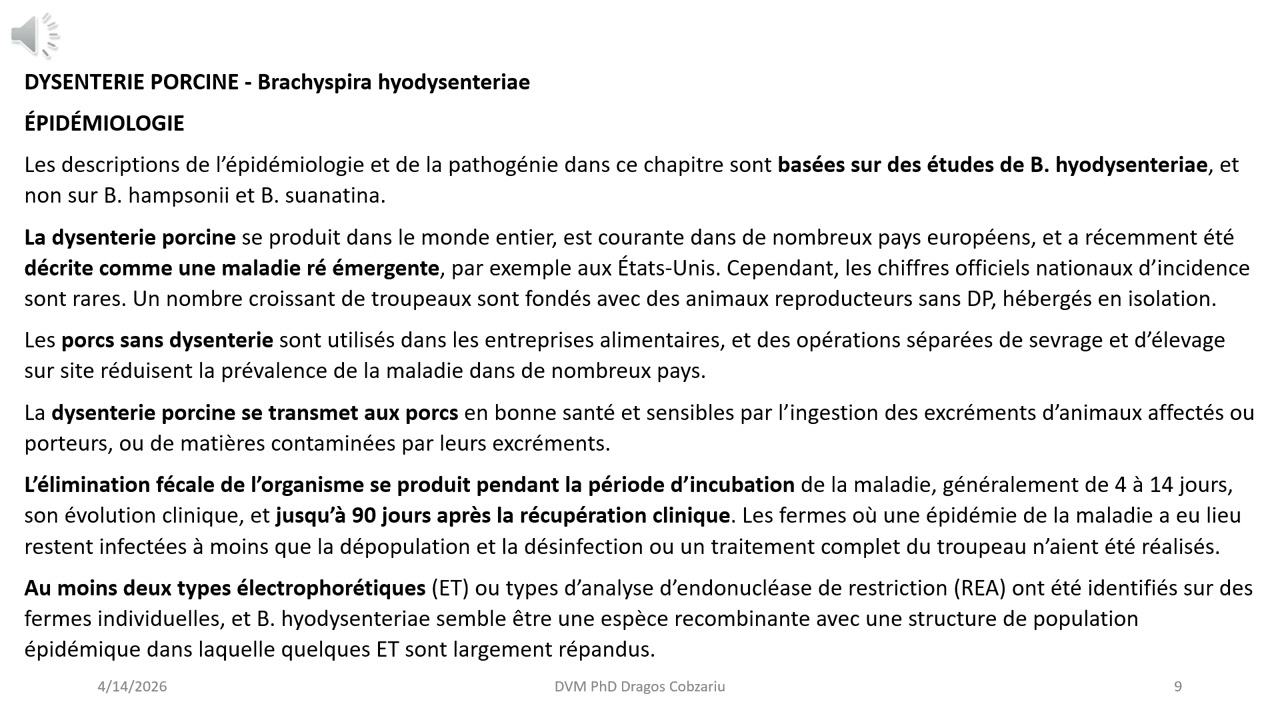
CURS 7 MamAviSpiro FRA 2026
Keywords
Summary
107 words
Critical Evaluation
Value of the Information & Strength of the Argument
The lecture provides a thorough and well-structured presentation of spirochete diseases, with a strong focus on swine dysentery. It covers the microbiology, pathogenesis, clinical presentation, diagnostic methods, and treatment options in detail. The argumentation is based on established veterinary knowledge and includes historical context and research findings. However, the lecture lacks explicit citations to specific studies, which reduces its value for those seeking evidence-based references. The information is presented in a clear, logical sequence, making it useful for educational purposes.
Scientific Rigor, Source Quality, Title Accuracy
The scientific rigor is generally high, with accurate descriptions of the organisms and diseases. The lecture does not cite specific sources, but the content aligns with standard veterinary textbooks and literature. The title is somewhat vague, but it is a course lecture, so it is acceptable. The adequacy between title and content is moderate; the title could be more descriptive. No comments were provided for analysis.
161 words
Title / Content Match
The title is generic and does not clearly indicate the content, but it is a course lecture (CURS 7) on spirochete diseases in mammals and birds, which matches the content.
Quality & Reliability
7/10
The lecture provides a detailed and structured overview of spirochete diseases in veterinary medicine, with specific focus on Brachyspira hyodysenteriae. It covers microbiology, pathogenesis, clinical signs, diagnosis, treatment, and control. The content is consistent with established veterinary knowledge, though it lacks explicit citations and references to recent literature.
Key Moments
Markers derived by PSI from the transcript: the creator did not define chapters.
- Introduction to spirochetes: morphology, motility, and classification.
- Overview of Brachyspira species and their veterinary importance.
- Detailed discussion of Brachyspira hyodysenteriae and swine dysentery history.
- Epidemiology of swine dysentery: transmission, prevalence, and risk factors.
- Pathogenesis of Brachyspira hyodysenteriae infection.
- Clinical signs and lesions of swine dysentery.
- Diagnostic methods: culture, PCR, serology, and differential diagnosis.
- Treatment options and antimicrobial resistance.
- Control and prevention strategies, including biosecurity and vaccination.
Contribution & Novelties
The lecture provides a comprehensive and up-to-date overview of spirochete diseases in veterinary medicine, with a particular focus on swine dysentery. It synthesizes current knowledge on the microbiology, pathogenesis, diagnosis, and control of these diseases. The lecture is valuable for veterinary students and practitioners as a reference. For further exploration, the following concepts and references are relevant:
- Swine dysentery - Wikipedia — Provides a general overview of the disease.
- Brachyspira hyodysenteriae - NCBI Taxonomy — Taxonomic information.
- Leptospirosis - CDC — Information on leptospirosis, a related disease.
- Lyme disease - Wikipedia — Overview of Borrelia burgdorferi infection.
97 words
Radar Profile
The radar profile shows high scores in quantity of information and technical level, indicating a dense and specialized lecture. The quality and reliability scores are slightly lower, reflecting the lack of explicit citations. Overall, the lecture is strong in content but could benefit from referencing sources.