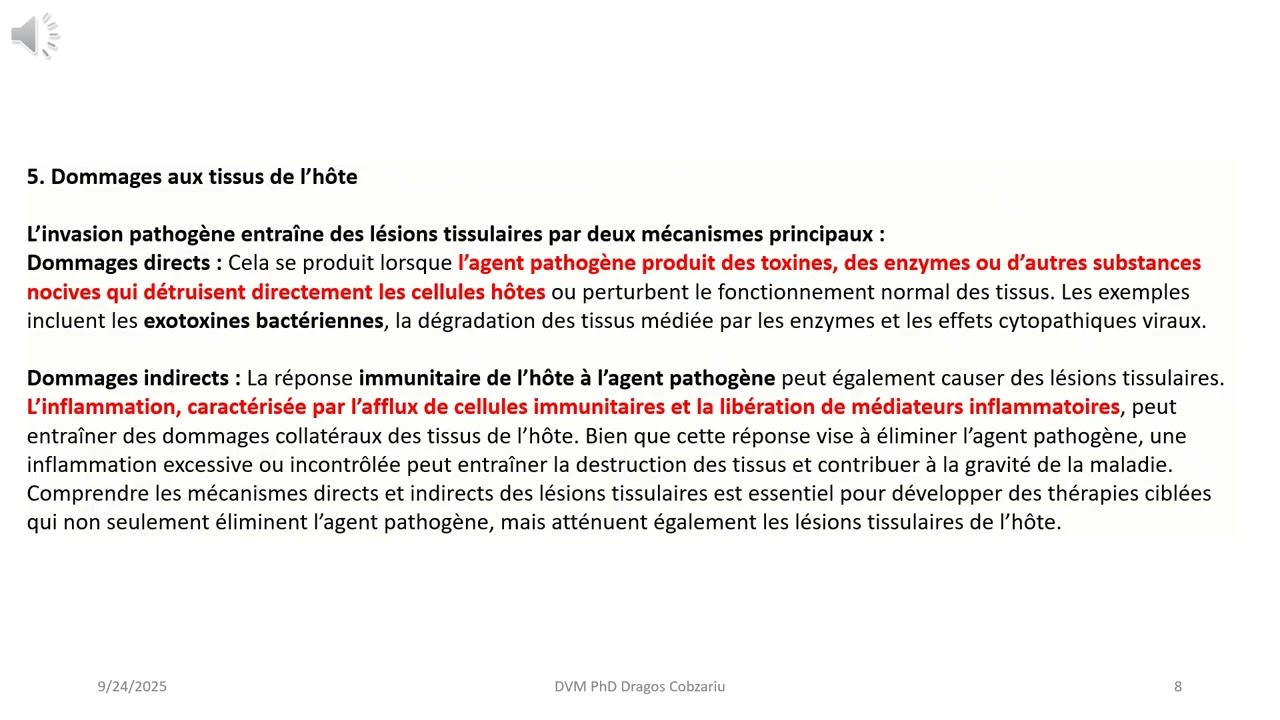
CURS 2 Cap2 Epi FRA 25 26
Keywords
Summary
163 words
Critical Evaluation
Value of the Information & Strength of the Argument
The lecture provides a solid foundation in infectious disease epidemiology, systematically explaining key concepts such as the infectious process and epidemiological process. The argumentation is logical and well-structured, with clear definitions and examples. However, it lacks depth in discussing specific diseases or real-world case studies, which would enhance its value. The presentation is largely descriptive, with limited critical analysis or discussion of controversies in the field.
Scientific Rigor, Source Quality, Title Accuracy
The lecture does not cite specific scientific sources, which limits its scientific rigor. The title is not descriptive and may not attract the intended audience. The content is accurate but presented without references, making it difficult to verify claims. The lecture’s structure is clear, but the lack of citations and visual aids reduces its overall reliability.
137 words
Title / Content Match
The title is cryptic and does not clearly indicate the content, but it does correspond to a course chapter on epidemiology.
Quality & Reliability
6/10
The content is a structured lecture on infectious disease epidemiology in veterinary medicine, covering key concepts accurately. However, it lacks citations to scientific literature and is presented as a monologue without visual aids or references, limiting verifiability.
Key Moments
Markers derived by PSI from the transcript: the creator did not define chapters.
- Introduction to the course on infectious disease epidemiology
- Explanation of the infectious process and its stages
- Discussion on routes of entry for pathogens
- Adhesion and colonization mechanisms
- Invasion and multiplication of pathogens
- Evasion of host defenses and tissue damage
- Exit and transmission of pathogens
- Epidemiological process and disease dynamics
Contribution & Novelties
This lecture offers a structured overview of infectious disease epidemiology in veterinary medicine, which is valuable for students. It clarifies the distinction between receptivity and susceptibility, a key concept. However, it does not present novel research or unique insights.
Pour aller plus loin :
- Koch’s postulates — Historical criteria for establishing causation, relevant to understanding etiology.
- One Health — Concept linking human, animal, and environmental health, relevant to disease control.
- Veterinary epidemiology — Overview of the field, providing context for the lecture.
82 words
Radar Profile
The radar profile shows moderate scores across all dimensions, indicating a balanced but not exceptional lecture. The highest score is in quantity of information, while reliability is lower due to lack of citations.