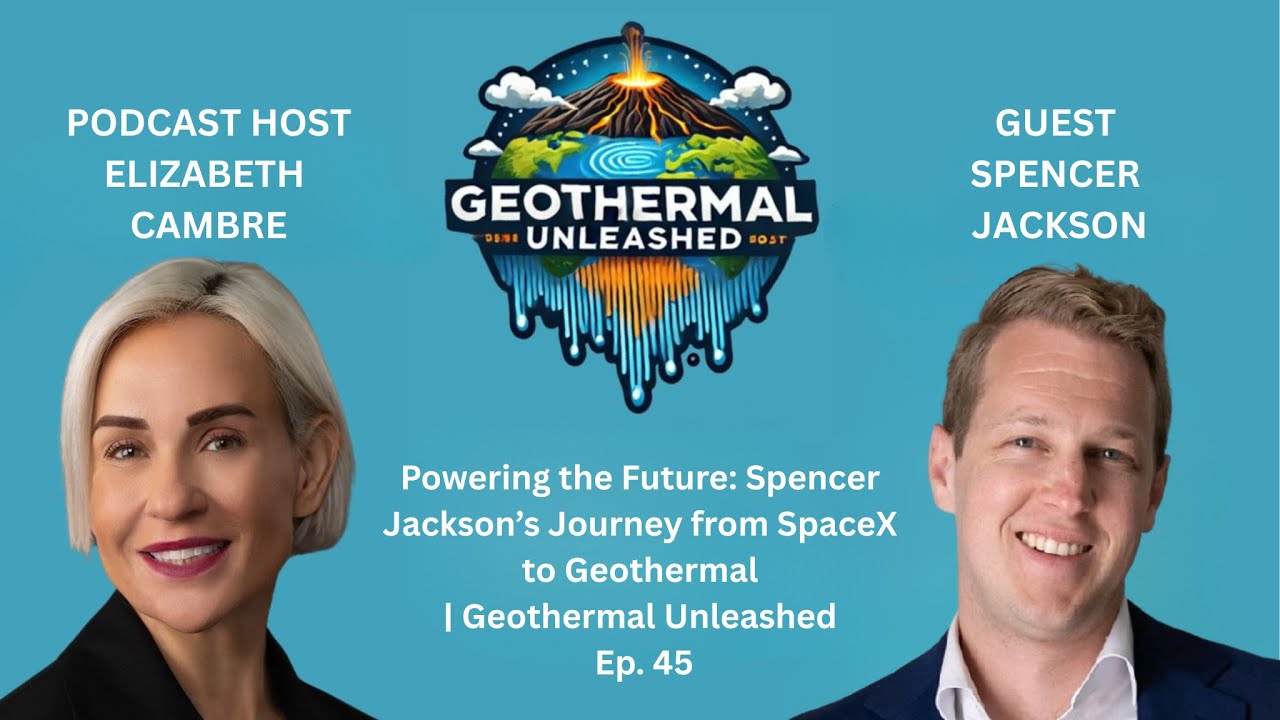
Powering the Future: Spencer Jackson’s Journey from SpaceX to Geothermal
Keywords
Summary
171 words
Critical Evaluation
Value of the Information & Strength of the Argument
The interview provides valuable insights into the application of aerospace manufacturing techniques to geothermal energy. Jackson’s argument for modular, factory-built power plants is well-structured, drawing parallels with SpaceX’s approach to rocket production. He effectively explains the technical and economic benefits, such as reduced on-site construction time, scalability, and cost savings through repeatable manufacturing. The discussion includes specific details about turbine design, working fluids, and the importance of air-cooled condensers, demonstrating a solid understanding of the engineering challenges. However, the argumentation is primarily based on the founder’s perspective and lacks independent data or comparative analysis with existing geothermal projects. The claims about cost and deployment speed are plausible but not backed by concrete evidence or case studies.
Scientific Rigor, Source Quality, Title Accuracy
The video is an interview, so the primary source is Spencer Jackson’s personal experience and knowledge. No external sources are cited in the description or during the conversation. The title accurately reflects the content, focusing on Jackson’s career transition and his company’s mission. The discussion is technically sound, but the lack of references to industry reports or academic studies limits the scientific rigor. The host’s questions are relevant and help clarify technical points, but the overall reliability is moderate due to the absence of verifiable sources.
217 words
Title / Content Match
The title accurately reflects the content, focusing on Spencer Jackson's transition from SpaceX to geothermal energy.
Quality & Reliability
7/10
The interview features a founder with credible engineering background from SpaceX, providing specific technical details about modular geothermal power plants. Claims are plausible but not independently verified; no external sources cited.
Key Moments
Markers derived by PSI from the transcript: the creator did not define chapters.
- Introduction and welcome of Spencer Jackson
- Spencer's background at SpaceX and transition to geothermal
- Explanation of Critical Energy's modular power plant concept
- Advantages of modularity and comparison to traditional plants
- Technical details of the power cycle and turbomachinery
- Use of metal 3D printing and manufacturing approach
- Progress with 50 kW prototype and future plans
Contribution & Novelties
The interview offers a unique perspective on applying aerospace manufacturing principles to geothermal energy. The concept of modular, factory-built power plants is not entirely new, but the specific application to geothermal and the emphasis on repeatable manufacturing is a fresh angle. The discussion provides insights into the technical challenges and potential solutions for scaling geothermal energy.
Pour aller plus loin :
- Organic Rankine Cycle — Relevant to the working fluid cycle discussed.
- Geothermal energy — Provides background on geothermal power generation.
- Additive manufacturing — Relevant to the metal 3D printing of turbine components.
93 words
Radar Profile
The radar profile shows balanced scores across information quantity, quality, technical level, and reliability, with a slight dip in reliability due to lack of external sources. The content is technically informative but relies heavily on the founder's claims.