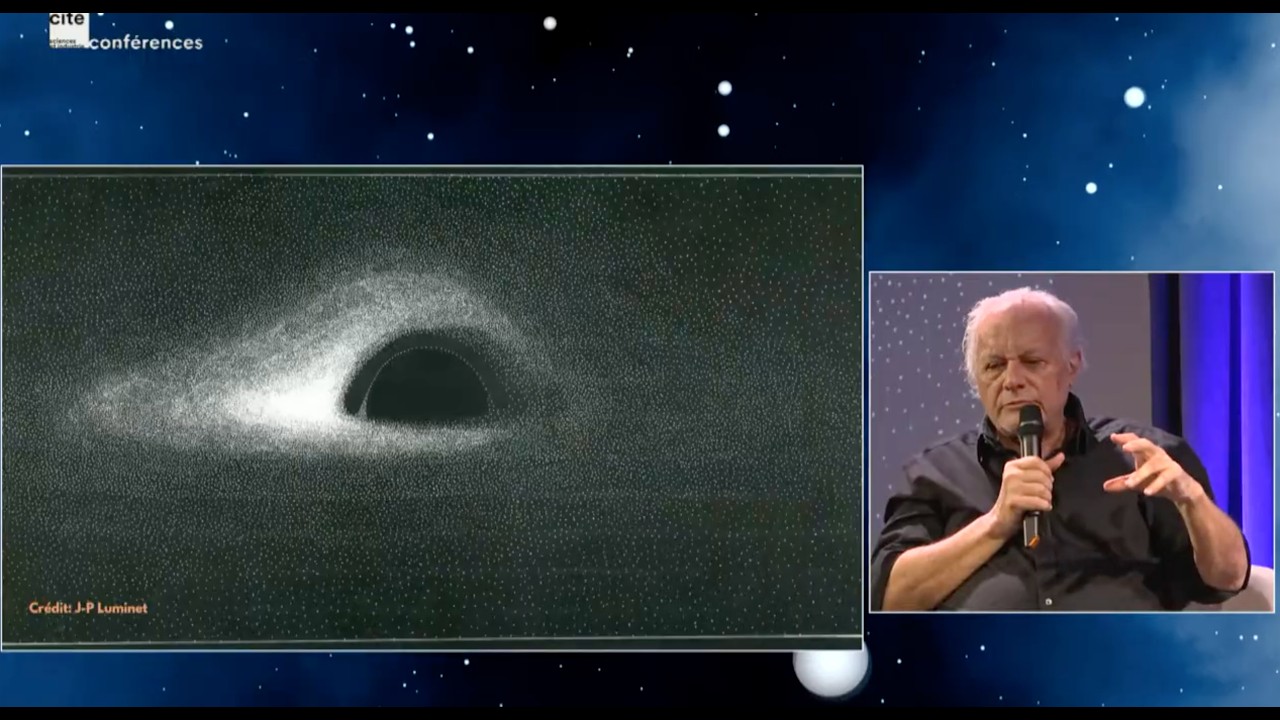
Trous noirs : 40 ans de traque
Keywords
Summary
199 words
Critical Evaluation
The round table provides an excellent overview of black hole physics, combining historical context with cutting-edge research. The panelists are highly credible: Jean-Pierre Luminet is a renowned astrophysicist who produced the first visualization of a black hole, Christophe Galfard is a theoretical physicist and former student of Stephen Hawking, and Frédérique Marion is a CNRS research director involved in the LIGO/Virgo collaboration. The discussion is scientifically rigorous, with accurate explanations of complex concepts such as the event horizon, gravitational waves, and the information paradox. The argumentation is solid, with each panelist contributing complementary perspectives from theory, observation, and simulation. The sources cited are primarily the panelists’ own work and well-established scientific literature, though specific references are not explicitly mentioned. The content is well-structured, moving from basic definitions to advanced topics, and the moderators effectively guide the conversation. The title accurately reflects the content, focusing on the 40-year journey of black hole research. The only minor weakness is that the discussion occasionally assumes prior knowledge, but this does not detract from its overall quality. The presence of a brief technical issue at the beginning is negligible. Overall, this is an outstanding educational resource that offers deep insights into one of the most fascinating areas of modern astrophysics.
206 words
Title / Content Match
The title accurately reflects the content: a retrospective on 40 years of black hole research, from theoretical predictions to direct detection.
Quality & Reliability
9/10
High-quality round table with renowned physicists and astrophysicists, including pioneers in black hole research. The discussion is scientifically accurate, well-structured, and covers historical and recent developments. No obvious errors or misleading claims.
Key Moments
Markers derived by PSI from the transcript: the creator did not define chapters.
- Introduction of the panel and the topic: 40 years of black hole research.
- Definition of a black hole as a gravitational trap and explanation of the event horizon.
- Discussion on the classification of black holes by mass: stellar, supermassive, and primordial.
- Historical origins: John Michell and Laplace's predictions of invisible stars.
- Jean-Pierre Luminet describes his 1979 first visualization of a black hole.
- Frédérique Marion explains the first gravitational wave detection by LIGO/Virgo in 2015.
- Discussion on the no-hair theorem and the simplicity of black holes.
- Christophe Galfard talks about Hawking radiation and the information paradox.
- Future prospects: space-based detectors like LISA and the search for primordial black holes.
- Philosophical implications and the nature of spacetime.
Cited Sources
- LIGO Scientific Collaboration — Mentioned as the collaboration behind the first gravitational wave detection.
- Virgo Collaboration — Mentioned as part of the gravitational wave detection network.
Concurring Sources
- First image of a black hole by Event Horizon Telescope — The EHT image of M87* in 2019 confirmed predictions about black hole shadows.
- LIGO/Virgo detection of gravitational waves — The 2015 detection of GW150914 confirmed the existence of stellar-mass black hole mergers.
Dissenting Sources
- Alternative theories of gravity — Some modified gravity theories propose alternatives to black holes, but these are not discussed in the video.
Contribution & Novelties
The video provides a comprehensive and accessible overview of black hole physics, highlighting the transition from theoretical predictions to direct observations. It offers unique insights from key figures in the field, including the first visualization of a black hole and the first gravitational wave detection. The discussion also addresses open questions and future research directions.
Pour aller plus loin :
- Event Horizon Telescope — The collaboration that captured the first image of a black hole.
- LISA mission — Future space-based gravitational wave observatory.
- Stephen Hawking’s paper on black hole radiation — Original paper on Hawking radiation.
- No-hair theorem — The theorem stating that black holes are characterized by only three parameters.
111 words
Radar Profile
The radar profile shows high scores across all dimensions, with particularly strong performance in information quality and reliability. The video excels in providing accurate, well-sourced scientific content, though the technical level may be challenging for absolute beginners.