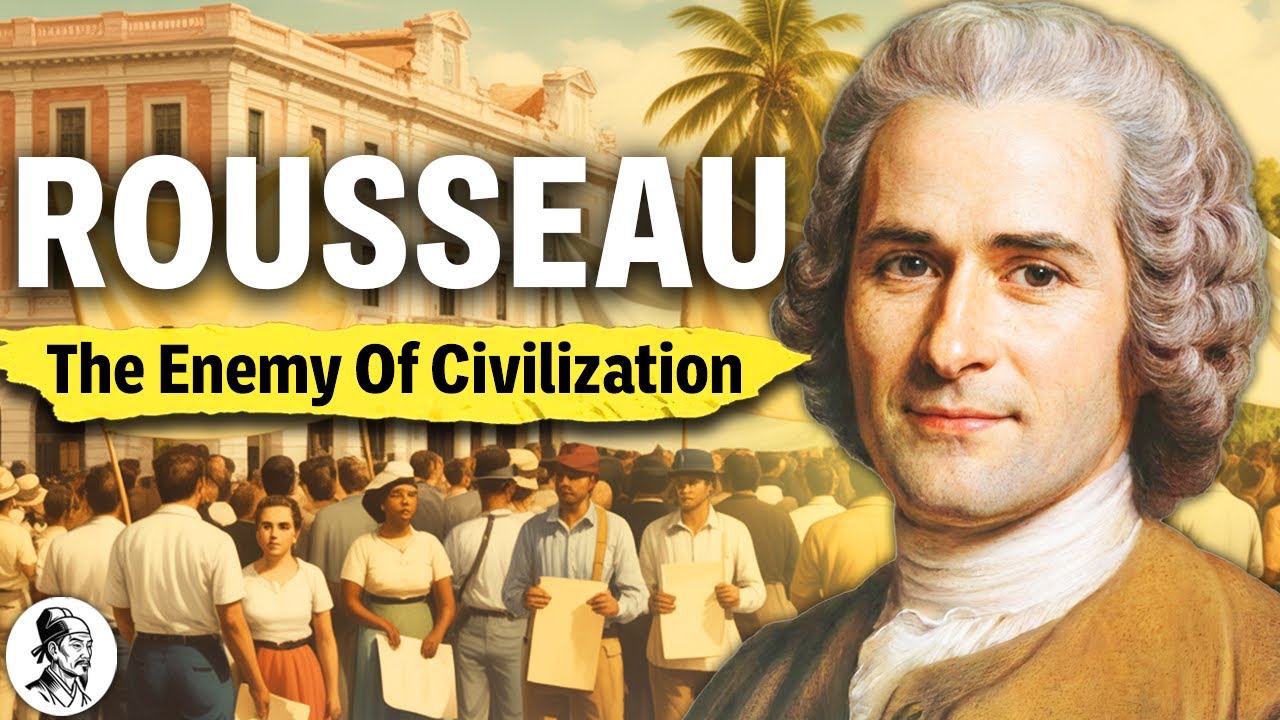
Rousseau Documentary to Fall Asleep To
Keywords
Summary
156 words
Critical Evaluation
Value of the Information & Strength of the Argument
The documentary offers a rich narrative that weaves together biographical details and philosophical ideas, making Rousseau’s complex thoughts accessible to a general audience. It presents a balanced view, acknowledging both his contributions and his flaws, which strengthens its credibility. The argumentation is coherent, tracing the development of Rousseau’s ideas from his early life experiences to his mature works. However, the documentary sometimes relies on dramatic storytelling rather than rigorous analysis, and it does not engage deeply with counterarguments or scholarly debates. The value lies in its ability to humanize Rousseau and contextualize his ideas within his personal experiences, but it may oversimplify some philosophical nuances.
Scientific Rigor, Source Quality, Title Accuracy
The documentary demonstrates a reasonable level of scientific rigor, presenting a chronological account of Rousseau’s life with attention to historical context. However, it lacks explicit citations to primary sources or scholarly works, which limits its reliability for academic purposes. The title accurately reflects the content, as it is indeed a documentary about Rousseau designed for relaxation. The description mentions major works and themes, which are covered in the video. The absence of direct source references is a notable weakness, but the overall narrative aligns with established historical knowledge. The documentary’s tone is engaging and suitable for a broad audience, though it may not satisfy viewers seeking in-depth scholarly analysis.
229 words
Title / Content Match
The title accurately reflects the content: a comprehensive biographical documentary about Rousseau, designed to be soothing for sleep.
Quality & Reliability
7/10
The documentary provides a detailed and engaging narrative of Rousseau's life and ideas, but lacks direct citations to primary sources and includes some interpretive elements. It is generally accurate but should be complemented with scholarly sources for rigorous academic use.
Key Moments
Markers derived by PSI from the transcript: the creator did not define chapters.
- Introduction to Rousseau's birth and early childhood.
- Rousseau's apprenticeship and flight from Geneva.
- Rousseau's relationship with Madame de Warens and his education.
- Rousseau's move to Paris and his early struggles.
- The revelation on the road to Vincennes and the First Discourse.
- The Second Discourse on Inequality.
- Rousseau's life at Montmorency and his major works.
- The Social Contract and Emile.
- Rousseau's later years, paranoia, and death.
Cited Sources
- The Social Contract — Mentioned as one of Rousseau's major works.
- Emile, or On Education — Mentioned as a major work on education.
- Discourse on the Sciences and Arts — Rousseau's first discourse that won the Academy of Dijon prize.
- Discourse on the Origin of Inequality — Rousseau's second discourse on inequality.
Concurring Sources
- Stanford Encyclopedia of Philosophy - Jean-Jacques Rousseau — Scholarly overview of Rousseau's philosophy.
Dissenting Sources
- Voltaire's critique of Rousseau — Voltaire criticized Rousseau's ideas and personal life, highlighting contradictions.
Contribution & Novelties
The documentary provides a comprehensive and engaging overview of Rousseau’s life and ideas, making complex philosophical concepts accessible to a general audience. It highlights the paradoxes in Rousseau’s character, such as his advocacy for education while abandoning his own children, which adds depth to the narrative. The documentary also situates Rousseau within the broader Enlightenment context, showing his relationships with other thinkers and his influence on later political thought.
Pour aller plus loin :
- Jean-Jacques Rousseau - Wikipedia — Comprehensive overview of Rousseau’s life and works.
- The Social Contract - Wikipedia — Detailed analysis of Rousseau’s political philosophy.
- Discourse on Inequality - Wikipedia — Background and context of Rousseau’s second discourse.
111 words
Radar Profile
The radar profile shows high scores in quantity of information and quality, but lower in technical level, indicating a documentary that is informative and reliable but not highly technical. The overall balance suggests a good introductory resource for a general audience.
💬 Sur les 0 commentaires analysés, aucune tendance n'est disponible.