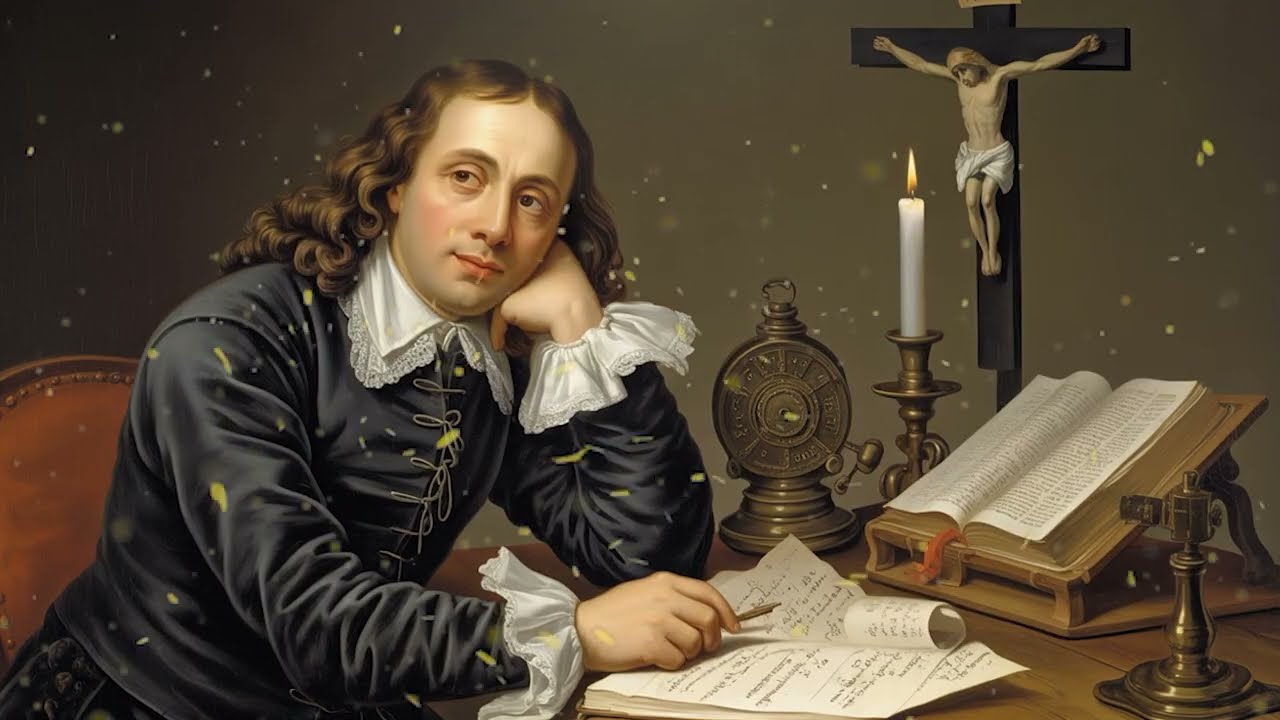
Pascal Documentary to Fall Asleep To
Keywords
Summary
126 words
Critical Evaluation
Value of the Information & Strength of the Argument
The documentary provides a rich and engaging narrative of Pascal’s life, synthesizing historical facts with interpretive storytelling. It effectively conveys the breadth of Pascal’s contributions to mathematics, physics, and philosophy, and the internal conflicts that shaped his later life. The argumentation is coherent, presenting Pascal’s intellectual journey as a progression from scientific achievement to religious devotion, and it supports this with specific examples and anecdotes. However, the documentary does not engage critically with historical sources, and some claims are presented without nuance, such as the details of Pascal’s religious experience. The value lies in its accessibility and narrative flow, making complex historical material understandable to a general audience.
Scientific Rigor, Source Quality, Title Accuracy
The documentary demonstrates a reasonable level of scientific rigor, accurately portraying Pascal’s known achievements and historical context. It does not cite specific sources, but the information aligns with established historical knowledge. The title accurately reflects the content, which is a biographical documentary intended for relaxation. The production quality is high, with clear narration and visuals, but the lack of explicit source citations limits its scholarly value. The documentary’s strength is its engaging storytelling, which makes it a good introduction to Pascal’s life, but it should not be considered a rigorous academic source.
215 words
Title / Content Match
The title accurately reflects the content: a comprehensive biographical documentary about Blaise Pascal, designed to be soothing and suitable for falling asleep.
Quality & Reliability
7/10
The documentary provides a well-structured and engaging narrative of Pascal's life, accurately covering major historical events and contributions. It relies on established historical knowledge, but lacks explicit citations or references to primary sources, and includes some dramatization and interpretive commentary.
Key Moments
Markers derived by PSI from the transcript: the creator did not define chapters.
- Introduction to Pascal's life and his final words about grace.
- Pascal's childhood and his father's unusual educational approach.
- Pascal's early mathematical achievements, including his work on conic sections.
- Invention of the Pascaline calculator and its commercial failure.
- Pascal's experiments on vacuum and atmospheric pressure, including the Puy de Dôme experiment.
- Pascal's encounter with Jansenism and the influence on his family.
- Pascal's move to Paris and his interactions with Descartes and Mersenne.
- Pascal's health decline and the death of his father.
- Jacqueline's entry into Port-Royal and Pascal's isolation.
- Pascal's religious conversion and his focus on theology.
Contribution & Novelties
The documentary offers a comprehensive and accessible overview of Pascal’s life, synthesizing his scientific and philosophical contributions in a narrative that emphasizes his personal struggles. It provides a balanced view of his achievements and his religious turn, making it a valuable introduction for those unfamiliar with Pascal. The documentary’s unique angle is its focus on the tension between Pascal’s intellectual brilliance and his spiritual quest, which is often overlooked in more technical treatments.
Pour aller plus loin :
- Blaise Pascal - Wikipedia — Comprehensive overview of Pascal’s life and work.
- Pascal’s Wager - Stanford Encyclopedia of Philosophy — Detailed philosophical analysis of Pascal’s argument.
- Pascaline - Computer History Museum — Information on the mechanical calculator.
- Jansenism - Catholic Encyclopedia — Background on the religious movement.
125 words
Radar Profile
The radar profile shows high scores in quantity of information and technical level, reflecting the documentary's comprehensive coverage and accessible explanations. The quality of information and global reliability are slightly lower, indicating a need for more rigorous sourcing. Overall, the documentary is a solid educational resource, but not a scholarly reference.