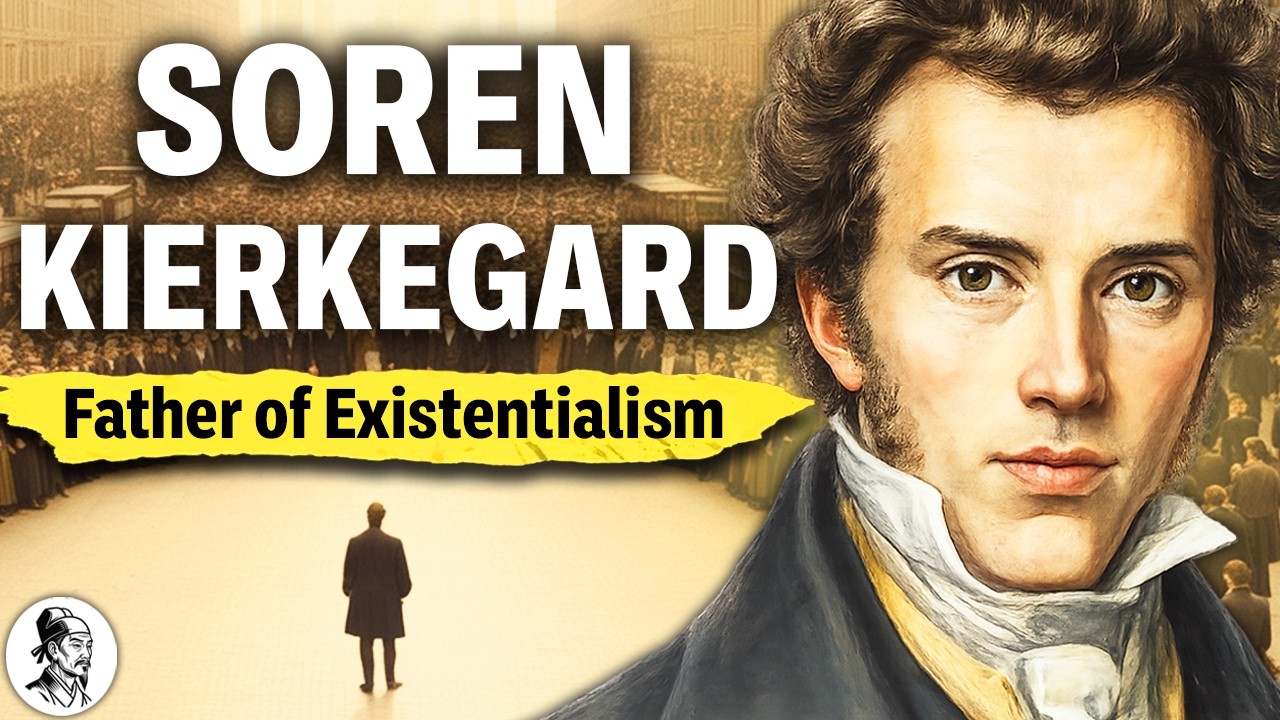
Soren Kierkegard Documentary to Fall Asleep To
Keywords
Summary
130 words
Critical Evaluation
Value of the Information & Strength of the Argument
The documentary provides valuable insights into Kierkegaard’s life and thought, effectively connecting his personal experiences to his philosophical ideas. It presents a coherent narrative that explains the development of his existentialist themes, such as anxiety, despair, and the leap of faith. The argumentation is generally solid, though it sometimes simplifies complex philosophical concepts for a broader audience. The use of pseudonyms and indirect communication is well-explained, and the documentary successfully conveys the emotional and psychological depth of Kierkegaard’s work.
Scientific Rigor, Source Quality, Title Accuracy
The documentary demonstrates a reasonable level of scientific rigor, drawing on well-established biographical facts and philosophical interpretations. However, it does not cite specific sources or provide references to scholarly works, which limits its academic credibility. The title accurately reflects the content, and the documentary’s tone is appropriate for its intended purpose of helping viewers fall asleep. The absence of direct citations is a notable weakness, but the overall narrative is faithful to the known historical record.
170 words
Title / Content Match
The title accurately reflects the content: a comprehensive documentary on Kierkegaard's life, designed to be soothing and suitable for falling asleep.
Quality & Reliability
7/10
The documentary provides a detailed and engaging narrative of Kierkegaard's life, drawing on well-known biographical facts and philosophical concepts. It is generally accurate but lacks direct citations to primary sources or scholarly works, and some interpretations are simplified for a general audience.
Key Moments
Markers derived by PSI from the transcript: the creator did not define chapters.
- Introduction to Kierkegaard's public mockery in 1846 and his later influence.
- Kierkegaard's birth in Copenhagen in 1813 and his father's belief in a family curse.
- The deaths of Kierkegaard's siblings and the 'great earthquake' in 1835.
- Kierkegaard's engagement to Regine Olsen and his decision to break it off.
- Publication of 'Either/Or' and the concept of the aesthetic and ethical stages.
- Publication of 'Fear and Trembling' and the teleological suspension of the ethical.
- The Corsair affair and Kierkegaard's public humiliation.
- Publication of 'Concluding Unscientific Postscript' and the idea that truth is subjectivity.
- Kierkegaard's decision to stop writing and his later attack on the church.
- Kierkegaard's death and the legacy of his work.
Cited Sources
- Mind Palace YouTube Channel — The channel that published the documentary, mentioned in the description.
Concurring Sources
- Stanford Encyclopedia of Philosophy - Søren Kierkegaard — Provides scholarly information on Kierkegaard's life and philosophy, consistent with the documentary's narrative.
Contribution & Novelties
The documentary offers a comprehensive and engaging overview of Kierkegaard’s life and thought, making his complex philosophy accessible to a general audience. It emphasizes the biographical roots of his ideas, particularly his relationship with his father and his broken engagement, which adds a human dimension to his work. The film also highlights the importance of his pseudonymous authorship and his critique of Hegelianism.
Pour aller plus loin :
- Søren Kierkegaard - Stanford Encyclopedia of Philosophy — A comprehensive academic overview of Kierkegaard’s philosophy.
- Existentialism - Internet Encyclopedia of Philosophy — An introduction to existentialism, the movement Kierkegaard is often considered the father of.
- Fear and Trembling - Wikipedia — Detailed information on one of Kierkegaard’s most famous works.
118 words
Radar Profile
The radar profile shows a balanced performance across all dimensions, with slightly higher scores in quantity of information and reliability, reflecting the documentary's comprehensive and generally accurate content. The lower score in technical level indicates that it is accessible to a general audience rather than deeply academic.
💬 No comments were provided for analysis.