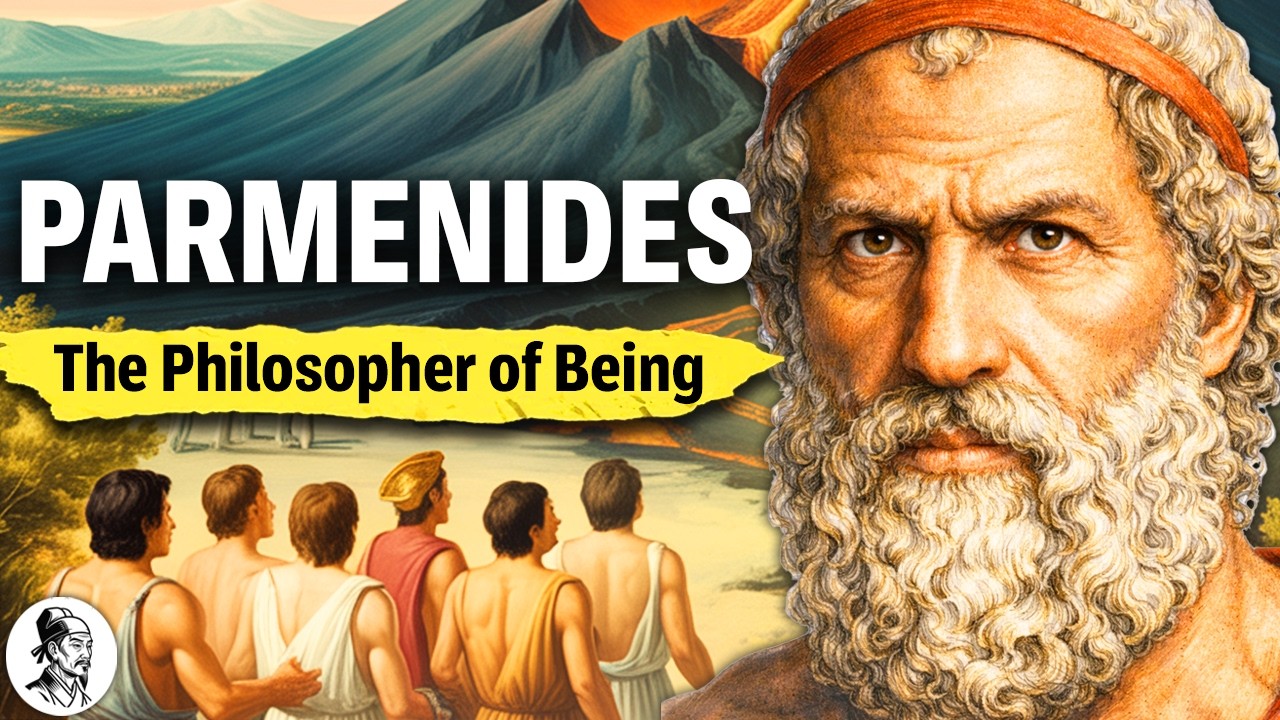
Parmenides Documentary to Fall Asleep To
Keywords
Summary
151 words
Critical Evaluation
Value of the Information & Strength of the Argument
The documentary provides a clear and engaging explanation of Parmenides’ arguments, making complex philosophical ideas accessible without oversimplifying. It effectively conveys the logical structure of Parmenides’ reasoning, showing how each conclusion follows from the premise that ‘what is’ cannot come from ‘what is not’. The narration also situates Parmenides within the broader context of pre-Socratic thought, contrasting his approach with that of earlier natural philosophers. The argumentation is solid, though it does not engage with counterarguments or scholarly debates in depth. The value of the information lies in its synthesis of historical and philosophical material, offering a comprehensive introduction to Parmenides’ thought.
Scientific Rigor, Source Quality, Title Accuracy
The documentary demonstrates scientific rigor by relying on established historical sources, such as Diogenes Laertius and Simplicius, and by acknowledging the fragmentary nature of Parmenides’ work. It clearly distinguishes between what is known with confidence and what is speculative, such as the details of his life. The quality of sources is good, but the video does not provide direct citations or references to primary texts, which would enhance its credibility. The title accurately reflects the content, as the documentary is indeed about Parmenides and is designed to be soothing for sleep. The content matches the title, with no misleading elements.
217 words
Title / Content Match
The title accurately reflects the content: a documentary about Parmenides designed for relaxation or sleep, with a calm narration and no abrupt changes.
Quality & Reliability
7/10
The documentary provides a well-structured overview of Parmenides' life and philosophy, drawing on historical sources and scholarly consensus. It clearly distinguishes between established facts and speculation, and avoids sensationalism. However, it lacks direct citations to primary texts or academic works, and some biographical details are presented with less nuance than a specialist might prefer.
Key Moments
Markers derived by PSI from the transcript: the creator did not define chapters.
- Introduction to Parmenides' radical claims: reality is an illusion, motion is impossible, change doesn't exist.
- Biographical background: birth in Elea, wealthy family, education, and possible Pythagorean influence.
- Parmenides' role as a lawgiver for Elea and his choice of the contemplative life.
- Description of Elea and its cultural context as a Greek colony in Magna Graecia.
- Parmenides' poem 'On Nature': the allegorical journey and the two paths of inquiry.
- Core arguments: being is eternal, unchanging, motionless, and indivisible.
- The section on mortal opinions: cosmology and the world of appearances.
- Influence on Plato and Aristotle, and the development of the Eleatic school.
- Zeno's paradoxes as defenses of Parmenides' views.
- Reflection on the tension between reason and experience, and Parmenides' legacy.
Cited Sources
- Diogenes Laertius, Lives and Opinions of Eminent Philosophers — Mentioned as a source for biographical details about Parmenides, including his Pythagorean influence and role as a lawgiver.
- Simplicius, Commentary on Aristotle's Physics — Preserved the largest fragments of Parmenides' poem, quoted in the documentary.
- Plato, Parmenides — Dialogue featuring Parmenides and Socrates, mentioned as evidence of his influence.
Concurring Sources
- Parmenides (Stanford Encyclopedia of Philosophy) — Provides scholarly consensus on Parmenides' arguments and historical context, aligning with the documentary's presentation.
Dissenting Sources
- Heraclitus, Fragments — Heraclitus' philosophy of constant change directly contradicts Parmenides' denial of change, representing a contrasting view.
Contribution & Novelties
The documentary offers a comprehensive and accessible synthesis of Parmenides’ life and philosophy, emphasizing the logical rigor of his arguments and their enduring impact. It highlights the paradox that a philosopher who denied change and motion was also a lawgiver, and it connects Parmenides’ rationalism to later philosophical debates. The presentation is original in its focus on the ‘sleep’ format, making complex ideas digestible for a general audience.
Pour aller plus loin :
- Parmenides (Stanford Encyclopedia of Philosophy) — Authoritative overview of Parmenides’ philosophy and scholarly interpretations.
- Zeno’s Paradoxes (Internet Encyclopedia of Philosophy) — Detailed analysis of Zeno’s arguments and their philosophical significance.
- Eleatic School (Wikipedia) — Overview of the philosophical school founded by Parmenides.
115 words
Radar Profile
The radar profile shows high scores in quantity of information and technical level, indicating a dense and intellectually engaging documentary. The slightly lower score in quality of information and reliability reflects the lack of direct citations and some speculative biographical details. Overall, the documentary is well-balanced, with a strong emphasis on philosophical content.
💬 Sur les 0 commentaires analysés, aucune tendance n'est disponible.