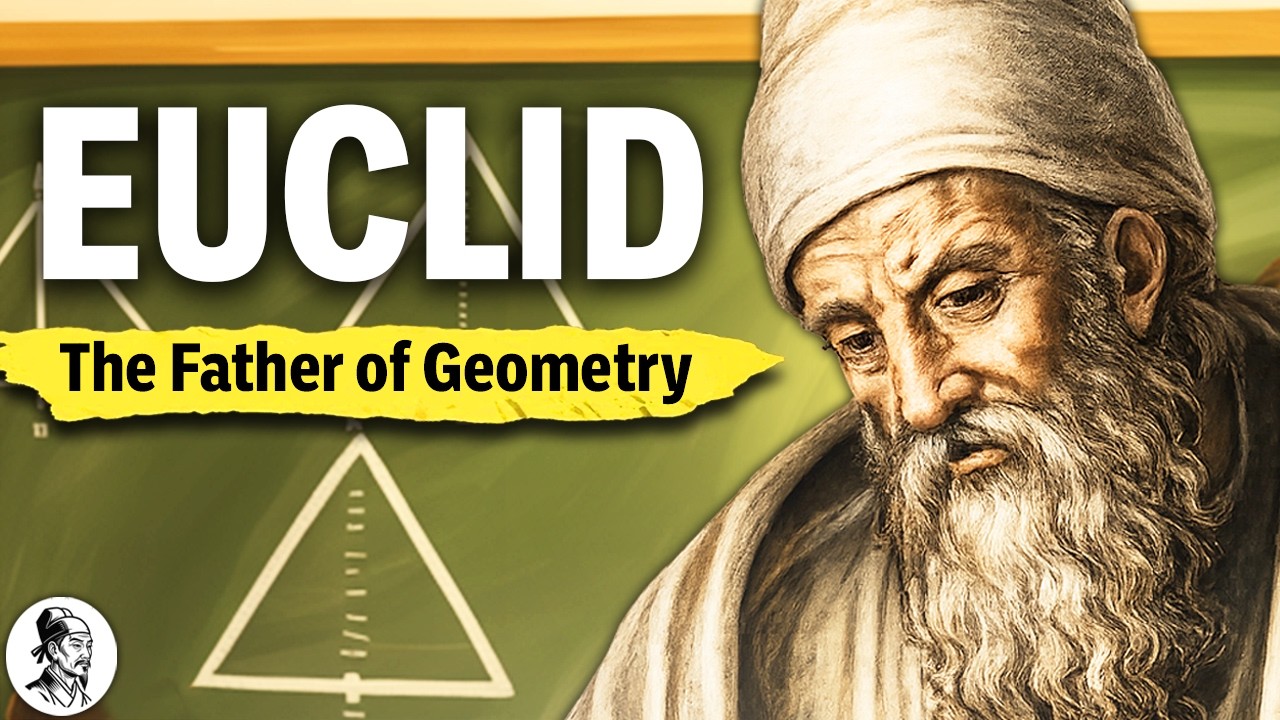
Euclid Documentary to Fall Asleep To
Keywords
Summary
159 words
Critical Evaluation
Value of the Information & Strength of the Argument
The documentary provides substantial value by offering a comprehensive overview of Euclid’s contributions and historical context. It effectively argues that Euclid’s genius lay not in original discoveries but in his systematic organization and rigorous presentation of existing mathematical knowledge. The argumentation is solid, drawing on historical accounts and the structure of ‘Elements’ itself. The video’s narrative is engaging and well-structured, though it relies on reasonable speculation due to the lack of biographical evidence. It successfully conveys the significance of Euclid’s work and its lasting impact.
Scientific Rigor, Source Quality, Title Accuracy
The documentary demonstrates scientific rigor by accurately presenting historical facts about Euclid and his works, such as the content of ‘Elements’ and its historical transmission. It does not cite specific sources within the video, but the information aligns with established scholarship. The title accurately reflects the content, and the video’s calming tone matches its purpose as a sleep aid. The lack of explicit source citations is a minor weakness, but the content is reliable.
174 words
Title / Content Match
The title accurately reflects the content: a documentary about Euclid designed to be calming and suitable for falling asleep.
Quality & Reliability
7/10
The documentary is historically grounded, presenting well-known facts about Euclid and his work, but it acknowledges the scarcity of biographical evidence and uses reasonable speculation. It does not cite specific sources within the video, but the content aligns with established historical knowledge.
Key Moments
Markers derived by PSI from the transcript: the creator did not define chapters.
- Introduction to Euclid's mystery and his lasting impact.
- Description of Alexandria as the intellectual capital and the founding of the Library.
- Discussion of Euclid's likely education at Plato's Academy and the philosophical context.
- Explanation of the need for systematization in mathematics and Euclid's goal.
- Overview of the structure and content of 'Elements'.
- Anecdotes about Euclid's teaching and his attitude towards mathematics.
- Discussion of the Ptolemaic patronage and the role of scholarship in Alexandria.
- Examination of the durability of 'Elements' and its pedagogical brilliance.
- Transmission of 'Elements' through Arabic and Latin translations.
- Influence of Euclid's method on philosophy and science, including Newton and Spinoza.
- Discussion of Euclid's other works and the mystery of his personal life.
- Reflection on Euclid's legacy and the enduring power of his work.
Contribution & Novelties
The documentary offers a unique synthesis of Euclid’s life and work, emphasizing the importance of systematization over original discovery. It provides a compelling narrative that makes the history of mathematics accessible and engaging. The video’s contribution lies in its ability to contextualize Euclid’s achievements within the broader intellectual and cultural milieu of ancient Alexandria.
Pour aller plus loin :
- Euclid - Wikipedia — Comprehensive overview of Euclid’s life and works.
- Euclid’s Elements - Wikipedia — Detailed information on the structure and content of the Elements.
- Library of Alexandria - Wikipedia — Background on the institution where Euclid worked.
- Non-Euclidean geometry - Wikipedia — Related concept that arose from attempts to prove Euclid’s fifth postulate.
114 words
Radar Profile
The radar profile shows high scores in quantity of information and global reliability, with moderate scores in technical level and quality of information. This indicates a documentary that is informative and reliable but not highly technical, suitable for a general audience.