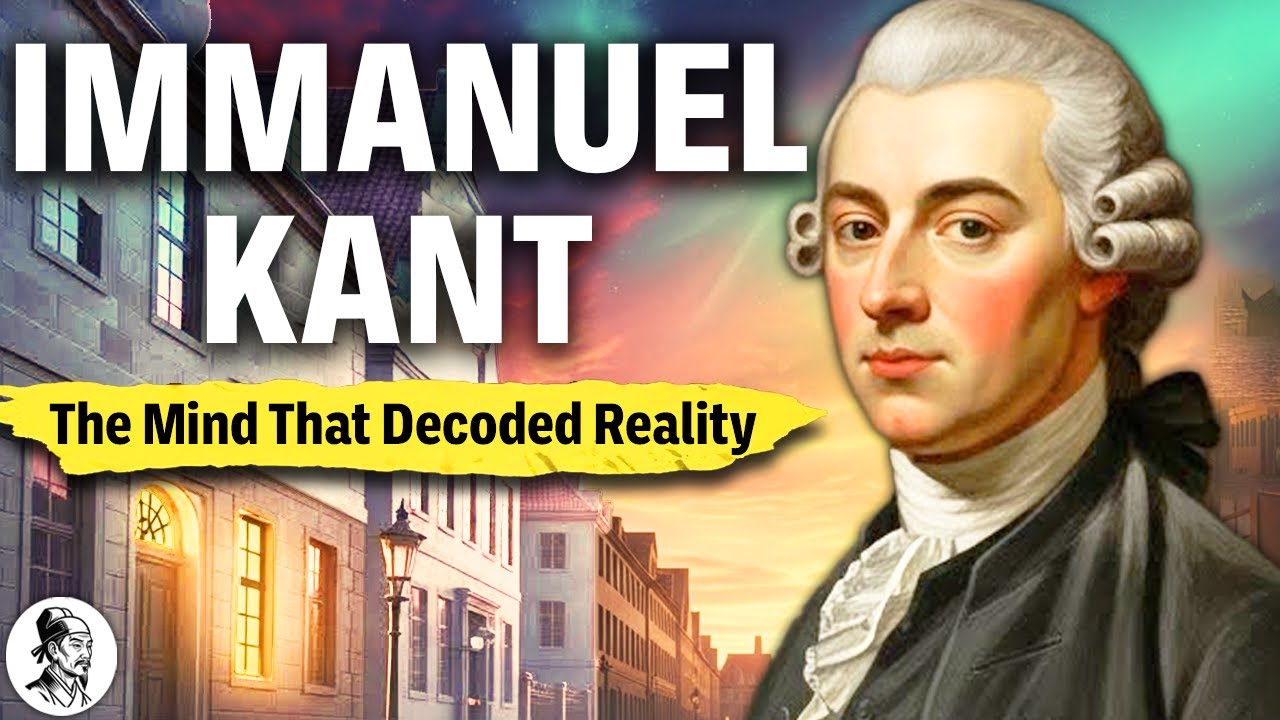
Immanuel Kant Documentary to Fall Asleep To
Keywords
Summary
148 words
Critical Evaluation
Value of the Information & Strength of the Argument
The documentary provides substantial value by offering a comprehensive overview of Kant’s life and philosophical contributions, making complex ideas accessible to a general audience. The argumentation is coherent and well-structured, tracing Kant’s intellectual evolution from his early works to his critical philosophy. It effectively explains the significance of his Copernican revolution in philosophy and his responses to Hume’s skepticism. However, the documentary occasionally oversimplifies nuanced philosophical positions and does not engage deeply with criticisms of Kant’s theories. The narrative is engaging and maintains a logical flow, but it relies heavily on biographical details rather than rigorous philosophical analysis, which may limit its value for those seeking a deeper understanding of Kant’s arguments.
Scientific Rigor, Source Quality, Title Accuracy
The documentary demonstrates a reasonable level of scientific rigor by adhering to well-known historical facts about Kant’s life and philosophy. It accurately portrays the main events and intellectual influences, such as his Pietist upbringing and the impact of Hume’s skepticism. However, it does not cite specific sources or provide references to primary texts, which reduces its scholarly credibility. The title accurately reflects the content, as the documentary is indeed a biographical and philosophical overview designed to be soothing for sleep. The lack of explicit citations and the occasional simplification of complex ideas are the main weaknesses in terms of source quality. Overall, the title-content alignment is strong, and the factual accuracy is generally reliable, though not exhaustive.
244 words
Title / Content Match
The title accurately reflects the content: a documentary about Kant's life and philosophy, designed to be soothing for sleep.
Quality & Reliability
7/10
The documentary provides a comprehensive and generally accurate overview of Kant's life and philosophy, based on well-established historical facts. However, it lacks direct citations to primary sources and simplifies complex ideas, which slightly reduces its scholarly rigor.
Key Moments
Markers derived by PSI from the transcript: the creator did not define chapters.
- Introduction to Kant's significance and the central question of his philosophy.
- Kant's birth in Königsberg and his Pietist upbringing.
- Education at the Collegium Fridericianum and university studies.
- Early career as a private tutor and first philosophical works.
- Return to university and appointment as professor.
- Development of the critical philosophy and the 'silent decade'.
- Publication of the Critique of Pure Reason and its revolutionary impact.
- Explanation of the categorical imperative and Kant's moral philosophy.
- Kant's later works on politics, religion, and perpetual peace.
- Kant's death and his lasting legacy in philosophy.
Cited Sources
- Mind Palace YouTube Channel — The channel's main page, where the documentary is hosted and additional content is available.
Concurring Sources
- Stanford Encyclopedia of Philosophy - Immanuel Kant — Provides a scholarly overview of Kant's life and philosophy, consistent with the documentary's portrayal.
Contribution & Novelties
The documentary offers a comprehensive and accessible introduction to Kant’s life and philosophy, synthesizing biographical details with key concepts. Its main contribution is making Kant’s complex ideas understandable to a broad audience, particularly through the narrative of his daily routine and intellectual development. It does not present new research but serves as an educational overview.
Pour aller plus loin :
- Immanuel Kant - Stanford Encyclopedia of Philosophy — Authoritative overview of Kant’s philosophy, including his major works and concepts.
- Critique of Pure Reason - Wikipedia — Detailed summary and analysis of Kant’s seminal work.
- Categorical Imperative - Internet Encyclopedia of Philosophy — Explanation of Kant’s central moral principle.
108 words
Radar Profile
The radar profile shows high scores in quantity of information and reliability, but moderate scores in technical depth and quality of information, reflecting the documentary's broad but simplified approach.
💬 No comments were provided for analysis.