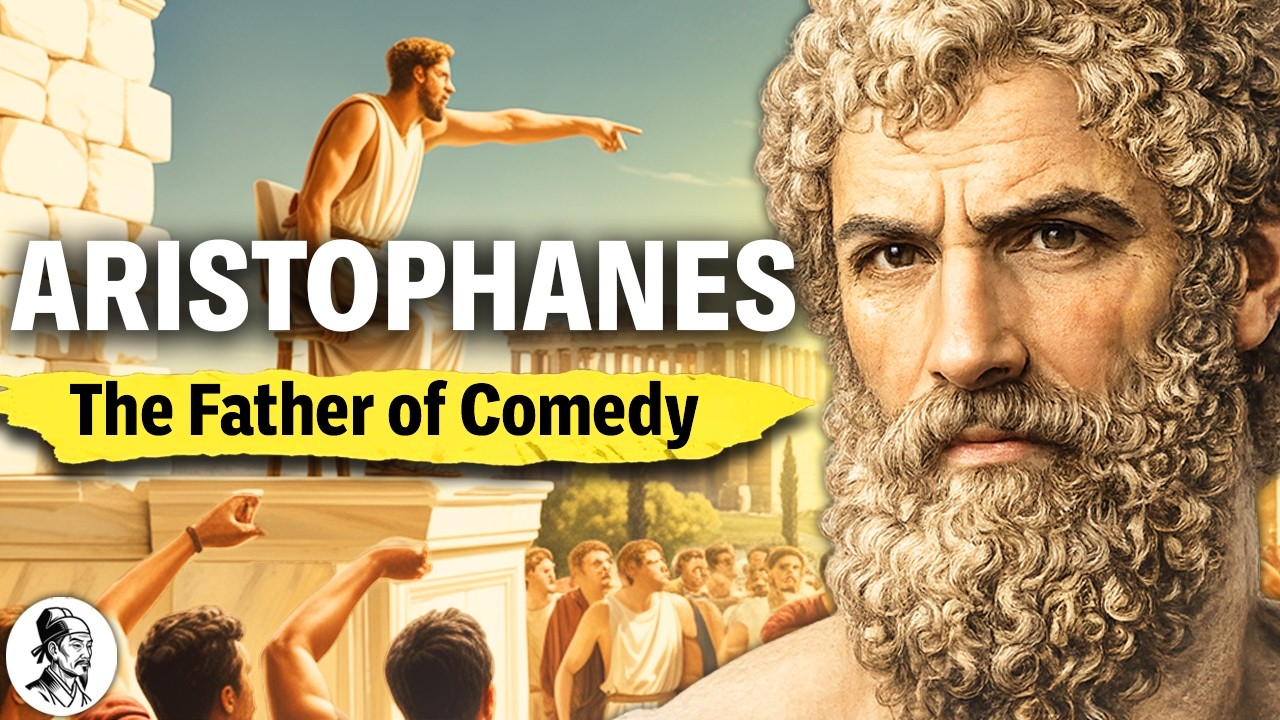
Aristophanes Documentary to Fall Asleep To
Keywords
Summary
149 words
Critical Evaluation
Value of the Information & Strength of the Argument
The documentary provides substantial value by synthesizing historical knowledge about Aristophanes and his works into an accessible narrative. It offers insights into the political and social context of 5th-century Athens, explaining how Aristophanes’ comedies functioned as political commentary and social critique. The argumentation is generally solid, presenting a coherent interpretation of Aristophanes’ career and themes, supported by references to his plays and historical events. However, it sometimes presents interpretations as fact without acknowledging scholarly debate, such as the intent behind The Birds or the impact of The Clouds on Socrates’ trial. The documentary’s strength lies in its comprehensive coverage and engaging storytelling, but it could benefit from more explicit acknowledgment of uncertainties and alternative viewpoints.
Scientific Rigor, Source Quality, Title Accuracy
The documentary demonstrates a reasonable level of scientific rigor by grounding its narrative in well-known historical facts and widely accepted scholarly interpretations. It accurately describes the historical context, the major plays, and the political climate of Athens. However, it does not cite specific sources or provide references, which limits its verifiability. The title ‘Aristophanes Documentary to Fall Asleep To’ is appropriate, as the content is informative yet presented in a calm, soothing manner suitable for relaxation. The documentary’s adherence to historical accuracy is generally good, but it occasionally simplifies complex issues, such as the nature of Athenian democracy or the reasons for Socrates’ trial, which could mislead viewers seeking deeper understanding.
241 words
Title / Content Match
The title accurately reflects the content: a documentary about Aristophanes designed for relaxation and sleep, with a calm narrative style.
Quality & Reliability
7/10
The documentary provides a comprehensive overview of Aristophanes' life and works, grounded in historical context and scholarly consensus. It avoids speculative claims and clearly distinguishes known facts from scholarly interpretation. However, it lacks direct citations to primary sources or academic references, and some details are presented without explicit sourcing.
Key Moments
Markers derived by PSI from the transcript: the creator did not define chapters.
- Introduction to Aristophanes' boldness and his early life in Athens.
- Discussion of Aristophanes' education and the cultural context of Athens.
- Analysis of his first plays and the conflict with Cleon.
- Examination of The Acharnians and its anti-war message.
- Overview of The Knights and its attack on Cleon.
- Discussion of The Clouds and its portrayal of Socrates.
- Analysis of The Wasps and the critique of jury service.
- Exploration of Peace and the desire for an end to the war.
- Deep dive into The Birds and its possible commentary on imperialism.
- Analysis of Lysistrata and the sex strike as a peace tactic.
Cited Sources
- Mind Palace YouTube Channel — The channel's subscription link is provided in the video description.
Concurring Sources
- Aristophanes - Britannica — Encyclopedic entry confirming biographical details and major works.
Contribution & Novelties
The documentary offers a comprehensive and engaging overview of Aristophanes’ life and works, synthesizing historical context and literary analysis. It provides a valuable introduction for those unfamiliar with ancient Greek comedy, highlighting the political and social significance of his plays. The narrative emphasizes Aristophanes’ role as a fearless critic of Athenian society, which is a key aspect of his legacy.
Pour aller plus loin :
- Aristophanes - Wikipedia — Provides a detailed biography and list of works.
- Old Comedy - Wikipedia — Explains the genre and its characteristics.
- Peloponnesian War - Wikipedia — Contextualizes the war that shaped Aristophanes’ plays.
- The Clouds - Wikipedia — Offers analysis of the play and its portrayal of Socrates.
- Lysistrata - Wikipedia — Provides background on the play and its themes.
127 words
Radar Profile
The radar profile shows a balanced performance across all dimensions, with slightly higher scores in quantity of information and reliability, reflecting the documentary's comprehensive coverage and generally accurate content. The lower score in technical level indicates that the content is accessible to a general audience, which aligns with its purpose as a documentary to fall asleep to.
💬 Sur les 0 commentaires analysés, aucune tendance n'est disponible.