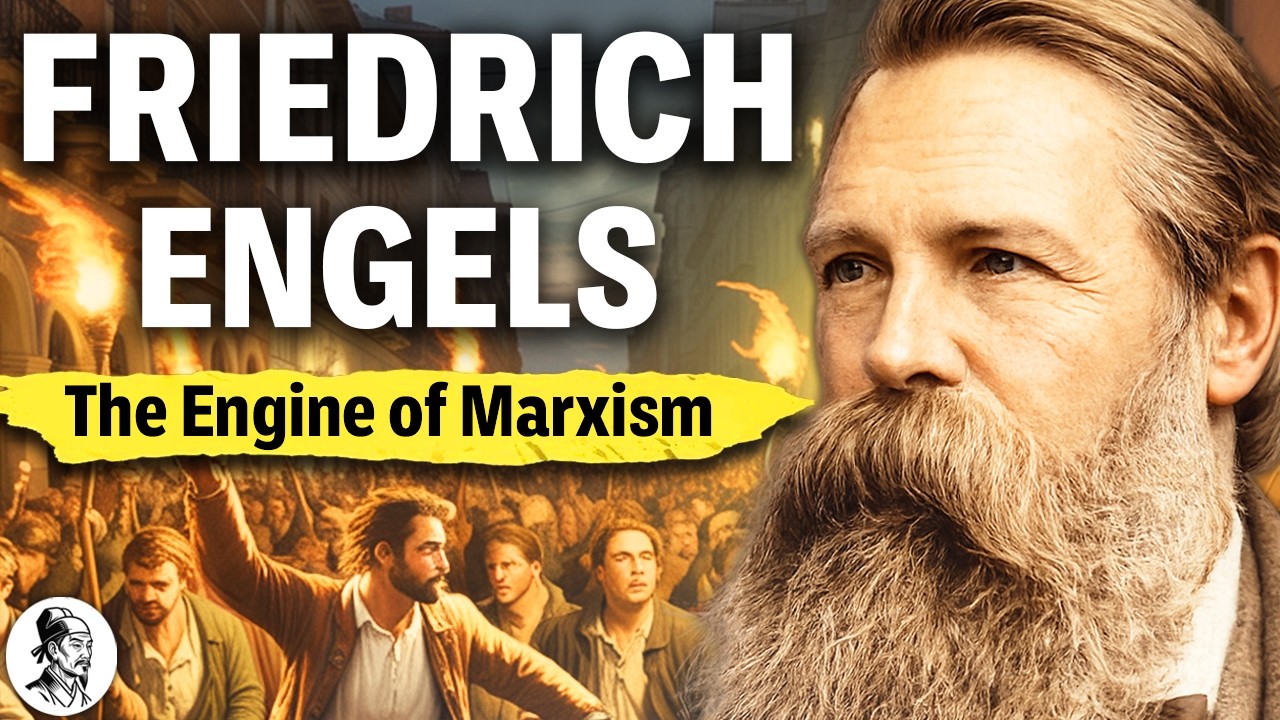
Friedrich Engels Documentary to Fall Asleep To
Keywords
Summary
167 words
Critical Evaluation
Value of the Information & Strength of the Argument
The documentary provides substantial value by synthesizing historical facts into a coherent and engaging narrative. It effectively argues that Engels’ empirical observations in Manchester were foundational to Marxist theory, and it highlights his often-overlooked contributions. The argumentation is solid, relying on well-documented historical events and Engels’ own writings. However, it occasionally leans into dramatic storytelling, which may oversimplify complex historical nuances.
Scientific Rigor, Source Quality, Title Accuracy
The documentary demonstrates a reasonable level of scientific rigor, drawing on Engels’ own works and established historical accounts. However, it does not explicitly cite sources within the video, and the description lacks references. The title accurately reflects the content, as it is a biographical documentary intended for relaxation. The lack of explicit citations may reduce its credibility for academic purposes, but it remains a reliable overview for general audiences.
145 words
Title / Content Match
The title accurately reflects the content, as the video is a biographical documentary about Friedrich Engels designed to be soothing for sleep.
Quality & Reliability
7/10
The documentary provides a detailed and engaging narrative of Engels' life, drawing on well-known historical facts and primary sources such as 'The Condition of the Working Class in England'. However, it lacks explicit citations or references to academic sources, and some dramatic elements may be embellished for storytelling.
Key Moments
Markers derived by PSI from the transcript: the creator did not define chapters.
- Introduction to Engels' double life as a businessman and revolutionary.
- Engels' early life in Barmen and the influence of the Wupper Valley's industrial conditions.
- Engels' education and his father's decision to pull him out of school.
- Engels' time in Bremen and his early writings under the pseudonym Friedrich Oswald.
- Engels' military service in Berlin and his engagement with Young Hegelian philosophy.
- Engels' move to Manchester and his research on working-class conditions.
- Engels' relationship with Mary Burns and his immersion in the Irish community.
- Publication of 'The Condition of the Working Class in England' and its impact.
- Engels' meeting with Marx in Paris and the beginning of their collaboration.
- Engels' lifelong dedication to promoting Marx's ideas and his legacy.
Cited Sources
- The Condition of the Working Class in England — Engels' seminal work, discussed extensively in the documentary.
- The Communist Manifesto — Co-authored by Marx and Engels, mentioned as a key outcome of their collaboration.
Concurring Sources
- Friedrich Engels - Biography — Encyclopedic entry confirming key facts about Engels' life and work.
Contribution & Novelties
The documentary offers a fresh perspective on Engels by emphasizing his empirical research and personal sacrifices, which are often overshadowed by Marx’s legacy. It provides a detailed account of his life that is accessible to a general audience, highlighting his role as a foundational figure in socialist thought.
Pour aller plus loin :
- Friedrich Engels - Wikipedia — Comprehensive overview of Engels’ life and works.
- The Condition of the Working Class in England - Wikipedia — Detailed analysis of Engels’ influential book.
- Marxism - Wikipedia — Context on the theoretical framework developed by Marx and Engels.
96 words
Radar Profile
The radar profile shows high scores in quantity and quality of information, with moderate technical level and reliability. This indicates a well-researched documentary that is accessible to a broad audience, though it may not delve deeply into theoretical complexities.
💬 No comments were provided for analysis.