Ionic Substituted Hydroxyapatite Scaffolds Prepared by Sponge Replication Technique for Bone Regeneration
Keywords
Summary
117 words
Critical Evaluation
Value of the Information & Strength of the Argument
The video provides valuable information on the synthesis and characterization of ionic substituted hydroxyapatite scaffolds. The argumentation is based on experimental results, including XRD, FTIR, SEM, and in vitro studies. The authors clearly explain the methodology and present data supporting the bioactivity and biodegradability of the scaffolds. However, the presentation is concise and lacks detailed statistical analysis or comparison with existing literature.
Scientific Rigor, Source Quality, Title Accuracy
The scientific rigor is moderate; the study is presented as original research but lacks references to peer-reviewed publications. The sources cited are limited to the conference presentation and the authors’ affiliations. The title accurately reflects the content, and the video adheres to the topic. No comments were provided for analysis.
127 words
Title / Content Match
The title accurately reflects the content, which focuses on the preparation and characterization of ionic substituted hydroxyapatite scaffolds for bone regeneration.
Quality & Reliability
7/10
The video presents original research from a conference (ANNIC 2015) with clear methodology and results. However, the audio transcription is poor, making it difficult to follow details, and the video lacks peer-reviewed publication references.
Key Moments
Markers derived by PSI from the transcript: the creator did not define chapters.
- Introduction to the study on ionic substituted hydroxyapatite scaffolds for bone regeneration.
- Explanation of the need for bone scaffolds and the use of hydroxyapatite.
- Synthesis of zinc and fluorine substituted hydroxyapatite nanopowders using chemical wet method.
- Characterization of powders: XRD and TEM showing flake-like and rod-like morphologies.
- Fabrication of scaffolds using polymer sponge replication technique.
- Sintering at 1250°C and resulting scaffold structure.
- FTIR and XRD analysis of scaffolds showing characteristic peaks.
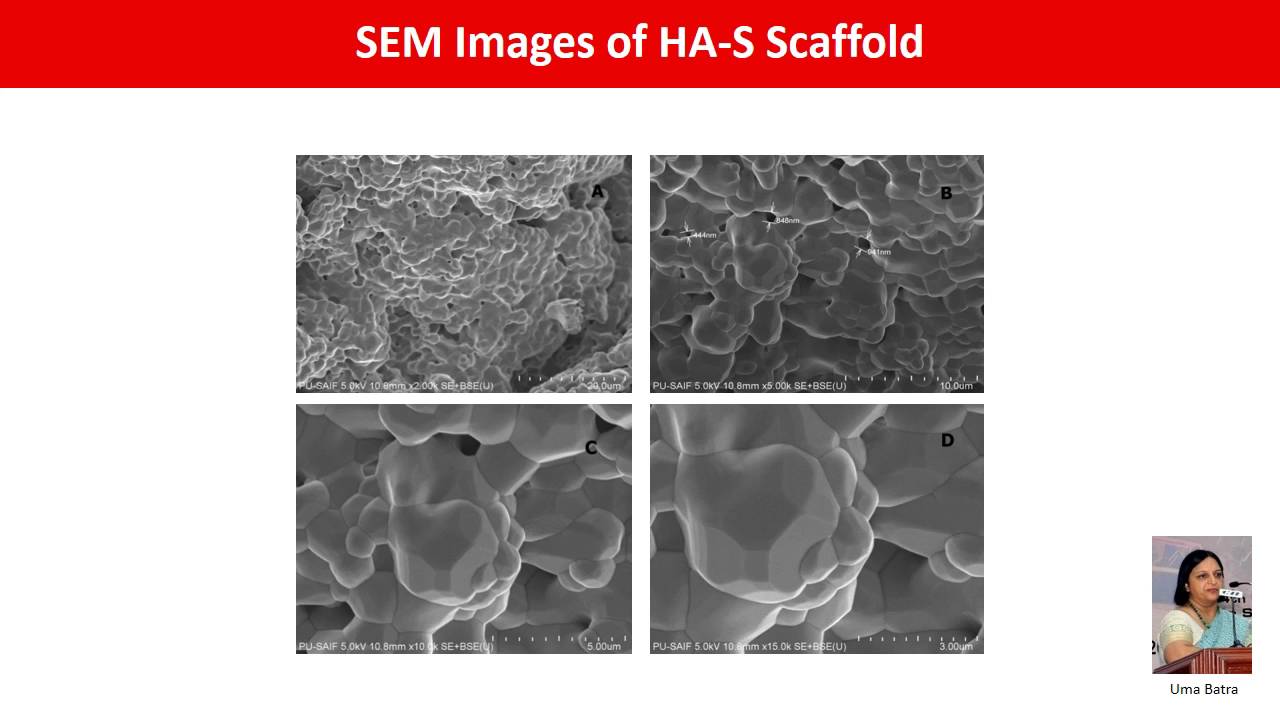
- SEM images showing microporosity and interconnectivity.
- In vitro bioactivity test in SBF: pH changes and mineral growth.
- Biodegradation test in Tris buffer: weight loss and pH changes.
Cited Sources
- ANNIC 2015 Conference — The study was presented at the ANNIC 2015 conference.
Concurring Sources
- Hydroxyapatite in bone regeneration — Review on hydroxyapatite-based materials for bone regeneration.
Dissenting Sources
- Potential limitations of ionic substitution — Some studies suggest that excessive ionic substitution may affect the mechanical properties of scaffolds, which is not discussed in the video.
Contribution & Novelties
The study provides original data on the fabrication of zinc and fluorine substituted hydroxyapatite scaffolds using a sponge replication technique. The novelty lies in the combination of ionic substitutions and the scaffold fabrication method, showing improved bioactivity and biodegradation properties. The results suggest potential for bone tissue engineering applications.
Pour aller plus loin :
- Hydroxyapatite — Overview of hydroxyapatite properties and uses.
- Bone tissue engineering — General principles of bone tissue engineering.
- Scaffold — Explanation of scaffolds in tissue engineering.
80 words
Radar Profile
The radar profile shows high scores in technical level and information quality, indicating a detailed scientific presentation. However, the quantity of information is moderate, and the overall reliability is slightly lower due to lack of peer-reviewed references.